Organising a family ski trip to Baqueira is easy when everyone skis the same. The problem appears when they do not: a mother who already handles red runs, a father who has barely put skis on twice, a 12-year-old impatient to go fast and an 8-year-old still afraid of the gradient. Multiply that by two or three families travelling together and the question stops being "where do we book?" and becomes "how do we do this without anyone getting bored, frustrated or left on their own?".
At Alpine Ski Academy we see the same doubt season after season, before the trip even starts: there is no single correct format for a family with mixed levels. There are several, and the one that works depends on your group — ages, willingness, how much you want to ski together and how much apart — and also on where you stay relative to the slopes, something many families decide without realising it directly shapes the logistics of the lessons.
This article is not the guide to the lesson itself — for that you have our page on private ski lessons for families in Baqueira. It is the guide for deciding, before booking anything, which format fits your group and which accommodation area makes it easier.
In short
- You do not have to choose "together" or "apart" for the whole week: formats combine, and get revisited.
- What decides is not raw technical level but each person's willingness, pace and travelling speed.
- With several families together, the children are grouped by age and level, not by family.
- The accommodation area shapes the logistics as much as the lesson format itself.
Why deciding how to organise the trip is so hard
Before booking, most families get stuck at the same point: they believe there are only two options, "all together" or "all apart", and neither fully convinces them. If they go together, they fear the lowest level will hold everyone back or the youngest will feel pressured. If they split everyone up, they fear overspending, complicating the timetable, or losing the very thing that motivated the trip: skiing as a family.
On top of that comes the logistics nobody explains until everything is already booked. Accommodation far from the slopes, with no direct gondola access, can turn a ski week into a daily race against the clock — especially with small children, with different lesson times to coordinate, or in busy weeks, where planning the hours stops being a detail and becomes the difference between enjoying yourselves and always being in a rush.
There is a common mistake here too: the obsession with always skiing first thing. For some families it is ideal; for others, with children who breakfast late or adults who do not perform the same at 9:00, it is avoidable stress. Starting around 11:30, with a snack on the slopes and a technical break mid-morning, comfortably allows 5 hours of skiing until 17:00 — with the added advantage of shorter lift queues. No time slot is better than another in itself: there is one that fits your holiday rhythm.
The usual result, without this kind of planning, is indecision: families who book as they go and arrive in Baqueira improvising every morning who skis with whom and when. It works, but it leaves a lot on the table — both in learning and in quality time together.
Five real ways to organise the week
There is no single format for skiing as a family with mixed levels. There are several, and they all work well when matched to the real group. These are the ones we see most at Alpine Ski Academy:
One instructor for the whole group, when the levels are compatible
It works when everyone has a minimum base, even if the levels are not identical: the instructor manages the dynamic, picks the right section of the run and shifts attention as needed.
Real case: Julián and his family almost always ski this way — one instructor for everyone, adapting the pace between father and children.
A private lesson for the children and one for the adults, separately
When intentions differ — some want to progress fast, others prefer to take it slowly — splitting into two private lessons stops anyone holding the rest back, without giving up meeting for the afternoon runs or whichever time slot you choose.
Real case: Julián's family again, at other points in the season, choose this format: a private lesson for the children and one for him, each at their own pace.
Each child with their own instructor, by level
When the gap in age and level between siblings is wide — and above all when the appetite for skiing is too — putting them in the same lesson benefits neither of them.
Real case: Lucía and her family. The father takes a private lesson; her two children, aged 12 and 8, match on neither age, level nor willingness, so each has their own instructor. She does not ski and runs the group's logistics while the others are on the slopes.
A group course for the children and a private lesson for one parent (or neither)
When children enjoy skiing with others their own age, the group ski course for children in Baqueira works just as well as a private lesson — and frees the parents for a lesson of their own, or for not skiing that day.
Real case: Alejandro and Montse. She takes private lessons while their two teenage children do a weekly course with others their age. He, who used to ski more on his own, has progressed thanks to Montse's lessons — and after two seasons they now ski together and take lessons as a couple.
Travelling with several families: how it is organised as a group
When 3-4 families meet up in Baqueira, the goal changes: it is not about coordinating levels within one family but coordinating the whole group. The format that works best: children are grouped into courses by age and level — not by family — and the adults do the same with their own lessons.
Real case: four couples travel together, with between 2 and 4 children per family. They set up two children's course groups by age and level, plus a separate private lesson for the youngest (3-5 years), who go to the nursery before or after their session. The adults also split into two groups with different instructors by pace — so nobody waits for anybody and everyone meets for the shared runs.
Is one instructor for the whole family better, or separate lessons by level?
It is less a question of technical level than of intentions, style and above all travelling speed. In a joint lesson the group always adapts to whoever needs to go slowest — whether by level or by choice — and the same applies to the difficulty of the run. Raw technical level is deceptive: someone still in an advanced, near-parallel wedge may be less fearful, faster and readier for steeper runs than someone who has skied parallel for years but prefers to take it easy.
A single instructor works when those intentions and rhythms are compatible, even if the technical level is not identical. When somebody clearly needs to go slower, or wants calmer runs while another is after more gradient, splitting into private lessons or combining a course with a private lesson usually works out better for everyone. The decision is not permanent: many families, like Julián's, alternate from one season to the next depending on how the group arrives that year.
Slopeside or in a village: where to stay depending on your format
The accommodation area directly shapes which of these formats is most convenient for you — especially if there are lessons at different times to coordinate.
| Area | For | Against |
|---|---|---|
| Baqueira (slopeside) | Direct access to the lifts, ideal if there are different lesson times to coordinate between siblings or between parents and children | Higher price, less village atmosphere |
| Bagergue / Salardú / Garós | A few minutes from Baqueira, a good price-comfort balance, quiet village atmosphere | Requires a car or an organised transfer to the slopes |
| Vielha / Les | More restaurants and things to do beyond skiing, a wider price range | A longer journey, less practical with lessons at different times or with small children |
How the week turns out when the organisation works
The result is not measured in technique alone but in how the family ends up at the close of the trip. Julián, alternating between a single instructor and separate private lessons depending on the season, has found that both formats work when matched to where the group is — there is no fixed "correct" decision, only one that gets revisited each time.
The clearest case of real progress is Alejandro and Montse's: two seasons of private lessons for her, with the children in a shared course, have led to the whole family being able to ski together today — even taking lessons as a couple. It is proof that splitting up at the start does not pull a family apart; often it is the fastest route to everyone genuinely skiing together later on.
Víctor's recommendation
In Baqueira, what I repeat most to families before they book is this: you do not need to decide between "together" or "apart" for the whole week. Start with whatever solves the first day — often separate private lessons — and let the trip tell you when it makes sense to join up.
That is what happened to Alejandro and Montse: they did not plan to ski as a couple from day one, but two seasons on, there they are. And if you travel with another family, do not try to fit the children together by family — fit them by age and level, which is how they genuinely enjoy it.
Víctor Puche Fita — TD3, SAFE Formación demonstrator, founder of Alpine Ski Academy
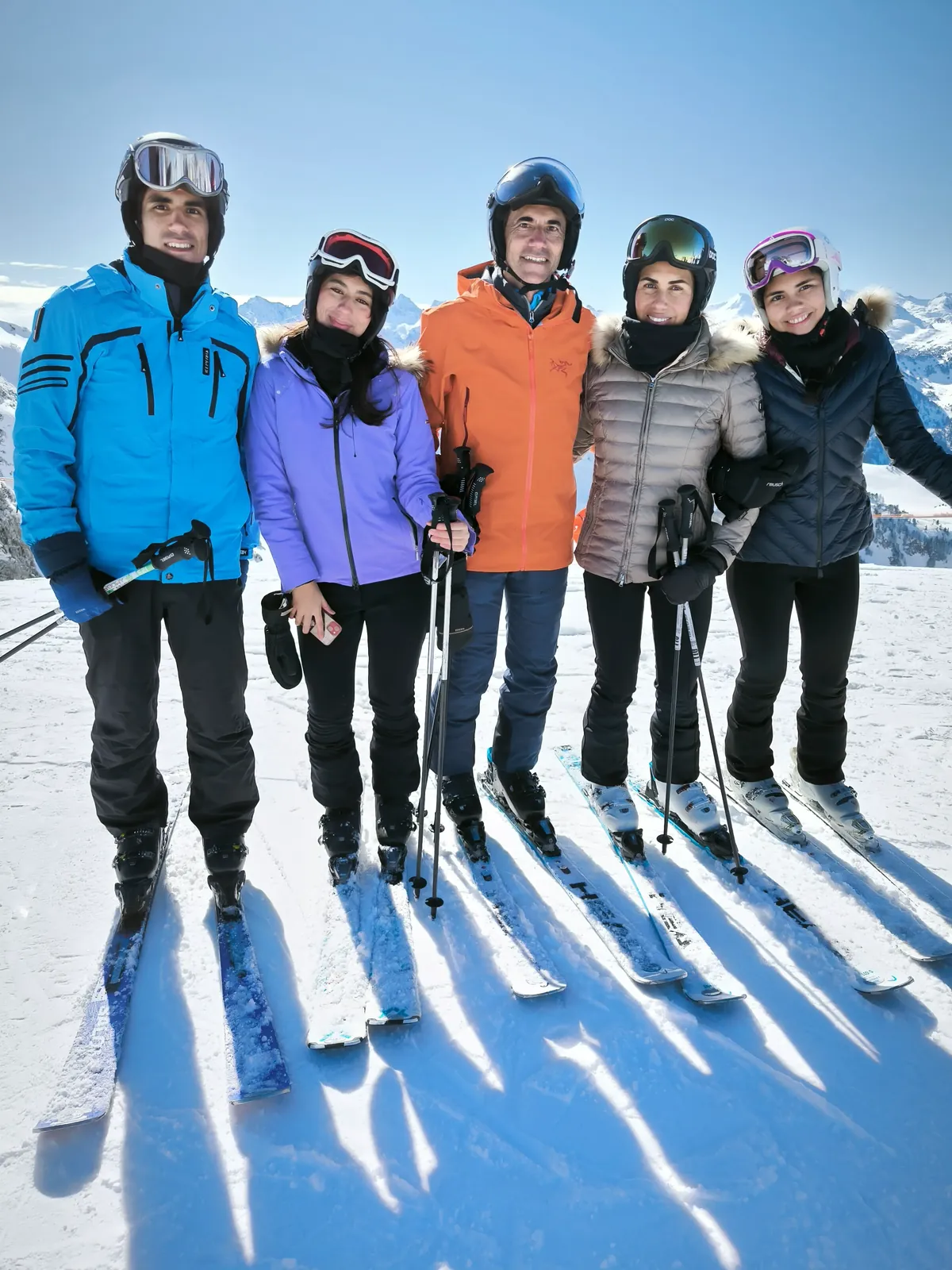
Does your family have different levels? We will help you organise it
Does your family have different levels, rhythms or intentions, and you do not know where to start organising the trip? Tell us what you are like and we will help you decide the format that fits best — one instructor, separate private lessons, or a combination of the two.
Víctor Puche Fita — TD3, SAFE Formación demonstrator, founder of Alpine Ski Academy.