Table of Contents
- The Real Pains of Day One: What Nobody Tells You
- Equipment and the Basic Stance: Before You Touch the Snow
- Sliding and Your First Stop: You Decide When to Stop
- Your First Turns: The Most Exciting Moment
- How Long It Takes to Learn to Ski: Realistic Expectations
- Beginner Areas in Baqueira Beret: Where to Start
- You might also like
1. The Real Pains of Day One: What Nobody Tells You
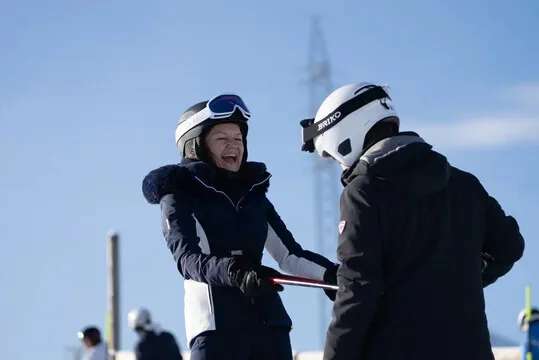
Before we talk about technique, we need to talk about what actually holds most beginners back. Some of it is fear. Some of it is physical discomfort. All of it has a solution if you know in advance that it is coming.
The Fear of Getting Hurt — Adults and Children
This is the most universal mental block of all. Adults feel it more intensely because they understand exactly what a fall can cost. Children feel it in a more immediate, physical way. In both cases the answer is not to tell the student that nothing will happen — it is to put them in situations where the real risk is minimal and success is guaranteed before the level goes up. A good instructor never takes a beginner onto terrain they are not ready for yet.
🎿 TD3 instructor: Fear is beaten with knowledge and controlled progression. Once the student understands why they are doing each exercise and sees that it works, the fear goes on its own. You do not fight it — you make it unnecessary.
The Fear of Looking Silly — Adults Only
An adult learning to ski for the first time carries something a child does not: the fear of looking clumsy, of falling in front of people who ski well, of not being able to do it when everyone else seems to manage effortlessly. It is a quiet fear, but a very real one, and more paralysing than the physical kind.
What clears this block is not motivation — it is visible progress. When an adult sees that after two hours they already have their braking under control, that fear dissolves on its own. The instructor manages it by choosing the right terrain and setting concrete milestones at every stage.
🎿 TD3 instructor: In 20 years I have never seen an adult who could not learn to ski. I have seen adults who took longer, who needed more patience or more explanation, but never one who did not get there. Ability is not the problem — managing fear is the instructor's job.
Muscle Exhaustion on Day One
This is the beginner's most universal physical complaint — and the most surprising. Thighs, knees and calves that are not used to the skiing stance feel those first hours as a very particular kind of fatigue. It is not a sign that something is wrong — it is a sign that your body is working muscles it does not normally use.
The problem starts when a beginner pushes too hard trying to squeeze everything out of the day. Muscle fatigue degrades your stance, and a degraded stance multiplies the risk of falling. A good instructor calibrates the length and the intensity so that the student finishes tired but not wrecked — and wants to come back the next day.
👉 If you can barely walk down stairs at the end of the first day, that is not normal — it is a sign that the intensity was too high or the stance was wrong. With a lesson, that does not happen.
Discomfort with the Equipment
Boots that pinch across the instep after two hours. Damp gloves that leave your hands frozen. Too hot with the base layer on, too cold without it. Badly managed equipment turns a good day into an ordeal — and it is one of the reasons many beginners never come back.
- Boots: if they hurt, go back to the shop. Do not put up with it. The adjustment takes 10 minutes and changes the whole day.
- Layers: base layer + mid layer + waterproof jacket. You can take layers off; you cannot add the ones you left in the car.
- Gloves: waterproof, not just warm. Wool gloves soak through in 20 minutes and never warm up again.
- Sun cream: a must. Snow reflects UV rays — burning on the mountain is easier and faster than on the beach.
"My Partner Will Teach Me" — The Most Common Mistake
Having someone who loves you teach you to ski sounds like a good idea. In practice, it is one of the most common sources of frustration we see in the resort. Being a good skier is one thing — knowing how to teach is quite another: knowing the correct technical progression, being able to demonstrate it and getting it across in a way that suits each person.
The usual result: bad habits that are hard to correct later, tension within the couple or the group, and a beginner who ends up convinced that skiing is not for them — when the problem was the method, not the person.
🎿 TD3 instructor: I see it every season. Students turn up who have spent two days trying to learn with a friend or their partner and are more stuck than they were on the first day. One hour of a private lesson unlocks what two days of good intentions could not.
2. Equipment and the Basic Stance: Before You Touch the Snow
Choosing the Right Equipment for Beginners
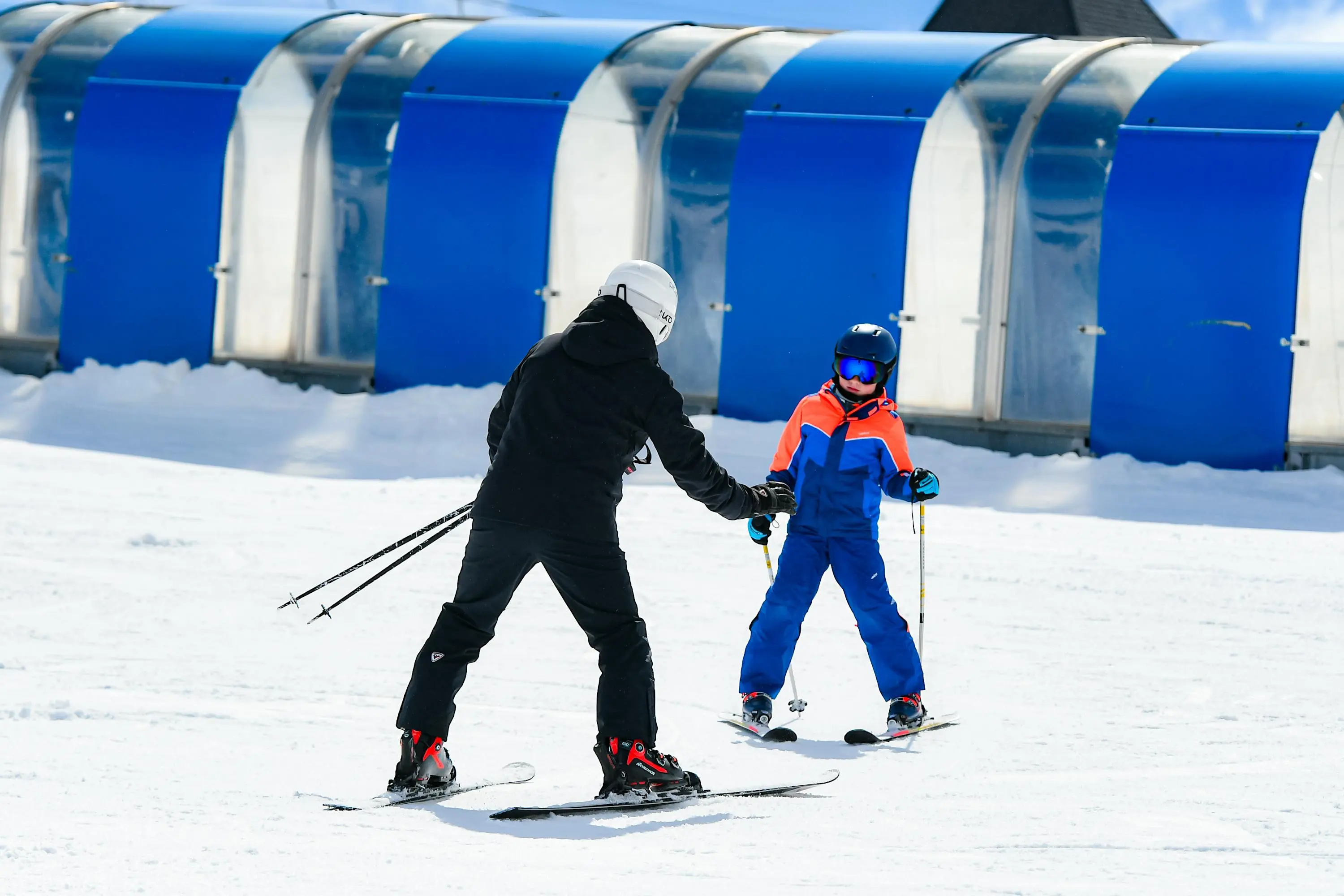
- Skis: 10-15 cm shorter than your height. It makes directional control and the transition between turns easier.
- Boots: They should hold the foot firmly, with no pain and no pressure points. A boot that is too loose costs you control and safety.
- Poles: When you plant them in the snow, your arm should be at 90 degrees. No longer, no shorter.
- Helmet and goggles: Essential. In our lessons a helmet is compulsory for all minors. Do not forget the sun cream.
→ Full guide to choosing your equipment: ski rental in Baqueira
The Skier's Basic Stance
The basic stance is the starting point for everything else. If it is not right, every technique that follows is built on an unstable foundation.
- Knees, hips and ankles slightly flexed. Feel your shins resting against the tongues of the boot — that pressure is the sign that you are in the right position.
- Weight centred over the sole of the foot. Never on the heels, and never pushed far forward.
- Legs a natural distance apart, at hip width. Neither too close together nor too far apart.
- Arms slightly in front of the body and out to the sides, outside the skis. Poles pointing backwards, without digging the tips into the snow.
Before you ski down your first slope there are exercises on the flat — on one ski and on two — to lock in this stance with no risk at all. It is the step that people learning on their own skip most often, and the one that makes the biggest difference.
🎿 TD3 instructor: The basic stance is not a static posture — it is a dynamic balance that you adjust constantly. At first you practise it consciously. In time it becomes automatic. That is exactly the goal.
3. Sliding and Your First Stop: You Decide When to Stop
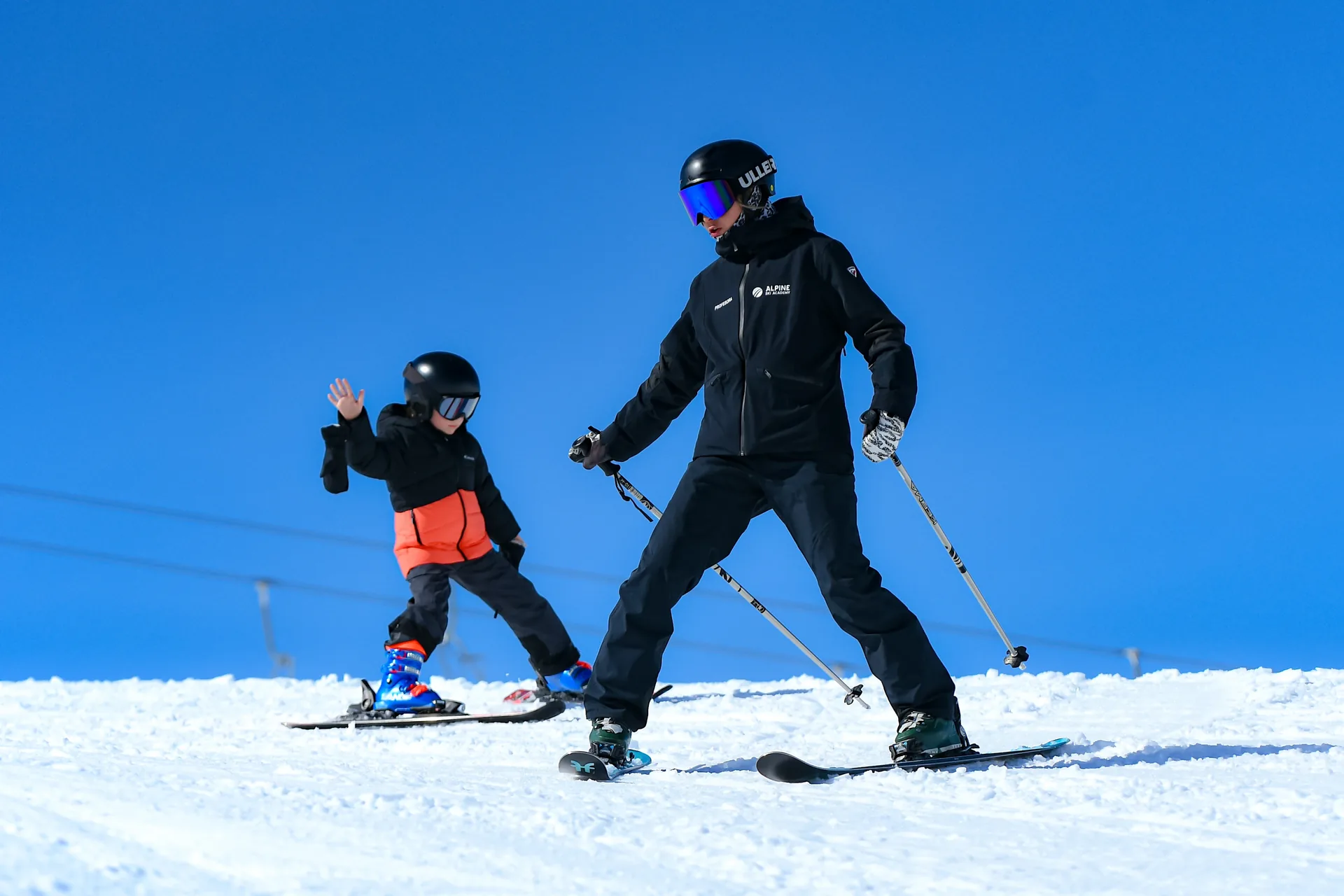
Once you are comfortable in the basic stance, it is time for your first slide on a gentle slope — always with a counter-slope at the end to remove any risk. The first big goal is not turning: it is stopping. Feeling that you control when you stop is the foundation of everything that comes after.
- Straight running: Let gravity carry you while you hold your balanced stance. No forcing, no over-correcting.
- The snowplough or "pizza": Bring the tips of the skis together and open the tails into a V. The inside edges create gentle friction against the snow. Very gentle, very gradual.
- Braking in a snowplough: The wider you open the V, the more friction and the more you slow down. Weight spread evenly, pressure centred, ski tips always in contact with the snow and never overlapping.
The first big achievement is discovering that you are the one who decides when to stop. That sense of control is the key to starting to enjoy skiing.
🎿 TD3 instructor: Be very gentle and gradual in every movement. The most common beginner mistake is trying to make the movements all at once. Skiing responds to slow, controlled movements — especially at the start.
4. Your First Turns: The Most Exciting Moment
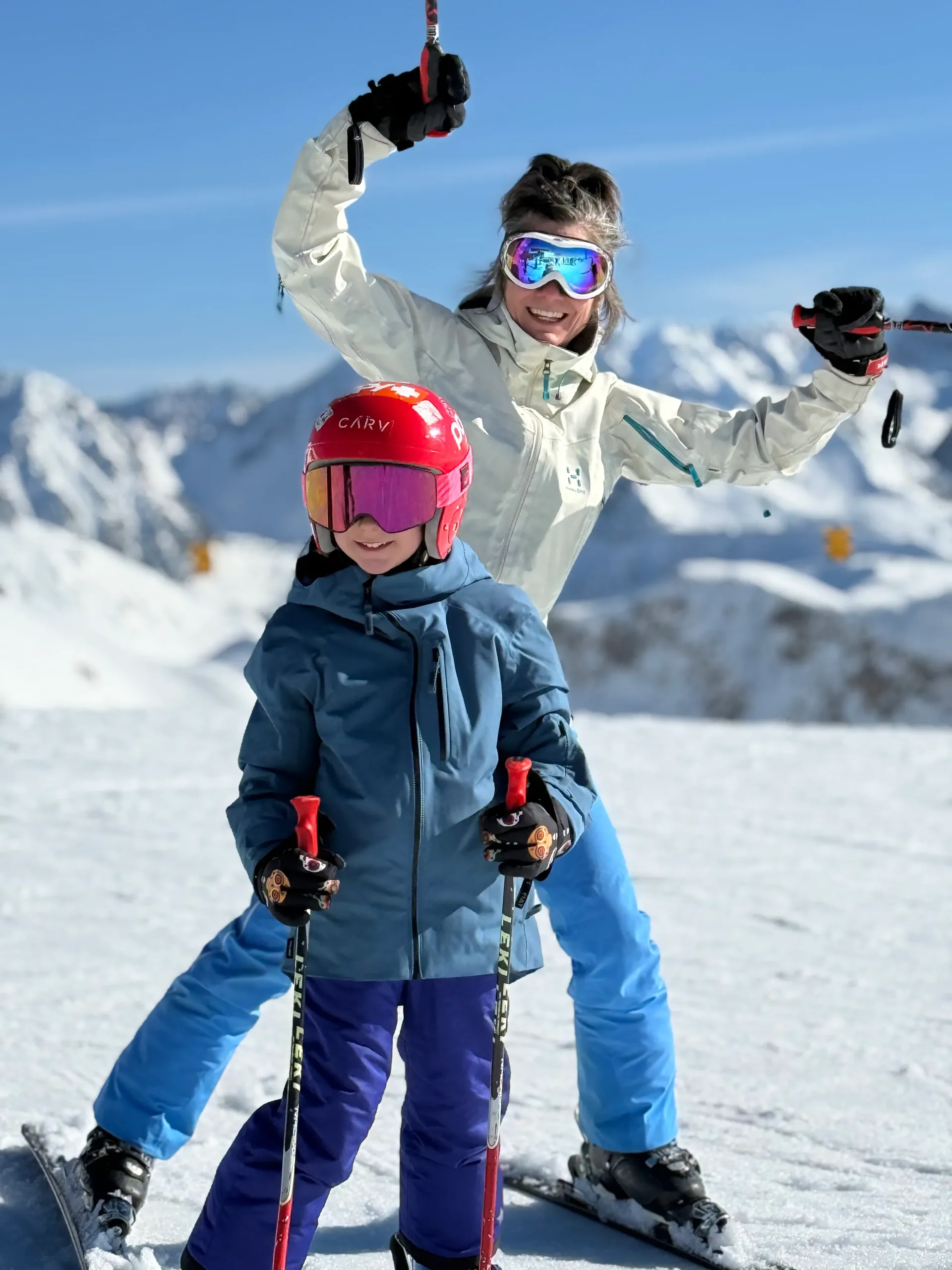
Mastering turns is the moment skiing stops being an exercise and becomes something you want to do again.
- Snowplough turns: To turn right, put more weight on the left ski and open its tail slightly, with a little angle from the inside of the foot — very gently. To turn left, do the same on the right ski.
- Body orientation: Follow the turn by looking where you want to go. Just like driving: your body leads the direction.
- Natural progression: Little by little the turns become smoother, until the snowplough turns into parallel turns and you start to ski with ease.
👉 You go where you look. It works almost every time — and the beginners who take it on board progress noticeably faster.
There are specific exercises for every stage of progress and concrete tips for each new movement. A good instructor significantly cuts the hours it takes to learn and makes the result technically sound from the start.
5. How Long It Takes to Learn to Ski: Realistic Expectations
It is the question we are asked most. The honest answer: everyone is different. What we can give you are guidelines based on 20 years of teaching in Baqueira:
- Adults: With around 10 hours of lessons, most people can ski green runs and easy blue runs safely. Some adults get there in 4-6 hours. Others need 15-20 hours for the same goal.
- Children: They learn at a speed that takes you by surprise — roughly 6 hours to their first parallel turns in many cases. Their advantage: no fear of looking silly, and a body better suited to dynamic balance.
What does stay constant: with a professional instructor, learning is faster, safer and free of bad habits to correct later.
🎿 TD3 instructor: I have had adults skiing blue runs in a single morning — and adults who took three days to reach the same point. Both are equally valid progress. What does not change is that with method and patience, everyone gets there.
6. Beginner Areas in Baqueira Beret: Where to Start
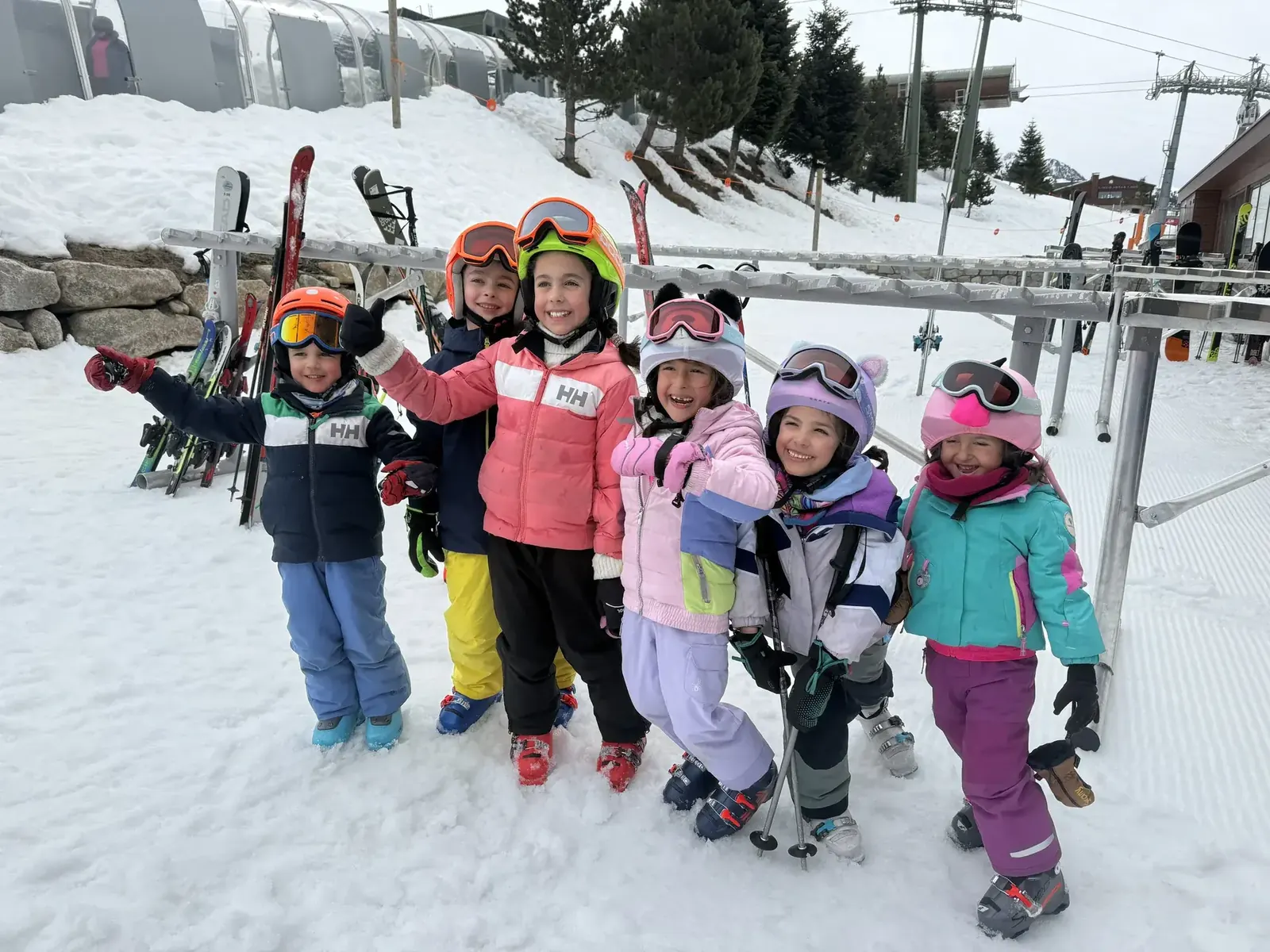
- Baqueira 1500-1800: Wide, gradual sections for practising the snowplough stop and your first turns, with easy returns to the base area.
- Beret: Wide areas with good visibility and fewer people. Ideal for linking green runs and building confidence.
- Bonaigua: Moderate gradients and a calm atmosphere. Perfect for consolidating the basic technique without rushing.
→ Recommended runs, lifts and tips by sector: Beginner areas in Baqueira Beret