You have a couple of seasons of skiing in Baqueira Beret behind you. You have the snowplough down, you ski parallel without thinking about it and the green runs have become too easy — but you still come down the same old blue runs, partly out of habit and partly because nobody has explained what real difference there is between the sectors of the ski area once the beginner stage is behind you.
It is a moment in the learning process we tend to overlook. When someone starts from scratch, the priority is clear: safety, orderly progression, a quiet area. But as soon as that beginner stops being one, the question changes completely — and the answer is no longer the same. Choosing well between Baqueira, Beret, Bonaigua or the most technical of the four, Baciver, is the difference between a week in which you genuinely keep progressing and a week in which you simply repeat what you already know.
With a private ski lesson for adults in Baqueira we adapt the sector and the pace to your real level on any given day — but even if you ski on your own, this guide will save you more than one afternoon lost looking for terrain that genuinely moves you forward.
The obstacle is usually not technical, it is informational. A skier who already has the parallel suddenly has 173 kilometres of pistes ahead and no clear criterion for deciding where to go each day. The result is almost always the same: they stay in the sector where they started, because it is the one they know, even though that sector is no longer giving them anything new.
This has a real cost. Repeating the same blue runs without raising the demand slows progression down — the body memorises the line, not the technique. And it fails the other way round too: jumping straight into terrain like Baciver without a well-settled parallel produces frights that undo weeks of hard-won confidence.
Then there is the logistics: not all the sectors connect to each other equally easily, and moving from one to another without knowing the way can eat up half a morning of skiing in needless travel.
The only mountain on the ski area where all four aspects are skied. Every kind of snow and every kind of demand, depending on which way you look on each descent.
Even gradients and full visibility across the sector. Terrain for settling technique calmly before making the jump.
More natural snow, terrain that follows the lie of the land and fewer people. A clearly more demanding profile.
The highest and most technical sector on the mountain, at 2,610 metres. Only recommended once the parallel is well settled.
What is the difference between Baqueira and Beret once you are no longer a beginner?
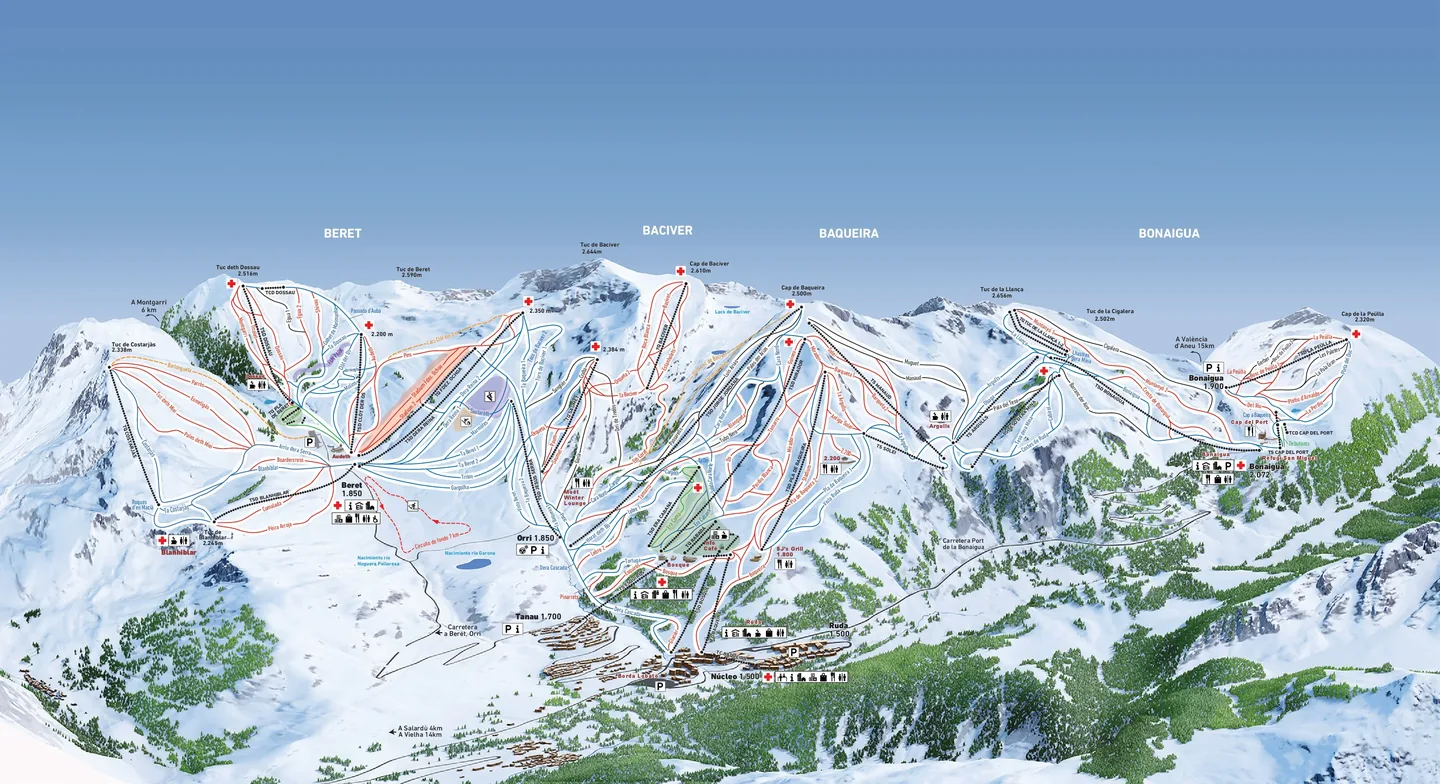
The difference is not in the overall difficulty — it is in the kind of progression each sector forces on you. Baqueira is the only mountain on the ski area where all four aspects are skied — south, west, east and north — something that does not happen in the other sectors: Beret, Bonaigua and Baciver run over a much more concentrated aspect. In Baqueira that means every kind of snow and technical demand depending on which way you look on each descent. Beret, by contrast, is a much more even sector: progressive gradients, full visibility and a base designed for thinking, executing and enjoying without Baqueira's constant variability.
Baqueira: the four aspects of a single mountain
This is what makes Baqueira special compared with the other sectors on the mountain: it is the only one where all four aspects are skied, and here that is everyday business.
Solei, Manaud, La Barqueta and Antiga Solei
Solei and Manaud have no snow cannons, with 100 % natural snow. Lower down are Antiga Solei, the lowest of the three, and its parallel Ta Argulls, both with machine-made snow. On the natural runs the snow changes with the temperature: powder on cold days, quick transformation as soon as the sun comes out. On busy days they tend to start smooth and well groomed and end with big moguls that demand considerably more technique by the end of the day.
Pla de Baqueira and Mirador
The classic par excellence. They combine red and blue sections where you can practise any skill at this level — from linking short, more rhythmic turns on the little walls of Mirador or Pla, to finding your first edging sensations on the flatter stretches beside the 2200 café or in the lower parts of Pla.
Escornacrabes
A single protagonist: the ski area's legendary itinerary run. Terrain for the most expert only.
Pales del Arias, Luis Arias and Isards
Red and blue runs of varying width and vertical drop — Isards, in equal parts fun and feared on icy days. It is the area that keeps fresh snow best thanks to the shade, although that same factor can work against it: poorer visual contrast on dull days, and if the snow transformed during the day and then froze, it stays very hard for much of the day.
Baqueira, Tortuga and Liebre
Forest and areas sheltered from fog and wind, perfect for days of difficult weather. That is where the Baqueira run is (the old "1", just below el Huevo), along with Tortuga and its variants, and Liebre coming out of Cabana.
Every aspect has its moment in the day. Knowing when and where to ski each one is what makes the difference between a mediocre run and an excellent one.
Beret: even progression with full visibility across the sector
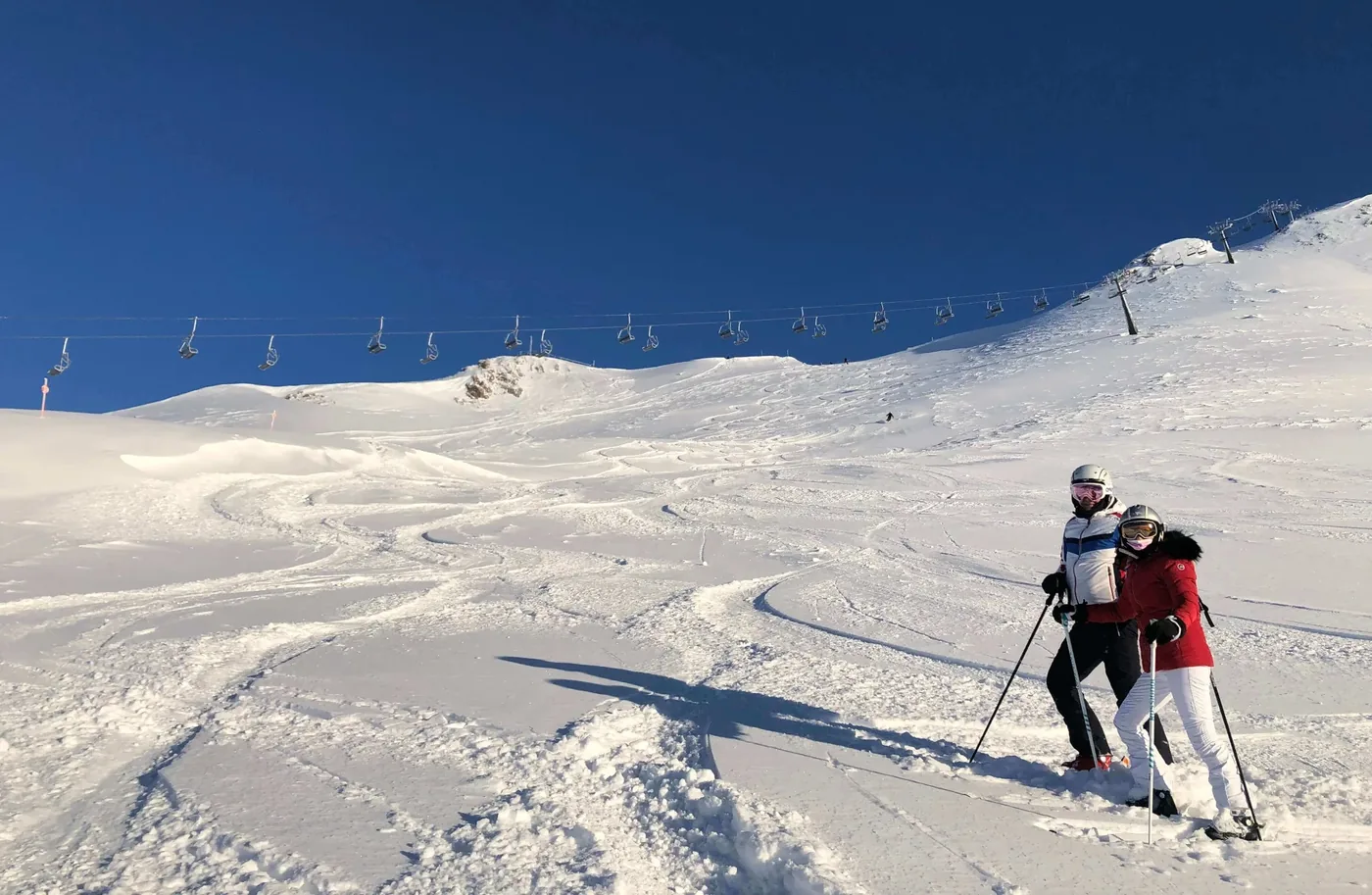
Beret is more progressive. Its gradients are more even, and the sector combines runs such as Banhiblar, facing south; Costarjàs and Dossau, facing south-west; and Reina and Clot der Os, facing north-west. The base is very well organised: a central café from which the three main chairlifts plus Dossau depart, all modern and detachable except the drag lifts — three 6-seater chairs and one 4-seater — which makes orientation simple: from every lift and every descent you can see practically the whole sector.
It is good terrain for settling technique calmly: time to think, execute and enjoy. It is also a good way into off-piste when conditions allow, with small stands of trees at the mid levels of Reina. Higher up the fun zones begin — Audi Cronos, the Fun Park and the Snowpark. If you are travelling with family and there are beginner levels, or even companions who do not ski, Beret is a good base sector.
Always taking the three main runs, or knowing the sector and using its quieter variants, makes a clear difference to the experience.
Bonaigua: natural snow and terrain that follows the lie of the land
The shadier, colder aspects of Bonaigua — Argulls, Tuc de la Llança and runs such as Muntañó — have no snow cannons: it is 100 % natural snow, and in years or spells with little transformation it can be the best snow quality on the whole mountain.
The sector combines medium-width runs with paths that narrow considerably, following the lie of the land — the Crestas de Bonaigua or Muntañó are a good example. Peülla is also here, of medium-high difficulty, with demanding blacks and reds that combine north-facing, shaded sections at the top with lower levels (below 2,000 m) facing east, which transform quickly on clear days.
Pletiu d'Arnaldo is perfect for someone who already skis parallel and is looking for steep little walls that make demands but quickly return you to the comfort zone. Peülla has only one blue run down, so it is better for a parallel that is already a little settled — or for going on an excursion and coming back on the blue if you are still on a basic parallel.
Baciver: the sector that only makes sense with a well-settled parallel
At 2,610 metres, Baciver is the highest point of the whole ski area. It combines a north aspect, in Saumet, with south and west aspects, in Baciver — mixing medium-width runs with narrower paths. It is a fairly alpine area, with trees spread across the whole sector, which makes it a good option on foggy days, except at its highest level.
Going from Baqueira to Beret, to Bonaigua: why the route matters as much as the sector
Going from Baqueira to Beret, to Bonaigua, or coming back towards Baqueira from either of the other two sectors, can be the difference between a spectacular day of discovery and one that falls short — especially when you are still on a basic parallel. Knowing which runs to take to move around, which turnings to make, and reading your own technical level against the crowds of the day and the hour, is what separates a really good experience from a merely correct one.
Marta, two seasons
With Marta we saw it very clearly. In her first season, fear held her back so much that after a whole week of lessons she could not get out of Cabana — the lower area of Baqueira, the most sheltered on the mountain. The following year, with more accumulated confidence, we planned the progression differently: instead of insisting on the same familiar terrain, on the third day we took her to see Beret.
The change of sector was, in itself, part of the progression. It was not that Beret was "easier" — it was the route chosen, with intent, that let Marta leave her comfort zone at exactly the right moment, without that step feeling like a leap into the void. That well-planned "getting to know something new" turned out to be the confidence push she needed to keep moving forward.
The same happens in the other direction, once you have the parallel: choosing with judgement where to move between sectors — which turnings to take, which route back to pick — lets you discover more of the mountain in a single morning than you would see in weeks of always repeating the same familiar terrain. That, at bottom, is what we work on with you in every lesson: not just the technical movement, but knowing when to touch new terrain and when to consolidate.
Alpine's recommendation for moving between sectors
It is hard to give a fixed rule. The variables change every day — snow, crowds, wind, aspect — and not even a good instructor with years of experience in Baqueira can always pick the perfect terrain. There are days and there are runs you simply have to go through, whether you like them or not.
What I can tell you is where the real difference lies: an instructor who knows the mountain well gets the choice of terrain right far more often, and reads the snow quality of each area at each moment of the day. That margin of getting it right is what makes your level, your safety and your sense of comfort improve steadily — and what spares you more than one unnecessary bad moment. It is not an infallible formula. It is, simply, getting it right more often than you get it wrong.
Which is the best sector in Baqueira Beret if you only have a few days?
It depends less on the sector than on reading the snow and the crowds of each day well. These are the five readings we use most on the mountain:
- Powder or fresh snowAny aspect works well — you can move freely across any face of the mountain.
- A hard freeze overnightThe most effective thing is to start on south-facing aspects at not too high a level, following the transformation of the snow as the temperature rises.
- First thing in the morningIt pays to head for the sectors furthest from the centre, before they fill up.
- Mid-morning onwardsWhen the busiest points start to saturate, it is a good moment to work back towards the centre on return runs nobody is skiing yet.
- In the afternoonWith sharper temperature swings, north-facing aspects usually offer better snow than the rest.
None of the five is a closed rule, but together they explain why two people with the same lift pass and the same number of days can finish the week with completely different experiences.
Book your lesson and discover the mountain like someone who has spent a lifetime on it
Knowing the four sectors well is not a matter of luck — it is a matter of having someone beside you who knows how to read each aspect, each type of snow and each moment of the day. If you want to stop repeating the same terrain and start genuinely progressing, message us on WhatsApp and we will organise your next lesson.
Víctor Puche Fita — TD3, SAFE Formación demonstrator, founder of Alpine Ski Academy.