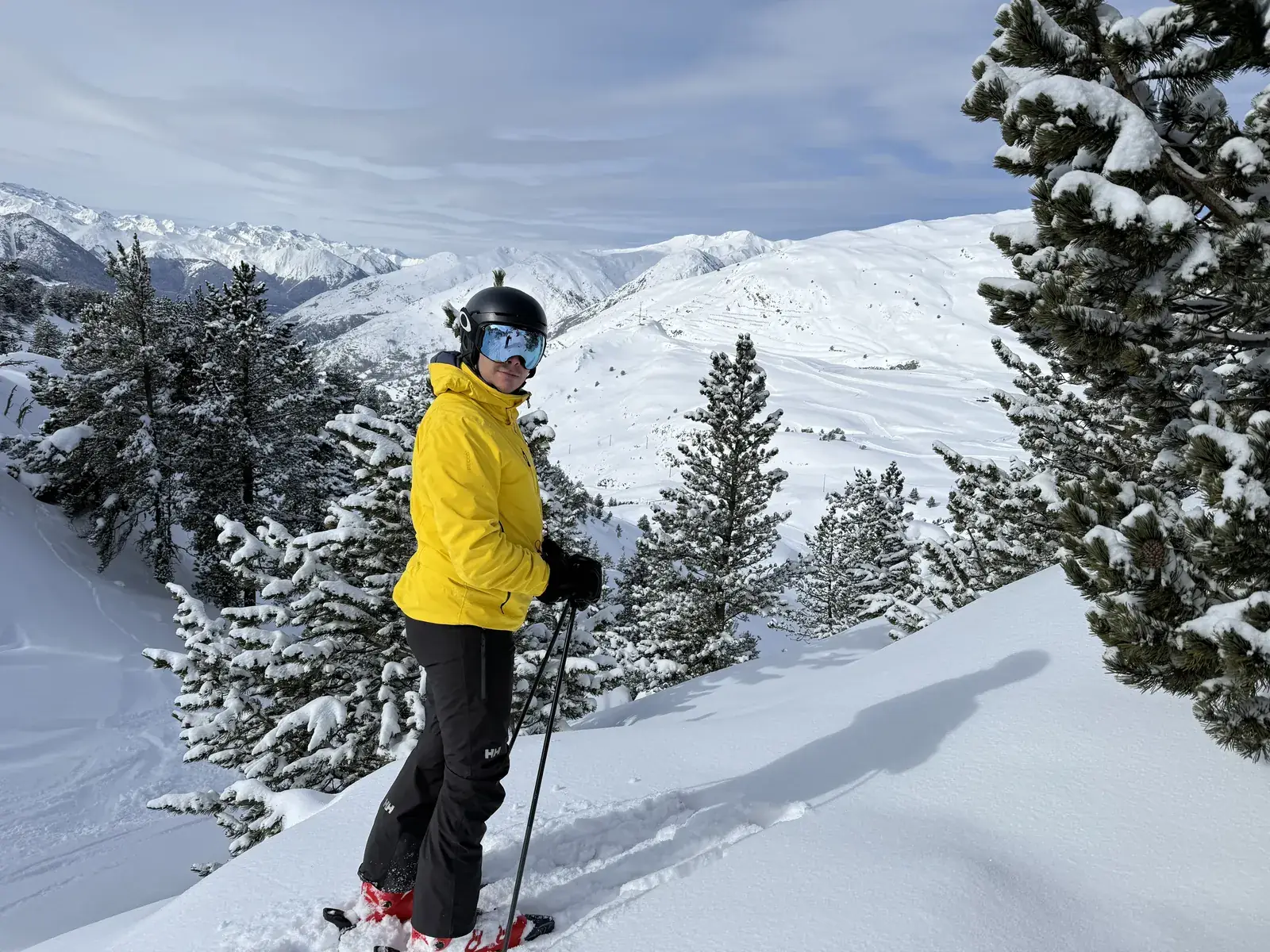
In the café at Baqueira, on any afternoon after good snow, you always hear the same conversation: “What a day we've had, what powder, what a run down such-and-such.” And if you only ever ski on piste, that conversation leaves you out. Not because you could not be part of it, but because nobody has explained to you how you get there.
Freeride in Baqueira is not a closed club for expert skiers. It is skiing off the marked pistes, on snow nobody has touched, and the level you actually need to start is far lower than you think: with basic parallel skiing already worked on, you have enough to take your first steps safely in our freeride lessons in Baqueira, in specific areas and on specific days.
At Alpine we have spent 24 seasons reading the mountain before deciding where to take each student. And that reading — of the snow, the wind, the risk — is exactly what separates a memorable day of freeride from one that puts you off trying again.
Why the first day of freeride is harder than you expect
What really holds a piste skier back is not technique — it is fear of the unknown. Untracked snow does not react the way a compacted piste does: it can grab your foot, snatch at your skis, hide the real shape of the ground. The first day is usually hard. It is difficult to find your stance, difficult to read what lies beneath the snow, and easy to end up exhausted and frustrated before your first run down.
And the fear does not come alone. Skiing off-piste asks more of the body than a compacted piste does — deeper or uneven snow makes you work your balance constantly and correct on the move, so arriving with borderline fitness adds tiredness exactly when you most need to react well. Fear and poor fitness are a bad combination: fatigue makes technique deteriorate, and deteriorating technique feeds the fear. That is why at Alpine we match the physical demand of each session to each student's real level, not just their technical one.
That initial frustration does not mean you are not ready. It means you are stepping into an environment that is neither prepared nor predictable — and that is precisely the appeal of freeride: no two days and no two kinds of snow are ever the same.
Skiing off-piste in Baqueira: how we choose the area to suit the day's conditions
The freeride area is not chosen on a whim — it is chosen by reading the mountain that same morning. Before deciding where to take a student, we weigh up how much new snow has fallen, the temperature and the quality it fell at, the direction of the wind that brought it, the avalanche risk given in the Lauegi Vall d'Aran bulletin, the visibility that day and our prior knowledge of the resort — knowing which areas had the best base before it snowed.
With that reading done, the terrain is chosen to suit the conditions on the day:
| Type of day | Recommended areas |
|---|---|
| Poor visibility, high ground closed | Low-altitude woods, Cavana, the old Hurat deth Bo, north-facing drops, the small woods at Beret |
| Good weather conditions, skiers of a high technical level | Pasarells, Escornacrabes, Peülla, Palas del Teso, Saumet |
| Severe cold, snowfall from a northerly, little accumulation | Palas de Costarjas, Dossau, Manaud (if the lee slopes are open and safe) |
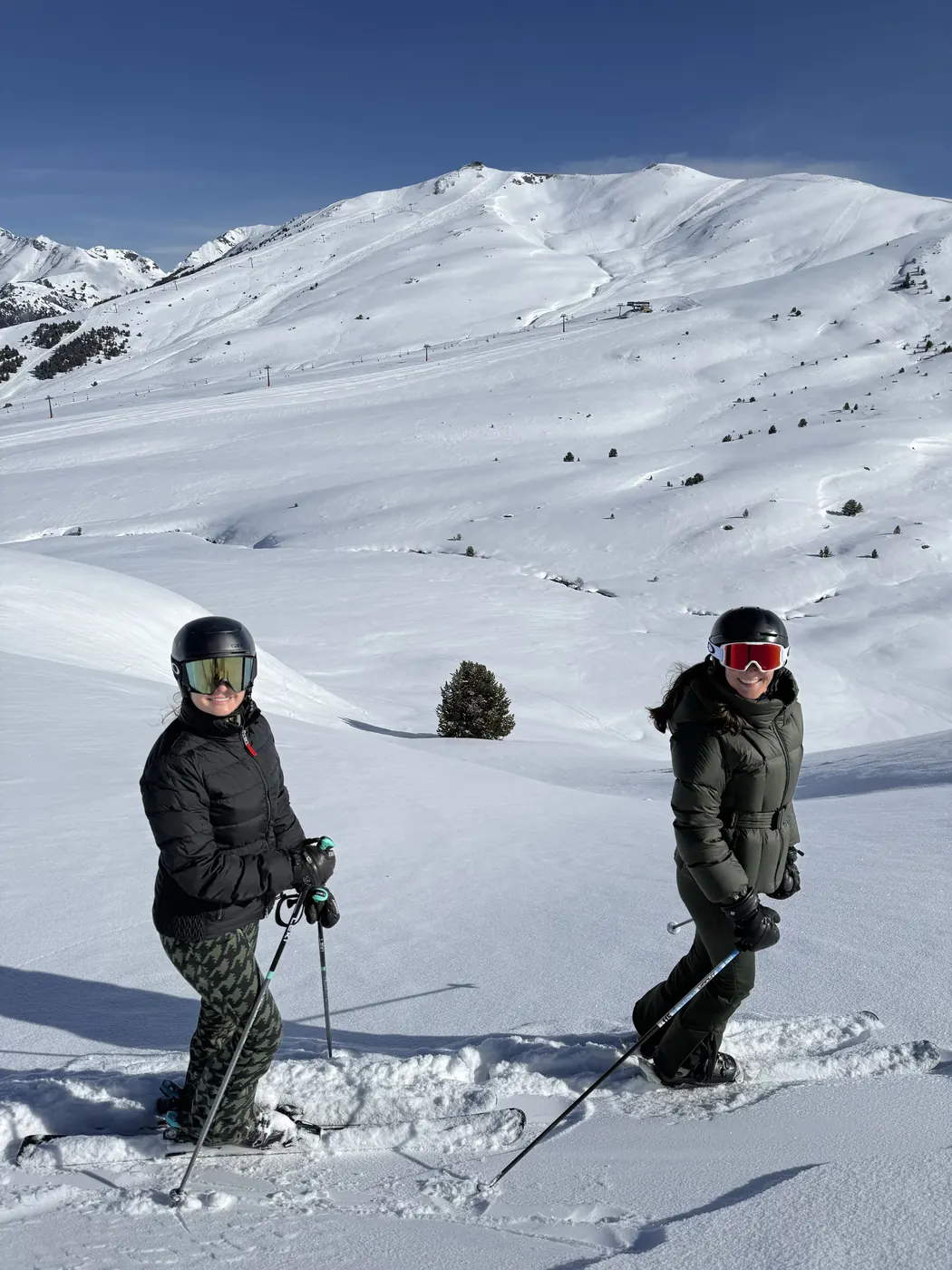
With today's equipment and a sensible progression, the technical work centres on stability, on how the pivot and the line are executed, on how fore-aft and lateral balance are adapted to centre the body and coordinate the limbs, and on line choice together with reading the terrain — knowing where the good snow really runs and anticipating what the ground hides. That is where command of the terrain starts to appear — and with it, that feeling of control that gets you hooked.
Safety equipment depends on level and area. For children and beginners, on safe terrain close to the piste, it is not essential kit — we do recommend a helmet and, where possible, a back protector for everyone, whatever their level. An avalanche transceiver (DVA), a probe and a shovel only become necessary from a more advanced level onwards, when you ski in areas well away from the pistes, on slopes of 30° or steeper.
How does the steepness of a piste translate into risk off it?
The difficulty of a piste is measured in % gradient; avalanche risk is measured in degrees of steepness — a 45° slope is equivalent to a 100 % gradient. This is roughly how piste colour translates to the terrain beyond it:
| Equivalent piste colour | Gradient (%) | Steepness (°) |
|---|---|---|
| Green | 5 % – 15 % | 3° – 8° |
| Blue | 15 % – 25 % | 8° – 14° |
| Red | 25 % – 40 % | 14° – 22° |
| Black / itineraries | +40 % (up to 70-100 % on extreme faces) | 22° – 45°+ |
But real avalanche risk does not follow that “the steeper the slope, the greater the danger” scale in a straight line. Below 30° the snow sits stably — a slab avalanche is almost impossible unless the slope is connected to a steeper one that collapses onto it. Between 30° and 45° is where the greatest tension builds up in the snowpack: that is where the vast majority of slab avalanches happen, with the absolute statistical peak between 38° and 39°. Above 45°, curiously, the risk “drops” again — the slope is so steep that the snow purges itself in small sluffs and never builds up the depth a large slab needs.
So if an untracked open face reminds you visually of a black run or a steep red wall, the rule is simple: treat it as avalanche terrain. For anyone already skiing freeride on slope angles equivalent to red-black, this is where you have to take every precaution — it coincides exactly with the zone of greatest technical demand and greatest real risk.
This 30°-45° band is the reference for the most common and most dangerous type of avalanche, the dry slab — which is also the one that concerns us most in freeride lessons, focused as they are on powder. With wet snow or in spring the behaviour changes and the risk can appear on considerably gentler slopes, but that is a layer of detail we will leave for a dedicated freeride safety article later on.
Can you take up freeride as an adult with no previous experience?
People often come to us after a long time skiing on piste, keen to try something new, to feel that those days of untracked snow they hear so much about could be theirs too. And the first day is often hard: it takes a while to get the feel of it, the snow grabs you or snatches at your skis, you misread the ground and nothing turns out quite as you expected.
That is normal — the freeride environment is neither prepared nor predictable. No two days and no two kinds of snow are the same, so there are days when everything comes easily and feels exhilarating, and others that are harder than you expected. That is not failure: it is part of genuinely learning this discipline.
We see it every season with Miriam and Miguel. They had skied on piste all their lives, and leaving it behind gave them doubts and a certain amount of fear — a very normal reaction after so many years doing things one way. Year after year they have improved, little by little, and they are now managing things they would not even have considered attempting a few years ago. It is not linear or immediate progress — it is consistency, session by session, with the right environment and the appetite to keep learning.
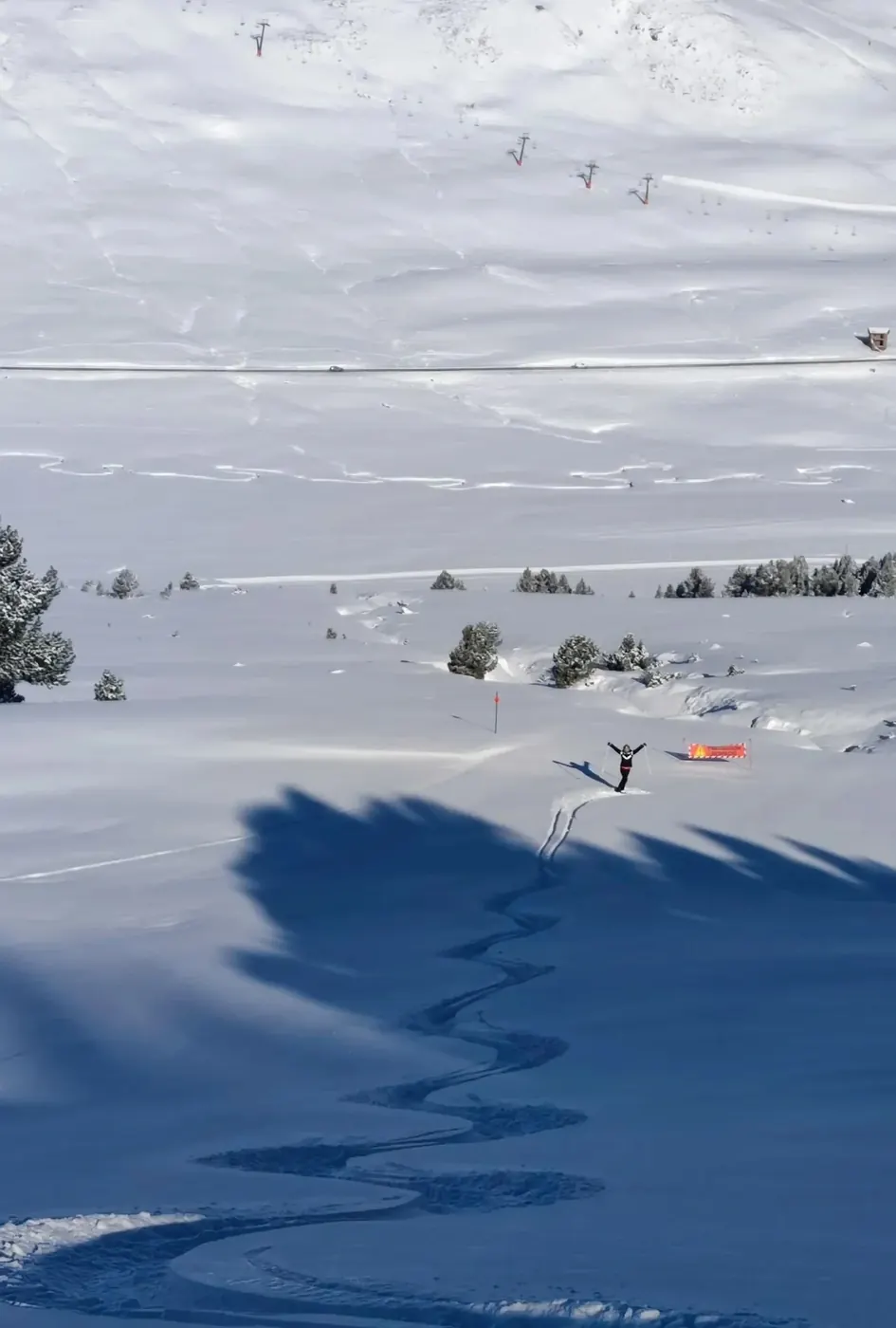
In Baqueira, the most efficient way to start out in freeride is not to look for the most spectacular slope on day one — it is to move into safe areas close to the piste, where the terrain forgives your mistakes while you learn to read it. With parallel skiing already worked on, you have what you need to take that first step. The rest — the line, reading the snow, the judgement to choose an area to suit the conditions that day — is built up with hours on the snow and with someone who knows every corner of the resort before taking you into it.
Is freeride dangerous if I have never tried it?
No, not if you go about it gradually and on the right terrain. The danger is not in freeride itself, but in getting into an area that is wrong for your level or for your condition on the day. That is why in Baqueira we always start in safe areas close to the piste, and only widen the range as the student's technical level rises.
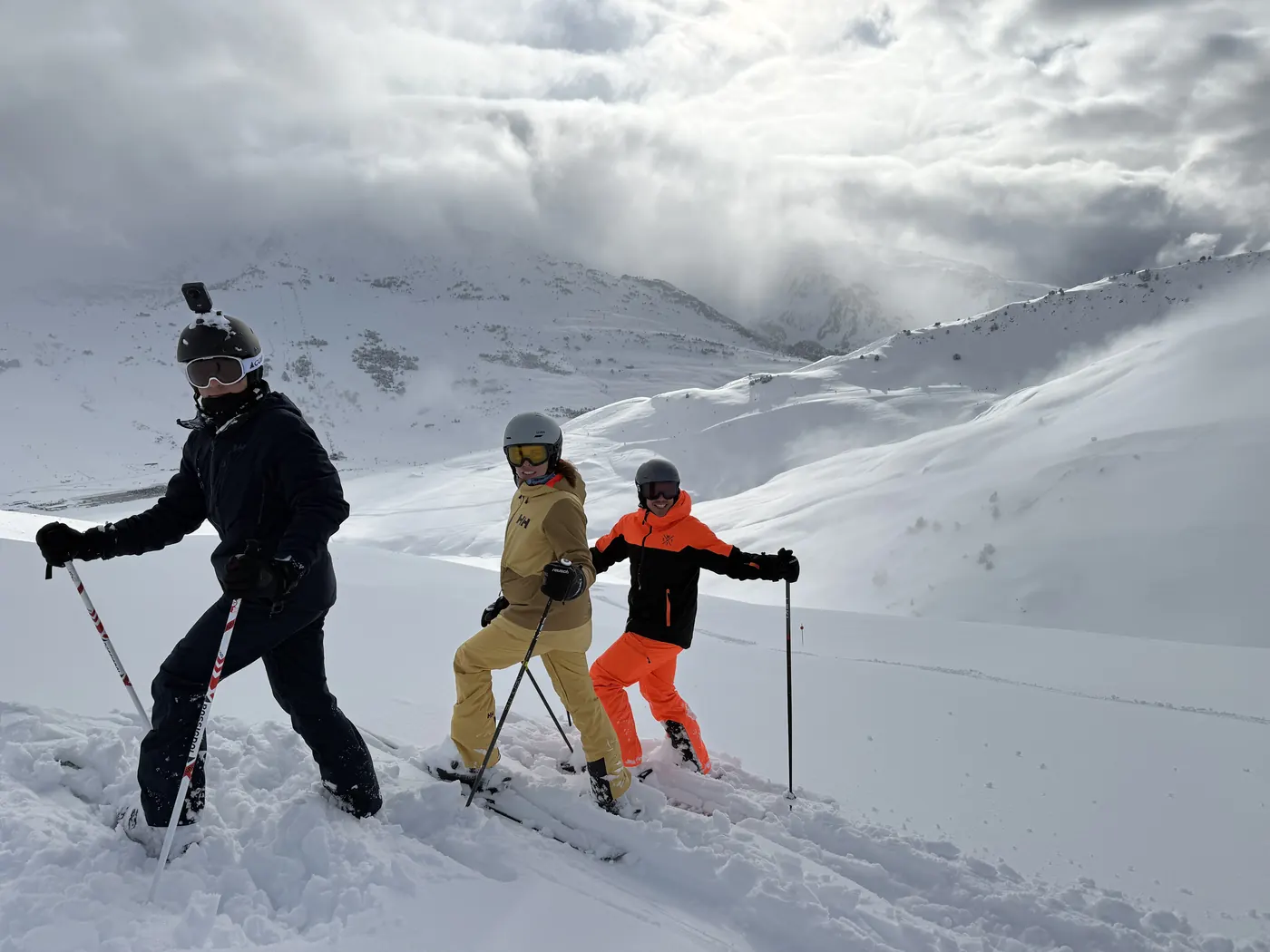
Make the jump to untracked snow
Already confident with parallel skiing and ready to make the jump to untracked snow? At Alpine we design your first freeride session around the real conditions on the day, in safe areas matched to your level. Find out how our freeride lessons in Baqueira work.