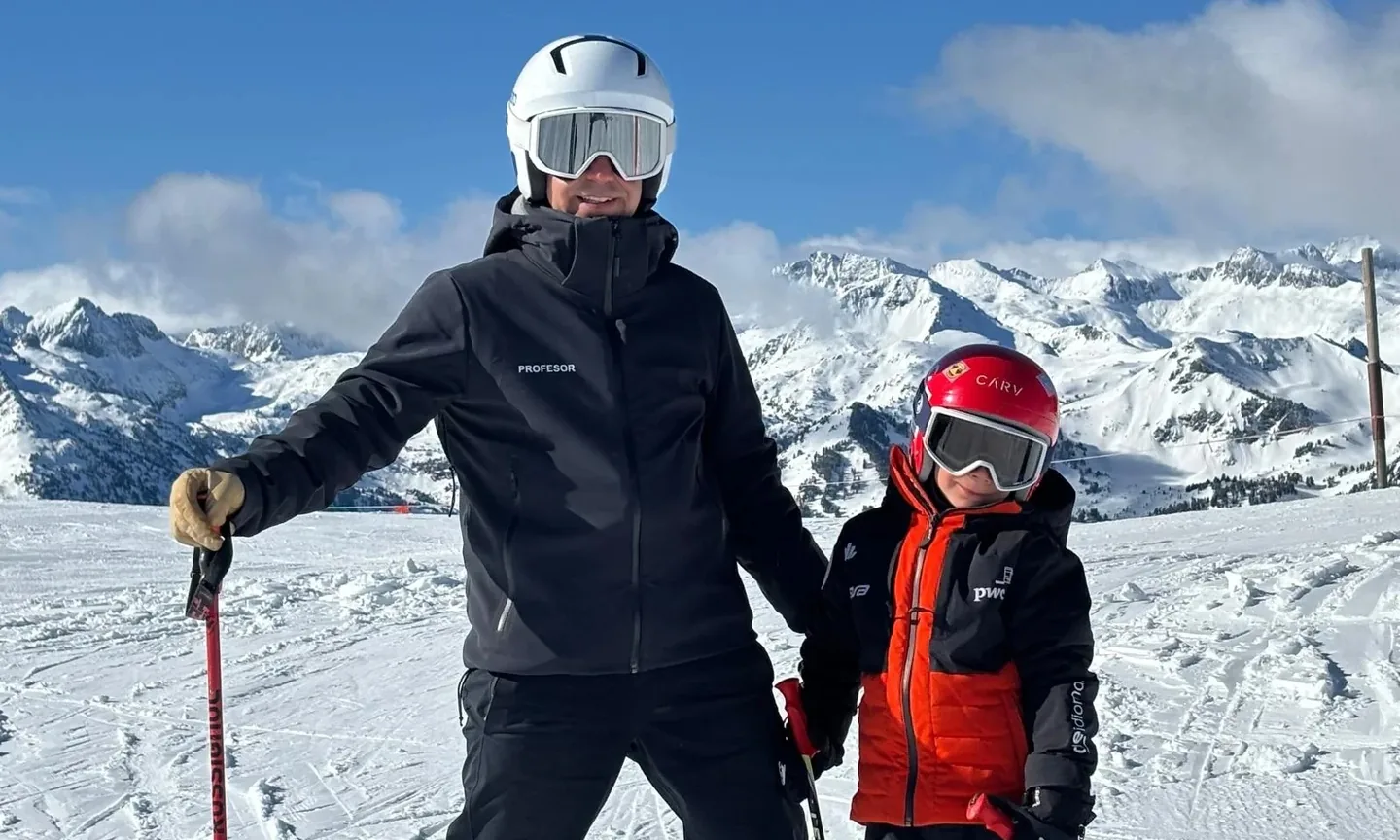
There is a moment when a child stops being a beginner but still does not ski "properly" in their parents' eyes. They no longer hold a wedge through the whole turn, but nor do they carry the skis together like the rest of the family. It is an awkward phase to name — neither one thing nor the other — and many parents ask us whether that moment has a specific age.
It does not. What marks the step from an advanced wedge to the elementary parallel is not the calendar, it is one specific technical movement: bringing the inside ski together throughout the whole turn, naturally and automatically, mainly on green, blue and easy red runs. We have seen 7-year-olds who already have it settled that way, and 10-year-olds still working on it, and both cases are completely normal.
What does change with age is not the technical objective but how we teach it. A 7-year-old and an 11-year-old can be working on exactly the same movement, yet they need different stimuli, a different span of sustained attention and a different way of framing the cue — something that also bears on whether private or group suits each band better, which we come back to later. This guide explains that central technical movement, how we adapt the method to the child's maturity, and why the youngest band, from 2.5 to 6, almost never reaches this point yet, apart from the odd exception.
The most common mistake we see in Baqueira is treating the elementary parallel as a box ticked all at once, rather than as a gradual settling. A child can bring the skis together on the odd turn, on an easy run with good snow, and that makes the family think they "already ski parallel" — when in reality they still fall back on the wedge as soon as the terrain, the snow or the demand of the turn changes.
Why does forcing gradient or speed slow down the elementary parallel?
We see it a lot in Baqueira: if in this phase the child is exposed to too much gradient or a speed they cannot yet hold with the technical movement well settled, they fall back on the wedge as a safety resource. The problem is not that isolated step backwards — it is that, repeated, the wedge becomes embedded as the default system for turning, leaning and "braking".
And there is the underlying misunderstanding: the wedge does not really brake, it is above all a tool for balance and for controlling acceleration, not a brake in the strict sense. When a child automates it badly, with that mistaken idea of "this is what stops me", the effect is worse than not forcing anything: a badly understood habit then has to be dismantled, not just the new movement taught. It is not the child's failure — it is a sign that the technical element was not yet automated and terrain was demanded beyond what they could hold.
The second block is family expectation: comparing an 8-year-old with the elementary parallel already settled against an 11 or 12-year-old still working on it creates worry with no technical basis. The technical element has no fixed date — what changes is each child's pace in automating it.
What do we work on to settle the elementary parallel?
The elementary parallel does not appear by repeating runs — it appears when the child automates one very specific movement: bringing the inside ski together throughout the whole turn, transferring weight onto the outside ski progressively from the start of the curve. At Alpine we work this movement on several fronts at once:
Progressive weight transfer
The child learns to load the outside ski not all at once, but continuously along the turn — it is what lets the inside ski stop needing the wedge as support.
Edge control on the inside ski, skidded and not carved
In this phase skidding is not a mistake, it is the correct control. We look for flexion of the inside knee, inversion of the inside foot and eversion of the outside foot, with the load properly applied on the outside ski. The sensation we pass to the child is one of following through with the inside heel "sweeping" the snow, to release that edge without it staying dug in.
A patient entry into the turn, on open curves
This is a critical moment: the start of the movement needs time, with no rush to close the radius of the turn. Working on open curves favours balance, minimises the errors normal to this phase and smooths the execution. It is also a good moment to work on gliding — keeping the skis parallel along the fall line — because anything that smooths that steering phase helps settle the movement.
Very easy, well-groomed terrain, with measured exploration
Very gentle gradients, wide runs, few people and snow in good condition. It is also a good moment to widen horizons and take the child to new areas of the mountain, such as the Fun Park or Argulls — but those moments of greater difficulty have to be minimal and very carefully chosen, so as not to encourage the wedge to take root as a safety resource.
Base stance
All of this is worked from a proper upper-body position, arms open and ahead of the body, minimising exaggerated rotations — so that the ski pivots come out more progressive and precise.
In Baqueira we usually support this phase in areas such as Rabadà and Cabana; Clot der Os in Beret and the Fun Park surroundings; and in Bonaigua, Argulls once the level allows it.
Differences by age band
Although the technical movement is the same for everyone, how we teach it changes with age — not the objective, but the stimulus, the length of the active work and the way the cue is framed.
Children aged 7 to 10 settling the elementary parallel
At this age the span of sustained attention is still limited — as a rough reference we use the age multiplied by two plus two minutes, so with a 7-year-old we work active blocks of around 16 minutes before changing the stimulus or bringing in a moment of play.
Within those blocks the cues are simple and very concrete — never a long explanation. The child imitates; the instructor knows why:
What the child hears
Only that: a track to follow, with no technical explanation behind it.
What the instructor is after
That track is not arbitrary — it is drawn deliberately so that the ski stays parallel a second longer than it naturally would, pointed down the fall line, and so favours a smooth, patient bringing together of the inside ski.
What the child hears
Again, only that: lift the ski a little.
What the instructor is after
That this small movement in the air favours the bringing together and the inversion of the inside foot without friction against the snow, and that the body organises and balances itself naturally over the outside foot.
The child does not yet need to know the technical reason behind any of the cues worked on in this phase. It is the instructor who decides the why, the when and the where of each one. With a clear instruction, the child practises with quality without having to think about the technical reason behind it. Only now and then, not on every run, do we add a light explanation of what we are going to do or what we want to feel — just enough to give context, never to load the child's head before moving.
The comparison is always against their own progress, never against other children in the group.
Children aged 10 to 12 settling the elementary parallel
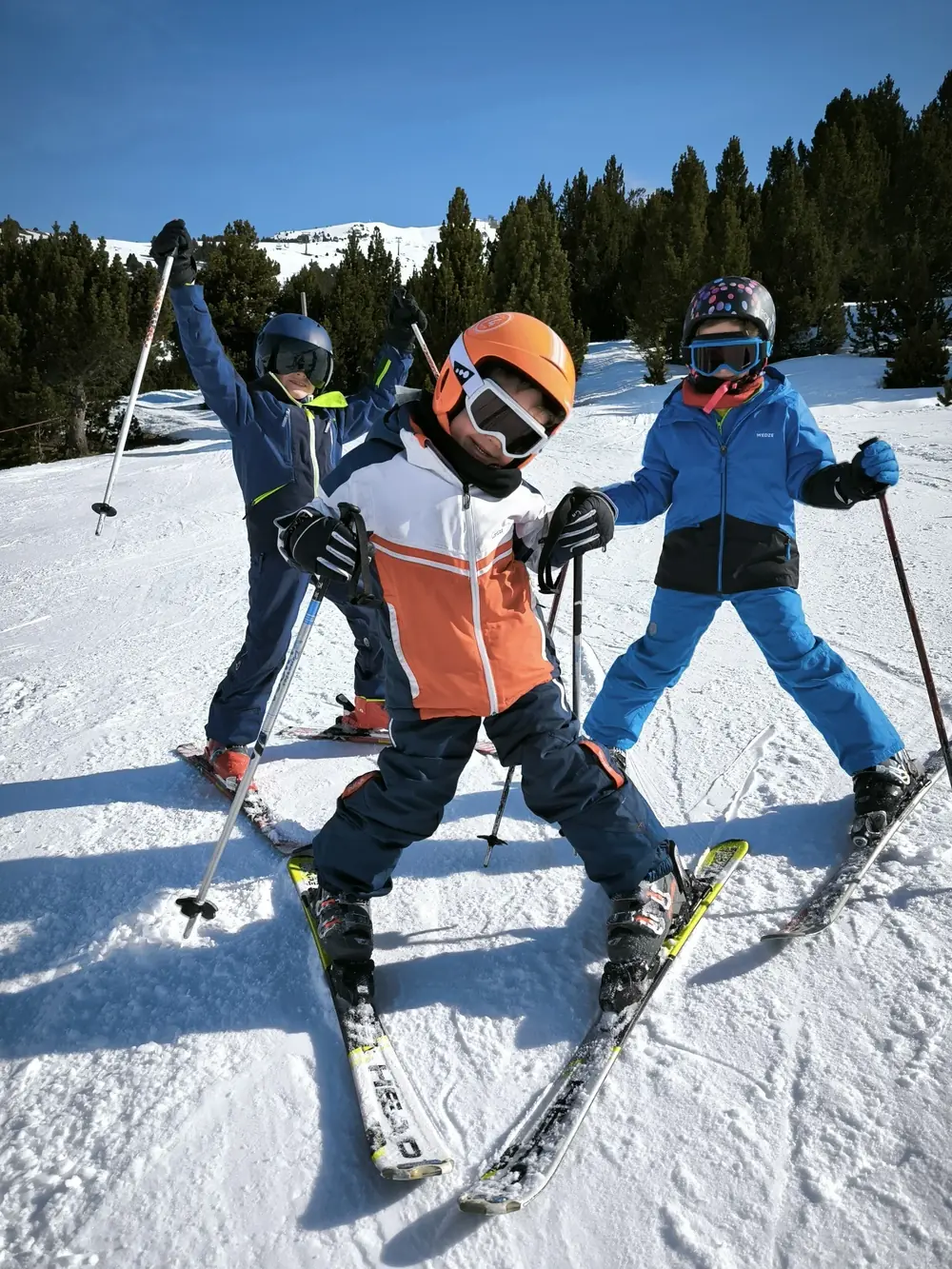
With a longer span of sustained attention —by the same reference, around 22 to 26 minutes of active block— and more capacity to reason about the movement, here we can anticipate the cue before setting off, not just correct it afterwards: asking them to visualise the turn, or to count how many times they manage to keep the inside ski together before losing it. Progression tends to be faster in this band, but not always — an 11-year-old can take as long as an 8-year-old, and there is nothing odd about that.
The exception: under 6 or 7 on the elementary parallel
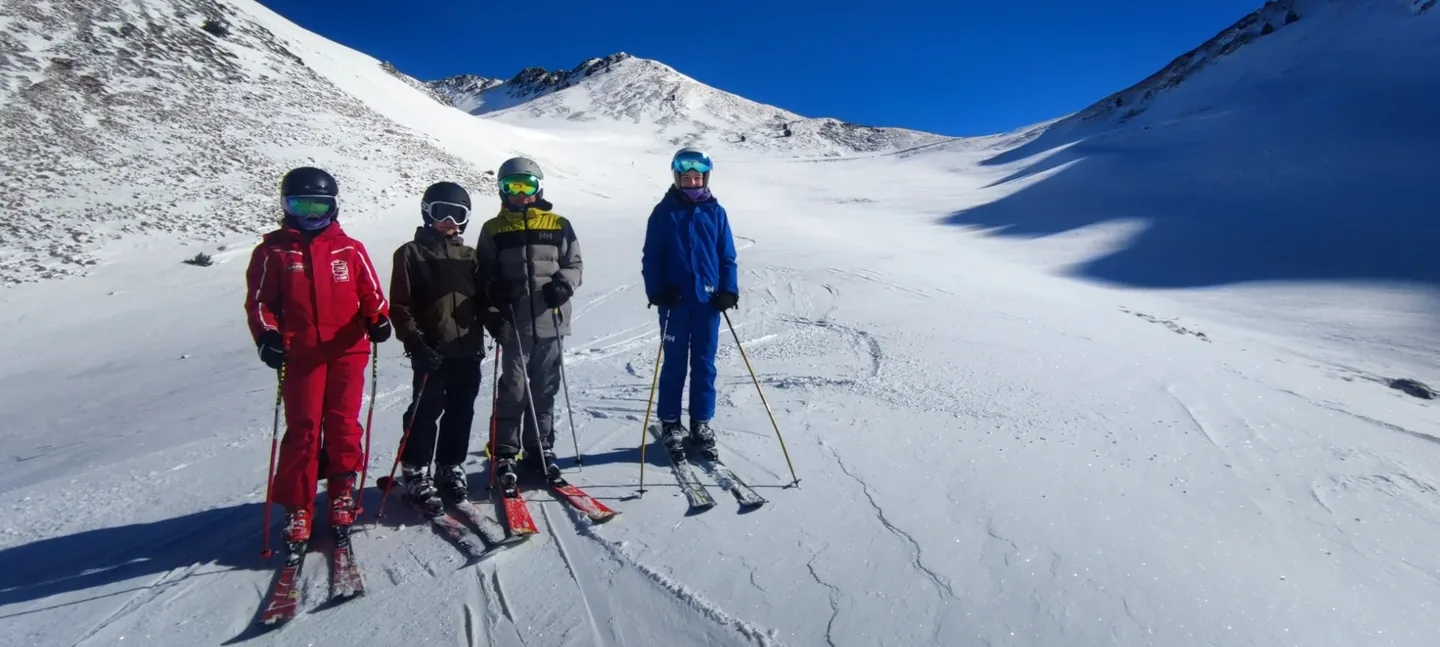
It is not common, but it happens. Before that age most children still depend on the wedge as the basis of their balance and speed control — loading the outside ski consciously and continuously is not yet within their motor reach. When it happens earlier, it is normally a child with a lot of prior motor experience off the snow, and we treat it as an individual exception, not as the expected objective for that age.
In these cases we apply the same basis as in the 7 to 10 band, but taken further towards play, experience and the dynamism proper to that age — never technical explanation, under any circumstances. The cues follow the same principle of "the child imitates, the instructor knows why", but always wrapped in a playful dynamic, with no hint of direct technical instruction.
Recommended practice hours per band
The capacity to sustain technical work also determines how many hours of lessons make sense in a day, not just the length of each active block. As a rough reference:
| Band | Recommended lesson hours per day |
|---|---|
| Exception below 6 or 7 | 2 to 4:30 h, heavily fragmented and with plenty of play |
| 7 to 10 years | 3 to 5 h |
| 10 to 12 years | Can rise to 5, 6 or 7 h if the child holds up well |
It is not a rigid rule — it depends on the motivation of the day, accumulated fatigue and how the child responds on that particular day. But as a starting plan, the older ones tend to tolerate longer days without losing quality of execution.
Why does my child ski worse with the family than in the lesson, when the lesson went so well?
It is one of the situations we see most in this phase, and it has nothing to do with anyone's bad intentions.
Julia and Pol, siblings aged 8 and 10
After a lesson with Julia and Pol, the instructor mentioned to the parents, without making much of it, that they had reached Beret that day and come back. The parents read that as "they can already ski the whole mountain" — and that same afternoon, with no lesson, they took them up for a few runs down Mirador and Vuelta a Casa.
What the parents could not know is that two wrong decisions for that technical moment came together there, for different reasons. Mirador is a run that is always difficult, in any condition — it was not suitable terrain for this phase. Vuelta a Casa, by contrast, can be a valid run for settling the elementary parallel, but it depends entirely on the particular route and the moment of the day: there are variants and hours where it fits perfectly, and others where it does not, because of people, snow or the real gradient of that variant. That day, neither choice matched the children's technical moment.
The result was a clear step backwards in the next lesson: both fell back on the wedge on the stretches they had been doing parallel the day before. Not for lack of level — for having been exposed, unintentionally, to stimuli that did not match that phase.
This happens a lot, and almost always for the same reason: parents see their child skiing well and easily in the lesson, and it is logical to think they can now do the same on their own. It happens with adults too. But what separates a run that settles from one that sets you back is not the child's level — it is choosing the run, the moment and the snow well. The tracks left by the good ski and snowboard instructors of Baqueira are almost never random: each piece of terrain and each hour is chosen for what that child needs to settle on that exact day.
Alpine's recommendation for this phase
If your child is on the elementary parallel, the best way to help in free time is not to go looking for new terrain on your own — it is to ask the instructor, as the lesson ends, what kind of run and what conditions suit that day if you are going to ski together afterwards. Five minutes of that question prevent most of the steps backwards we see in this phase.
Group or private to settle the elementary parallel?
Unlike the beginner phase, here it is a real alternative. On the elementary parallel a group can work well — but only if it is formed by real technical level, not just by age. One 8-year-old and another 8-year-old can be at completely different moments of the movement: one already has it settled on easy runs, the other still falls back on the wedge as soon as the demand rises. Putting them together because they share an age speeds up neither of them.
So if you are considering a group in this phase, what matters is not the age of the group, it is that the instructor confirms beforehand that the real technical level is homogeneous — not just that "they are all the same age" or "none of them is in a wedge all the time any more". A private lesson for children remains the safest option for settling quickly if the child is right at a delicate point of transition; the group, when properly formed by level, can fit very well from here on — above all for the social side and the motivation among peers, which at beginner level does not weigh so much yet.
Book your child's ski lesson in Baqueira
If your child is in that in-between phase —no longer a beginner, not quite parallel yet— at Alpine we adapt each lesson to the exact technical movement they need to settle, not to a generic age. Write to us and we will help you decide the best formula for this stage.
Book on WhatsAppOr ask us here
Víctor Puche Fita — TD3, SAFE Formación demonstrator, founder of Alpine Ski Academy.