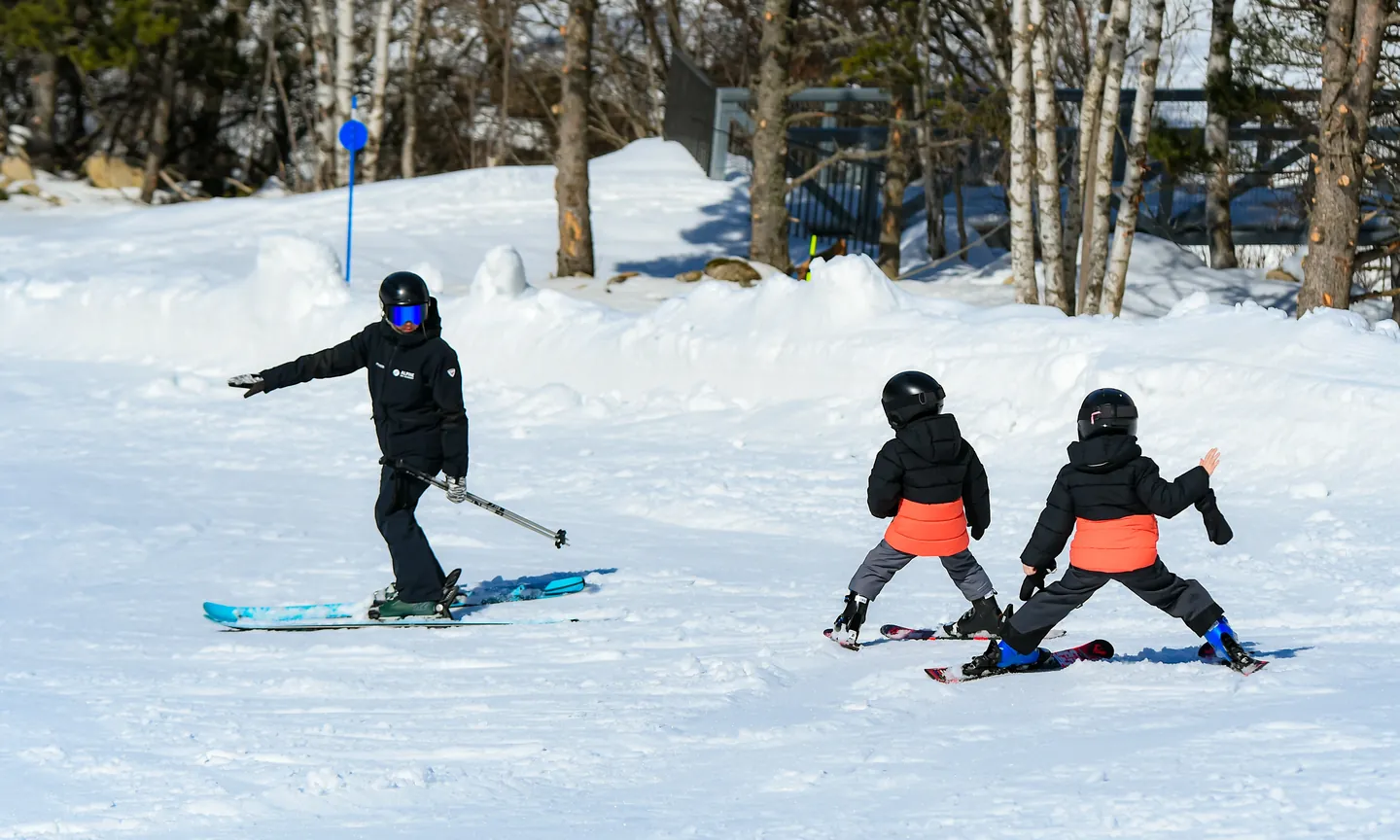
Every parent who arrives in Baqueira with a small child asks the same question before booking the first lesson: is he ready? The doubt does not disappear with age — it changes shape. With a 2 or 3-year-old, the question is whether they will cope with being away from you for a while without getting upset. With an 8 or 10-year-old, the question is different: whether they will feel comfortable starting from scratch when their friends or siblings may already ski.
At Alpine we have watched children start at every point in childhood for 24 seasons, and we know that "beginner" is not an age, it is a stage — and that stage is lived completely differently depending on where the child is in their development. This guide helps you identify which one yours is in, what to really expect from their first lesson, and why we approach each band differently on the slopes.
The first obstacle is almost never the child. It is the fear we parents bring from home. And it is understandable: you are about to leave your child with someone you had not met until that moment, in a setting that is new to you, doing a sport that looks risky at first glance. That fear is not a weakness, it is normal protectiveness — but it is worth telling it apart from real risk. With the right equipment and an instructor who can read a child, snow is a far safer and more controlled setting than it looks from outside.
That fear almost never resolves itself. It turns into postponing: "next year", "when he is a bit older", "when he is more mature". And the following year the same sentence appears. The problem is not waiting — sometimes that is right. The problem is waiting because of a fear the real setting does not justify, rather than because of a concrete signal from the child.
The signals that really tell you a child is ready to ski
The calendar does not decide it, the child does. These are the three signals we use on the slopes, in order of importance:
Genuine enthusiasm The most important
When you suggest the activity, does he open up to it or shut down? This is, in our experience, the most important signal for knowing whether he is ready to enjoy the experience that day.
Basic motor agility
That he jumps, runs and walks with a degree of ease. Nothing more is needed.
Being used to time away from parents
In the youngest, that they have already got used to spending an hour or two away from you. And if they are out of nappies, that they can give you about five minutes' warning.
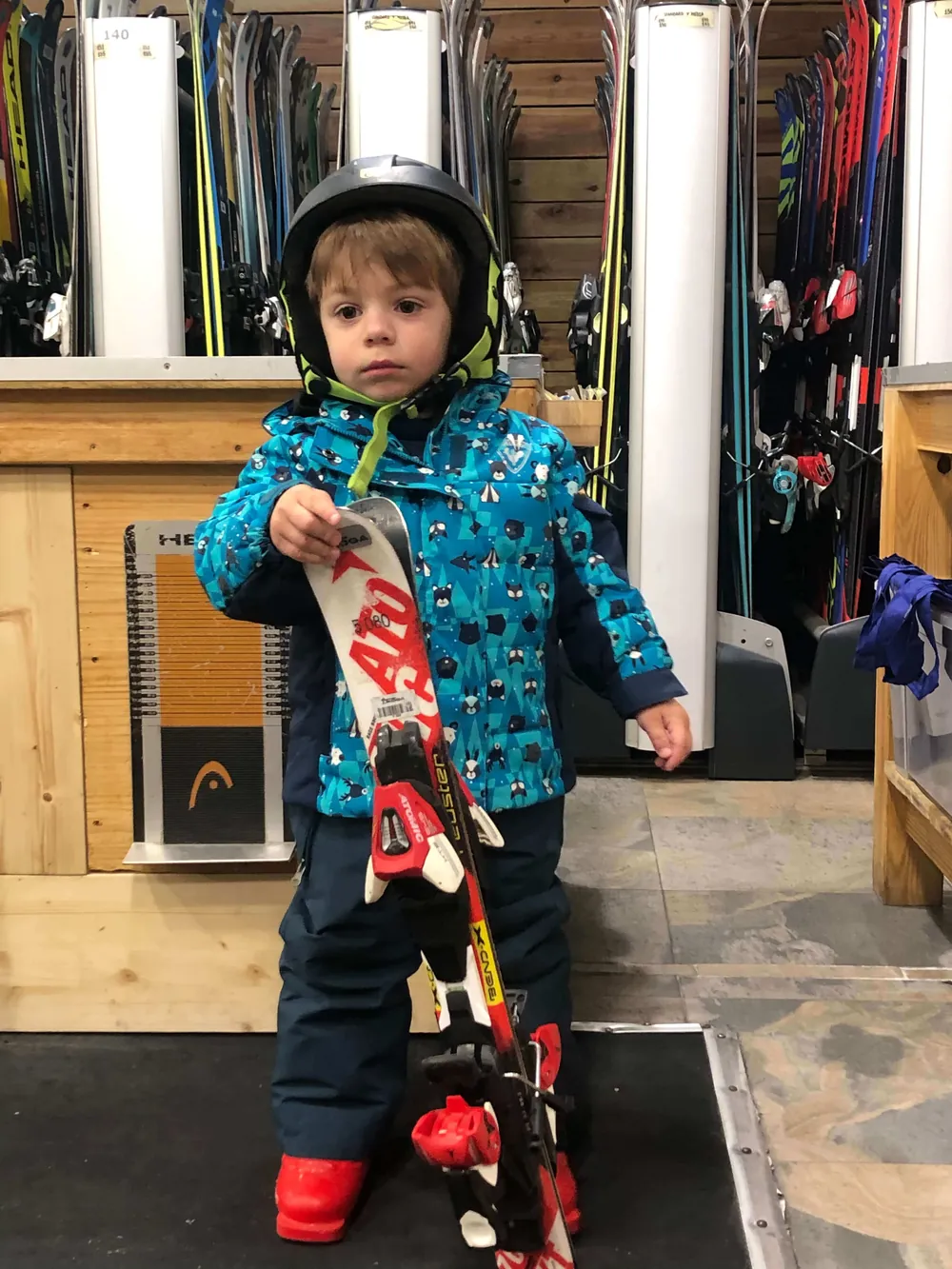
Is a private or a group lesson better for a beginner?
| Private lesson | Group lesson (2-5 years) | |
|---|---|---|
| Actual practice time | 100 % of the hour | Shared between all the children in the group |
| Pace | Adjusts to the child in real time | Fixed, set by the group |
| Alpine recommendation (3-5 years) | Yes, by default | Only in specific cases — groups of friends or siblings with 2 instructors |
| From 6 to 12 years | Also valid | Can fit well if the group is properly formed by age |
For beginners aged 3 to 5, a private lesson for children means practising 100 % of the hour, whereas in a standard group the actual learning time is shared between everyone. That is why we do not usually recommend the standard group in that band, apart from exceptions. There is a special format within the group lessons for children with two instructors at once for small groups of friends or siblings — the price sits between a private lesson and a plain group, and it removes a good part of those problems.
What every beginner child must learn, whatever their age
Before talking about ages, there is one technical objective shared by all beginners, and it is what marks when a child stops being one. In this first stage we work on:
- Getting to know the environment and the gear.That he feels at ease with the snow, the cold, the skis on — and that the gear suits his age: the younger he is, the simpler everything should be.
- Basic stance and balance, both fore-and-aft and laterally.
- Control of the wedge. The position that gives the child their first real control of speed, always on gentle slopes.
- A real sense of controlling speed. That he physically feels he can slow down when he wants — this is what turns fear into confidence.
- First turns and changes of direction in a wedge, to both sides, with a correct postural pattern both when sliding straight and when starting those first turns.
All of this is taught in a completely different way depending on age — pure play at 3, somewhat more instruction at 9 — but the underlying objective is the same. At Alpine we consider a child starts leaving the beginner phase behind when they link controlled wedge turns, in a basic way, on a simple green run. From there the next stage begins: consolidating parallel.
Why we do not teach every child the same way
A child does not learn to ski just by repeating a movement. They learn to hold their balance, coordinate their body, read what is happening around them and find solutions that let them control speed and direction. And those capacities do not develop the same way in every child.
Two children of the same age and the same starting level may need different teaching strategies. Prior motor experience, coordination, balance, strength, the ability to follow an instruction, confidence and motivation can make the same task easy for one and too demanding for the other.
That is why at Alpine we do not follow a rigid progression identical for everyone. We adapt the terrain, the space, the difficulty of the task, the equipment, the way instructions are given and how much help each child needs. We also use play and varied exercises so they learn to adapt to different situations, not merely to repeat one particular run.
Research on children's development and motor learning supports exactly this: the importance of building motor skills and of adapting learning experiences to the child. In practice, that means the goal is not to get every child doing exactly the same thing, but to help each one build the capacities they need to ski with more control, confidence and independence.
How the first lesson changes with age
We start on the beginners' carpet, with short sessions and technical work in stretches alternating with play. Play is not a break: it works balance, coordination and speed control.
Same technical starting point, a noticeably faster progression curve. They already follow a more elaborate instruction and can consciously load the outside ski.
The challenge is no longer only motor. You can reason with them almost as with an adult, but the embarrassment of being the only one in their group who does not ski yet appears.
First ski lesson for children aged 2 to 6: what it is really like
With the youngest beginners we always start in the same place: in Baqueira, the beginners' carpet, right above the nursery — we meet there directly, or at the Info-Café, altitude 1800, same spot; if the lesson is in Beret, we meet in front of the control tower. It is not a coincidence: it stops the child having to walk a fair distance from the usual meeting point, which is further away, and arriving at the lesson already tired or feeling the activity is costing an effort before it has even begun.
Up to 6-7, and even more so if the child is shy, two details make the difference: making sure they have been to the toilet before putting the skis on, and, if the lesson is long, taking a 10-minute break every hour and a half or two hours — a snack, a distraction, a moment to reset. Within those blocks, the real technical work always comes in short stretches alternating with play — this does not change only with age, it changes with how technically demanding the moment is, in any band. And play is not simply a pause: set up well, it also works balance, coordination, perception, orientation, speed control and decision-making.
Children aged 7 to 10 starting to ski: what changes
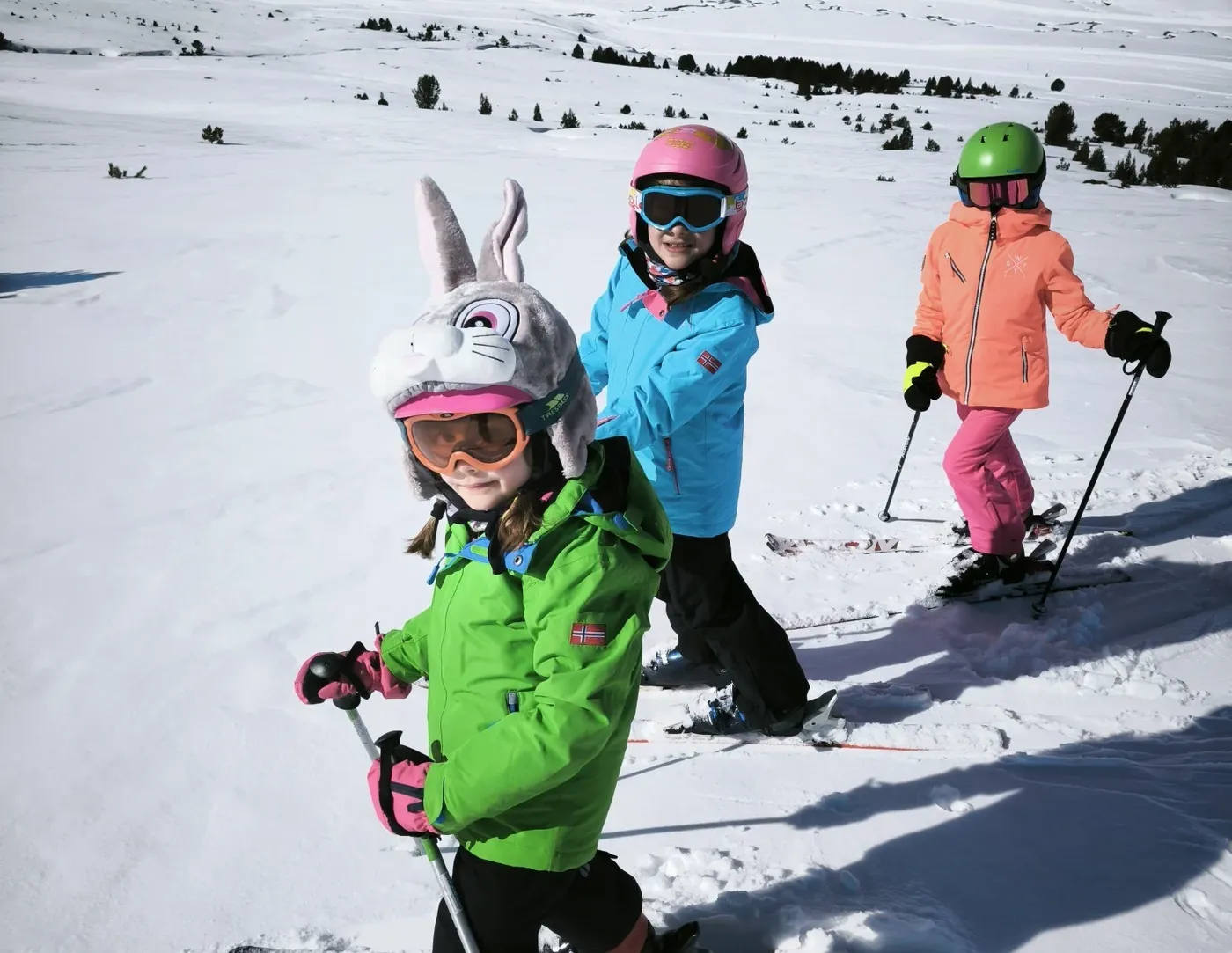
A child this age who has never skied starts from zero technically, but not from zero in everything else. They already follow a slightly more elaborate instruction without getting lost, and they respond better to competing against their own progress — "you came down in control 8 times, let us see if you beat that today" — than to being compared with other children. Physically, at this age they begin to be able to load the outside ski consciously, which is still much harder for a 4-year-old beginner. The result: the same technical starting point as a small beginner, but a noticeably faster progression curve in fewer runs.
Beginners aged 10 to 12: the challenge is no longer only motor
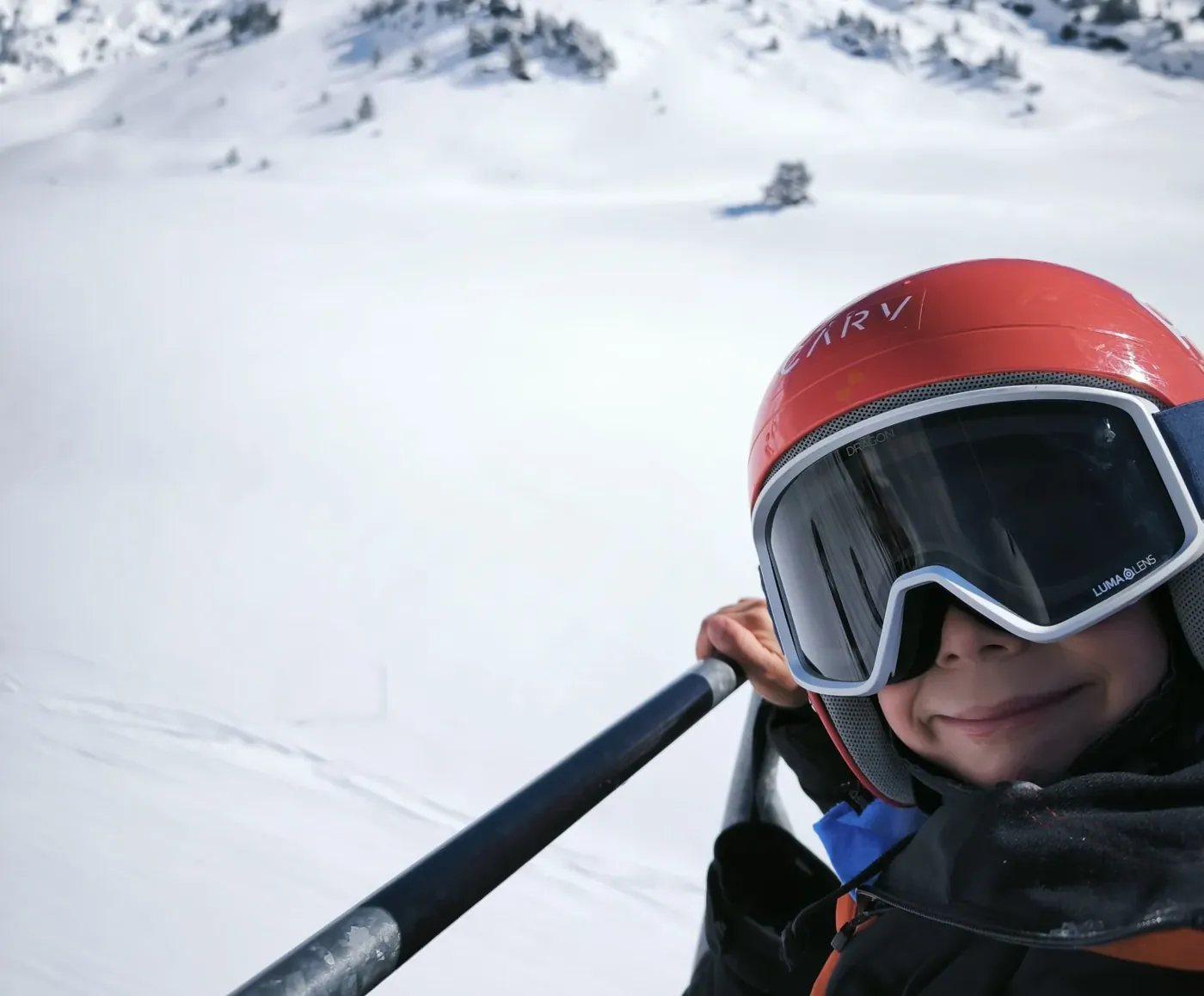
At this age you can reason with the child almost as with an adult — involve them in the decision ("shall we try this way or that way?"), even ask them to visualise the turn before attempting it. As they grow, we can not only raise the technical difficulty: we can also give them more say in decisions and in choosing small challenges. But an obstacle appears that does not exist in the youngest: the embarrassment of perhaps being the only one in their group of friends or siblings who cannot ski yet. Here the instructor's work weighs as much emotionally as technically — and, technically, the progression is usually the fastest of the four bands.
Gear for beginner children: what we check before the first run
The boots
It is common to have them too loose "so they do not bother him", and that is exactly the opposite of what helps — with loose boots, it is much harder for the child to execute precisely what the instructor is asking for.
The skis
Neither too long (they take away control until he masters more) nor too short (they take away stability). As a rough guide, somewhere between the nose and the eyes usually works.
Everything else
Layers of clothing, type of goggles, sun cream, any equipment question — at Alpine we advise you with no obligation before the first lesson, you do not have to get everything right on your own.
The right ski length depends on age, height, weight, level and type of ski — the nose reference is only a starting point, not a rule.
Can parents watch their child's ski lesson?
If you want to stay and watch, that is no problem at all — but from a distance where your presence does not influence the child. The aim is not to separate the child from their parents for its own sake, but to let them build a reference of trust and independence with the instructor. At the end of the session there is always a moment to share the progress, watch the last video or the last run together.
Why do some beginner children progress faster than others?
Two girls, same age, same day
Last year we taught two friends of the same age, on the same day, with two instructors working side by side in the same setting. One of them managed to come down and control the wedge independently along the whole nursery slope, on her own, straight down. The other barely managed two runs — she flatly refused to carry on.
Same day, same age, same setting, same instructors. The difference was not in the technique or the slope. It was in the openness each girl arrived with that day — exactly the signal we described earlier as the most important of the three.
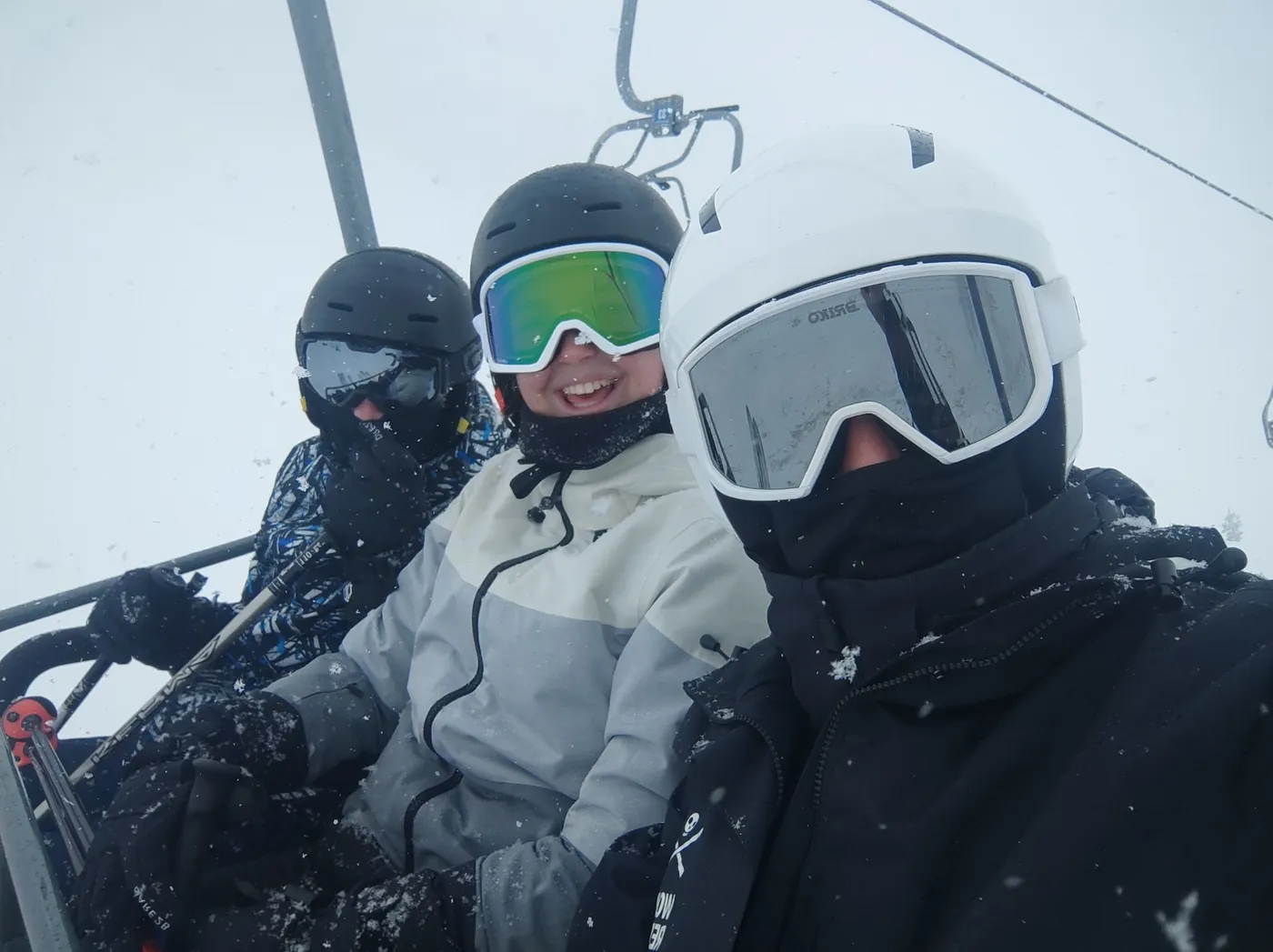
Bosco, 3 years old
That openness does not always translate into meteoric progress, but when it appears, this can happen: Bosco, 3 years old, cheerful, barely speaking, enjoying everything from the first minute. On the nursery carpet, with a tip connector, after three runs he was ready for the yellow carpet. There he did three more runs, and we tried without the connector: he came down on his own, controlling his braking and his stability, within the same hour of the lesson. The next day he was already working on changes of direction, and the lesson stretched to an hour and a half because he was the one who asked.
Not every beginner progresses that fast, and it does not matter if they do not. In that first experience, the difference is often not in the technique the child brings, but in the enthusiasm, confidence and willingness they arrive with each day.
Beginner siblings at different levels: same lesson or separate?
Markus and Elias, 8 and 5
Markus and Elias, British brothers, both beginners — 8 and 5. We started the lesson together, and within the first 20 minutes it was clear they could not carry on that way: with the same instructions, Markus was already coming down steadily, controlling his speed, alone, straight down the yellow carpet. Elias needed guided runs with a tip connector, the instructor skiing backwards in front of him using the poles as support, giving him the protection and the sensations he needed to progress at his own pace.
We split the lesson: an hour and a half with Elias, and Markus doing laps on his own with quick pointers each time he passed nearby. In the afternoon, Elias skied a little more and Markus added two or three more hours of laps. The next day they were two different worlds — Elias was still on the tip connector, Markus was already turning in a wedge and was two runs away from moving from the button lift to La Cabana. And it was only the second day.
With equal motivation, motor capacity, strength, coordination and comprehension can make real differences. Prior motor experience and the confidence each child brings to a new situation also matter. We had warned the parents this could happen — they thought the two could stay together all week. When it does happen, we do not force them to keep the same pace: we split the hour into two blocks, each with the instructor's full attention on one child, and reorganise the rest of the week so each progresses at his real speed.
A group for older beginner children: when does it make sense?
It is common, and we see it a lot: a child of 10, 11 or 12 starting from zero rarely finds beginner groups of their own age and level, because the norm is to start between 3 and 5. The result, in many schools, is that they end up in a course with children well below their age.
Two problems appear at once there. The first is technical: they do not advance at their real pace, because the group is pitched at capacities very different from theirs — and that can turn the experience into something boring rather than a challenge. The second is social: they find themselves sharing an activity with much younger children while their own friends or siblings already ski. Some children are not affected by this, but in many cases they are, and significantly.
In both cases the outcome is the same: you do not get what you were after, and the money spent on the course does not deliver what it should. With a beginner this age we almost always recommend the opposite — invest in private lessons, even if fewer hours, and fill the rest with practice as a family or on your own. Fewer lesson hours, better spent, with completely different results — unless you make sure the beginner group is made up of children aged 6 to 12, the band where it starts to fit and to be productive for everyone. It is the kind of nuance the best ski schools in Baqueira should confirm for you before you book.
Alpine's recommendation for deciding when to start
If I had to keep one idea from all of this, it would be this: do not try to guess whether your child is ready before they get onto the snow. Give the professional the first ten minutes. If it works, we carry on. If it does not work, that is fine too — we look for another formula, we wait a little longer, and that is that. Skiing is not compulsory at any age. It has to come from everyone at home wanting it, not from a calendar.
And if you have more than one beginner child, do not assume they will be able to go together just because they share a surname. Sometimes they can, and it is wonderful. Sometimes they cannot, and that is just as fine — what matters is that each one gets what they need so that their first contact with snow is an experience they want to repeat.
Book your child's first ski lesson in Baqueira
Every child arrives at their first lesson at a different moment, and at Alpine we adapt the session to them, not the other way round. If you are unsure which band fits your child or what to expect from their first day, write to us and we will help you decide, with no obligation.
Víctor Puche Fita — TD3, SAFE Formación demonstrator, founder of Alpine Ski Academy.