What ski level am I? It is the first question on any booking, and almost everyone answers it with one word: intermediate. It is the word most often written on a ski lesson form. It is also the one that says least.
Behind that “intermediate” sit two skiers with nothing in common. One comes down any red in Baqueira linking wedges with real skill and no fear. The other carves clean turns in Beret and goes rigid the moment the snow hardens. Both wrote the same thing, and both need a different lesson.
Every country has invented its own language for it. French children collect bears, snowflakes and stars. The Swiss rise from prince to king. The Japanese count backwards, from fifth grade to first. In Norway there are groups named after hares and snow leopards. And yet they all trip over the same places.
I have spent twenty-four winters teaching in Baqueira and training future instructors at SAFE Formación and at the INEFC. My conclusion fits in one sentence. Level is not measured by the colour of the run you come down, nor even by how well you carve: it is measured by how much you decide.
This guide helps you put a name to your skiing before you book a private ski lesson for adults. That way, whoever is waiting for you on the snow knows from the first minute where to start.
Why does the colour of the run not tell you your ski level?
The colour describes the mountain, not the skier. A red run means a medium-to-high difficulty in normal conditions. It says nothing about how you came down it.
The colour is not a universal measure either. Every country and every resort sets its own criteria. In North America reds do not even exist: they go from blue to black. A red in Baqueira and a red somewhere else may have little in common.
And the same run changes through the day. First thing, with hard freshly groomed snow, a red demands precise edges. At midday, with the snow worked over, it forgives almost everything. By the afternoon, with heaps of pushed snow, it has become another run. The colour is the same; the demand is not.
That is why “I ski reds” is no use as a level. You can get down a black by surviving it, on long skids and emergency stops. And you can ski a blue with a precision many black-run skiers do not have. Getting down is not the same as skiing.
Ski levels by country: how schools in Europe, America and Japan measure them
No federation publishes an official table translating one country's levels into another's. Each school has built its own scale, and many pupils arrive in Baqueira with a medal or a number from a different system.
France. The ESF hands out medals: Ourson, Flocon and the Étoiles. At the top, the timed Flèche and Chamois tests.
Switzerland. The Swiss Snow League uses blue, red and black leagues, each with its prince, its king and its star. It describes movements, not colours: Red Star already does short turns on steep reds. It is the only system where the medal means the same in any official school in the country.
Italy. Since 2018, seven levels defined by the type of turn: from the wedge of level 1 to the carved sports turn of level 7.
Japan. It counts backwards. Adults are examined from 5th grade to 1st, and above those sit the Technical and Crown awards. 5th grade is the wedge on a gentle run. 1st is long and short parallel on a steep ungroomed slope.
The United States and Canada. In the United States nine levels are often cited, but every school reads them its own way. In Canada, Whistler uses six: from the first day to the expert who skis under control on any snow and terrain.
Austria, Germany and Norway. They have no national pupil scale; each school sets its own. In Norway, some name their groups after northern animals, such as the Arctic hare or the snow leopard.
Spain. There is no public national scale here either. Many schools run a level assessment on the first day. In courses one habit has taken hold: ordering groups by letters, from A (complete beginner) to F (command of every technique).
Rough equivalences between countries:
| What the skier does | Spain | France (ESF) | Switzerland | Italy | Japan | Canada (Whistler) |
|---|---|---|---|---|---|---|
| Brakes in a wedge and starts to turn | A | Ourson | Blue Prince | 1 | 5th grade | 1 |
| Turns in a wedge and brings the skis together at the end | B | Flocon | Blue King, Blue Star | 2 | 4th grade | 2 |
| Parallel on easy runs | C | 1st and 2nd Étoile | Red Prince | 3 | 3rd grade | 3 |
| Parallel on every kind of run, with pole plant | D | 3rd Étoile | Red King | 4-5 | 2nd grade | 4 |
| Short turns on a steep pitch, starting to carve | E | Étoile de Bronze | Red Star | 5-6 | 1st grade | 5 |
| Commands every technique and every kind of snow | F | Étoile d'Or | Black Prince | 6-7 | Technical and Crown awards | 6 |
There is no official conversion: this is our reading of what each scale asks for on the snow.
The five thresholds every ski scale shares
The names change, but the thresholds are the same everywhere. There are five:
| Threshold | What changes in your skiing |
|---|---|
| 1. The wedge disappears | The skis stay parallel from the start of the turn to the end |
| 2. The pole sets the rhythm | The turn has a before and an after, and you link them without pauses |
| 3. You choose the radius | You make short or long turns because you want to, not because the gradient takes you there |
| 4. The edge carves when you decide | You alternate skidding and carving at will, not by accident |
| 5. It all holds when the terrain changes | The technique survives ice, heavy snow, moguls or a steep pitch |
No system puts it in these words, but they all measure the same thing: how much real control you have over what your skis do.
From beginner to advanced: what your skis do at each level
Scales are usually drawn as a staircase, step by step up to “expert”. In recreational skiing that image misleads. It is more like a tree: a common trunk growing up to the advanced level and, from there, specialist branches.
The trunk is what every skier needs, wherever they go. The branches are choices: some want the perfect carve on hard snow, some want moguls and some dream of untracked snow. Nobody has to master them all to be a fine skier. But they do have to be able to take on any of them when the mountain puts it in front of them.
| Level | Usual letter on courses | What your skis do | Where you feel comfortable in Baqueira | The lesson that fits you |
|---|---|---|---|---|
| Complete beginner | A | You slide in a straight line and brake in a wedge | Beginner area: the Babies carpet and the Carreretes carpets | Private from scratch |
| Wedge and basic turn | B | You turn in a wedge and start to bring the skis together at the end of the turn, without controlling the skid yet | The carpets and the green Cabana run | Private or beginner group |
| Elementary parallel | C | You stop when you want to in parallel and control your speed with the skid. In a second phase the pole plant appears | First, the blue Cabana run, the Desvío del Tamarro down to Cascada, Tanau and Jesús Serra; then all the blues and the first easy reds | Group or private improvement lesson |
| Refined parallel | D | Parallel through the whole turn, simultaneous edge change, you slow down when and how you want. The pole plant is refined and adjusted to each turn | Every kind of run, except the hardest blacks | Private technique lesson or a group at your level |
| Advanced level | E-F | The technical resources combine without being thought about and reorganise themselves according to the terrain. The pole is now a tool: it appears when it helps, naturally and efficiently | The whole resort, with no exceptions | Private lesson with a specific goal |
| Specialist branches | E onwards | Carving, moguls, off-piste, snowpark | The terrain belonging to each speciality | A lesson specific to each speciality |
Read from top to bottom, the table is also a map of Baqueira. The trunk starts on the beginner carpets and climbs through Cabana, first the green and then the blue. On the Desvío del Tamarro, on Tanau and on Jesús Serra, elementary parallel is tested on gentle gradients. Then come all the blues and the first easy reds, unhurried. Refined parallel opens up almost the whole resort. And the advanced level leaves no run off the map.
If there is one moment that separates the skier who turns from the skier who skis, it is the step from B to C. And it does not show in the skis being together, but in trusting the outside foot.
At B, the pupil starts to go parallel. They bring the skis together at the end of the turn, and from a distance it looks as if they have it. But they come together because the curve allows it, not because the pupil controls the skid. If the gradient bites or the speed rises, the wedge comes back by itself. It is their safety net.
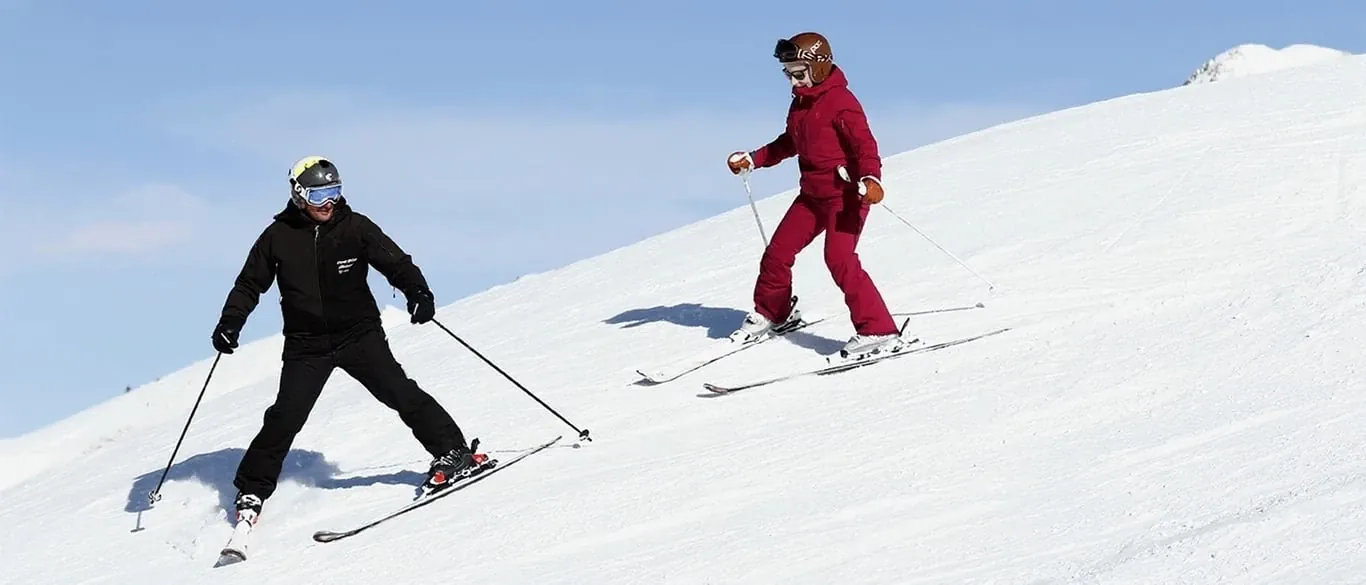
At C, the pupil can already stop in parallel, and that changes everything. To do it they combine three things at once. First, they set the skis across the fall line. Then they turn the sole of the outside foot slightly outwards inside the boot, which makes the inside edge of that ski bite. Finally, they apply just the right load: not so much that the edge locks, not so little that the ski runs away.
That parallel stop is not just another exercise. It is the proof that the skier trusts their outside support and manages the skid at will. From then on, the wedge stops being necessary on blues and easy reds, which is where a level C skier spends most of their time.
The step from elementary to refined parallel is the longest on the trunk, and the most misread. In refined parallel, the wedge does not disappear altogether. It stops being a fixed mechanism and becomes a resource. You use it, if you want, to get through a narrow passage or a particular pitch. You no longer need it.
Something similar happens with the pole, but the other way round: it does not disappear, it matures. It arrives in a second phase of C, almost always as an added movement you have to remember. At D it is refined and adjusted to the rhythm and the size of each turn. At the advanced level it stops being a movement and becomes an amplifier. It appears when the turn asks for it, it helps you anticipate and balance, and nobody would say the skier is thinking about it.
What is a genuinely intermediate ski level?
“Intermediate” usually covers everything from C to D. That is, everything between the first parallel and the parallel that already controls braking on any gradient. It is enormous territory, and that is why the word says so little.
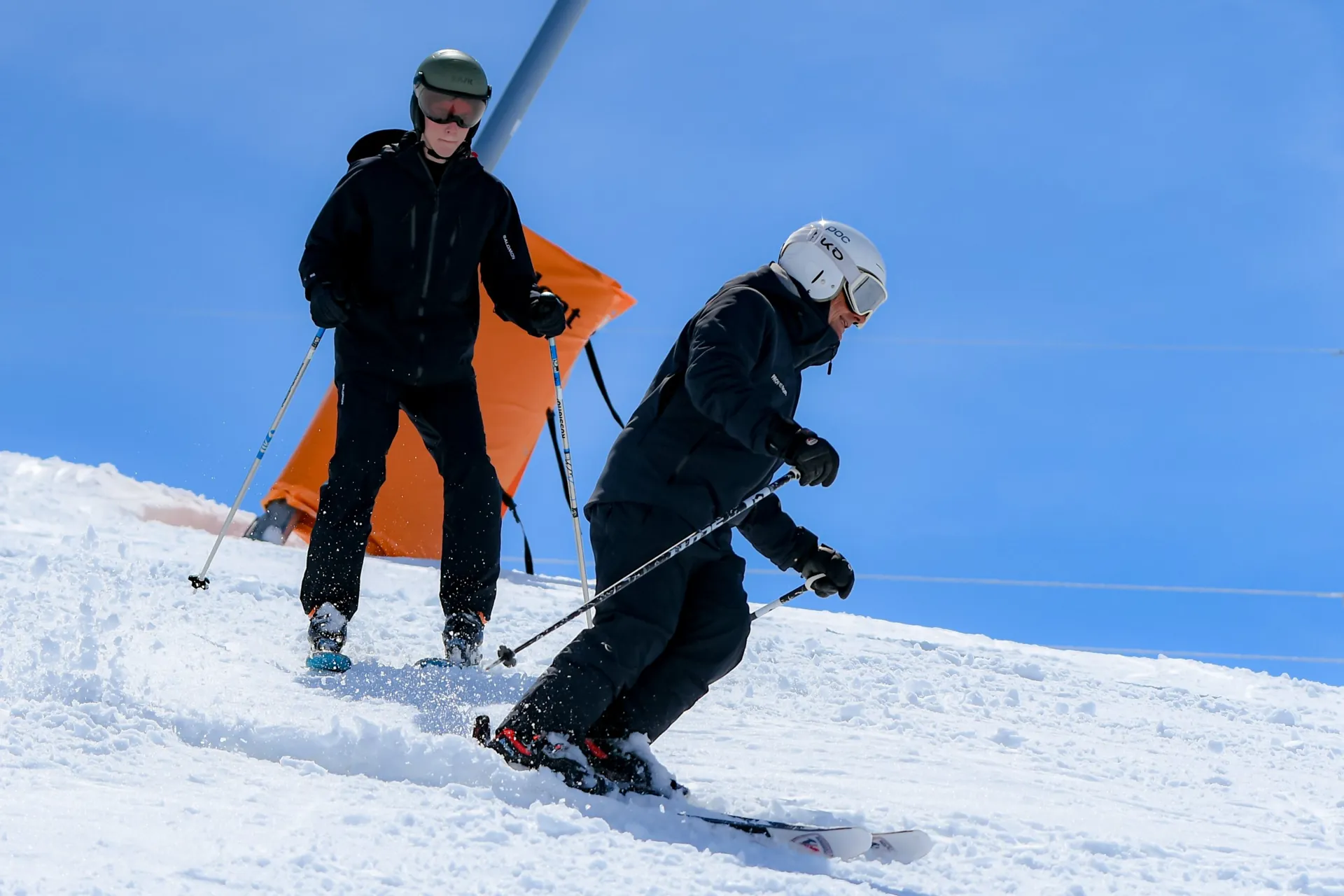
There is a simple test that separates them, and it shows even on a gentle run. Every turn creates a kind of invisible bump: as the curve starts you feel light and, as it finishes, loaded. The intermediate skier amplifies that bump with their up and down. They extend as they start, they sink as they close, and the curve pushes them around.
The advanced skier does the opposite. They flex exactly as the load arrives and absorb it. From outside it looks as if they are doing nothing. In fact, they are deciding how much force they let through from the snow into their body.
That is why two people can come down the same blue with similar turns and be at very different levels. The difference is not in the shape of the turn. It is in who is managing whom.
Carving or skidding: what really shows your ski level
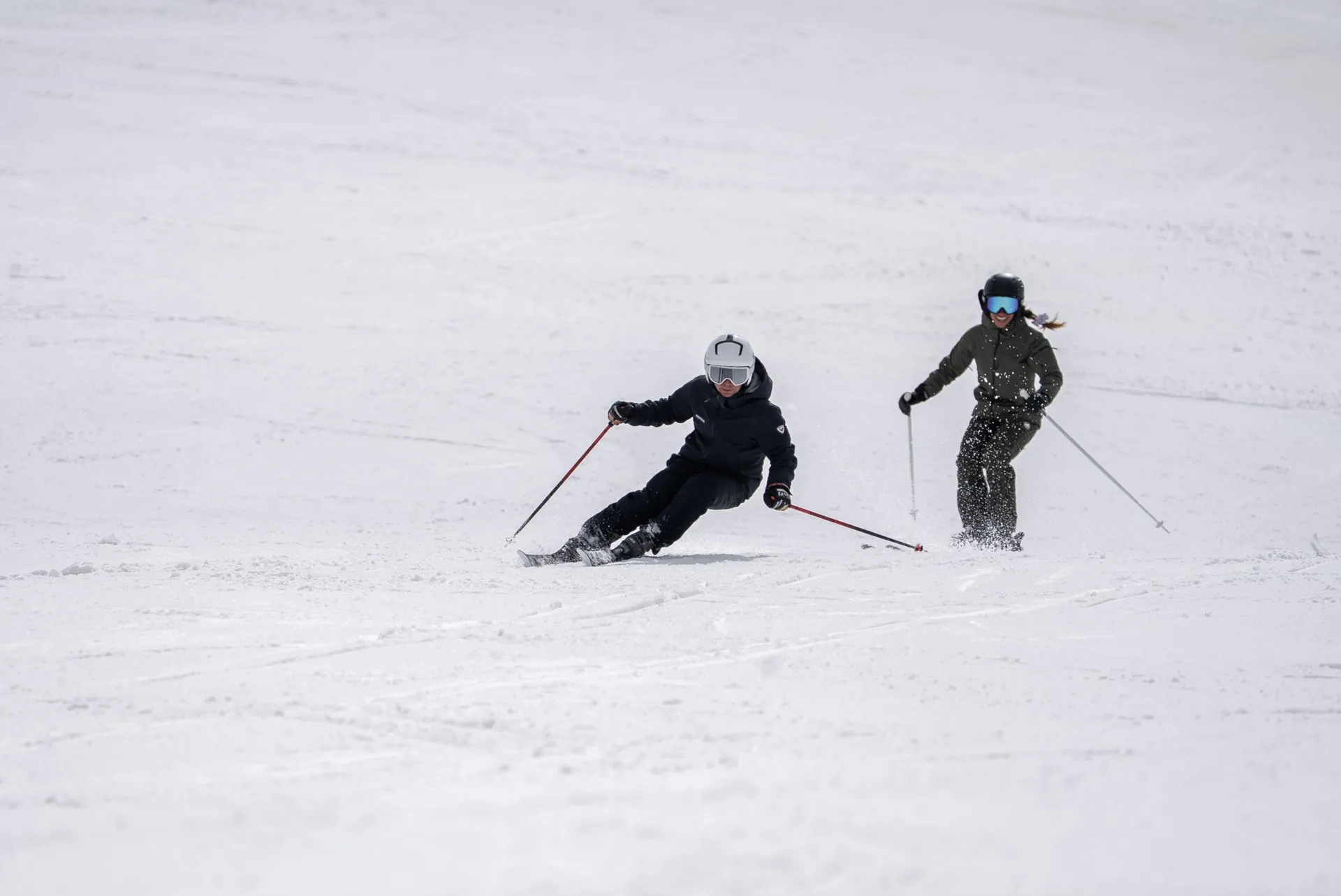
From parallel onwards, almost all of us measure our skiing by the track it leaves: the thinner the better. It is a comfortable trap. A modern ski almost carves by itself on a freshly groomed blue, and you can feel like the pilot when you are really a passenger.
The difference shows when the terrain stops cooperating. Ice first thing, heavy spring snow, a pitch that steepens without warning. There it is not the one who carves most who wins, but the one who chooses when to carve and when to let the ski skid. And above all how much and how: with the efficiency of someone who spends only the effort the turn needs.
That is why, for me, level is measured in decisions. Does your turn finish where you want it to, or where the ski takes you? Do you slow down because you decided to, or because you had no choice left? I went further into this idea in Cuando las palabras cambian la técnica, in Nevasport.
Ski level test: six questions to ask yourself on the snow
You do not need an exam to know where you are. A run you know well and six honest questions are enough. Ask them in order: your level is just before the first “no”.
In Baqueira there are two perfect runs for this: Pla de Baqueira and Mirador, right as you come off the gondola. Both combine steep walls, half-walls and flat sections in a single descent. So in one run down you can check how your skiing changes when the gradient changes. If you are still at B, look no further than Cabana: the test starts there.
- Can you stop in parallel wherever you decide, on a blue run? No wedge, without looking for a counter-slope, at the exact point you have chosen. If the answer is no, you are between A and B. If it is yes, you already have elementary parallel, level C.
- When the gradient bites, does the wedge appear by itself? If it comes back without being called, you are still at C: your parallel depends on the terrain. If it only appears when you choose it, to get through a particular passage, you have entered refined parallel.
- Can you make short and long turns on the same run, whenever you want? Not because the gradient forces you, but because you decide. Choosing the radius is the mark of level D.
- Do you control your speed without crossing the run from side to side? Long traverses are a way of slowing down without having to control the turn. A skier who commands parallel slows down inside the curve, with round turns, and leaves the width of the run free.
- Does your skiing respond the same on hard snow first thing as on pushed-around snow in the afternoon? If your technique works on one type of snow only, it is still a technique for ideal pistes. When it adapts without your having to think about it, you are at the advanced level.
- Can you come down a stretch of moguls or ungroomed snow without turning into a different skier? It does not have to look pretty, it has to still be you: same balance, same decisions. This is where the specialist branches begin.
How to read your answers. If you stopped at question 1 or 2, look for a lesson that consolidates parallel before moving up a run. If you got to 4 or 5, what you lack is not courage but resources: technique that works on any snow. And if you answered yes to all six, your next lesson is not about level, it is about a speciality.
One last piece of advice. Sensations deceive, above all those who ski alone. Ask someone to film thirty seconds of a descent. What feels to you like a clean turn is sometimes something else on video. That video is also the most useful thing you can send us when you book.
My child has ESF, Swiss or other medals: what level is that in Baqueira?
Every winter children arrive in Baqueira with a French Flocon, a Swiss Red King or an Italian level 4. Look their medal up in the equivalence table above: it will give you the starting letter for booking.
Use it as a guide, not as a verdict. A medal certifies what your child did on one particular day, at one particular resort. A week without skiing or different snow can change the result a great deal. That is why, in the first lesson, the instructor always checks on the snow.
What level do I need for adult group lessons in Baqueira?
None. There are groups from the very first day on skis up to the advanced level. What matters is not your level, but that the group looks like you.
And “looks like” does not only mean the same letter. Two level C skiers can need different terrain: one enjoys any blue, the other tenses up as soon as the run steepens. A good group is formed by terrain capability, not by technique alone.
That is why, in our group ski lessons for adults, the group is decided before you reach the snow. We start from what you tell us when booking and we check it on the snow during the first few minutes of the lesson. For a group to run we need at least three pupils of compatible level. If that number is not reached, we tell you in good time and look for the best alternative with you.
You can come on your own: you do not need to bring anyone. What you do need is to describe your level well, because that is what makes your group work from the first turn.
How to describe your ski level when booking a lesson in Baqueira
A label says little. Three concrete details say almost everything. When you book, tell us:
- Your letter or your level, from the table in this guide.
- Where you feel comfortable and where you freeze up. For example: “I come down the blues fine, but on Mirador I tense up on the wall”.
- A thirty-second video, from this season or the last.
| Instead of… | Write… |
|---|---|
| “Intermediate level” | “I ski parallel on blues, but on reds I go back to the wedge” |
| “Advanced level” | “I ski the whole resort, but on ice or moguls I lose control” |
| “My child already skis” | “My child is 8, turns in a wedge on Cabana and wants to try the blues” |
With that information we choose the instructor and prepare the lesson before you reach the snow. It is how a ski school in Baqueira Beret that would rather invest five minutes understanding you than lose an hour of your lesson finding out works.
Book your ski lesson in Baqueira for your level
Tell us your letter, where you feel comfortable and where you freeze up. If you have a video, better still. With that we propose the format and the instructor that suit you before you reach the snow. Write to us on WhatsApp and we will organise it.
Víctor Puche Fita — TD3, demonstrator for SAFE Formación, ski lecturer in the 4th year of the INEFC in Lleida and founder of Alpine Ski Academy, with 24 seasons teaching in Baqueira Beret.
Sources, consulted on 11/10/2026: SAFE Formación (TD1 teaching plan and TD2 alpine ski progression) · INEFC (descriptive scale of the alpine ski turn) · École du Ski Français (medal system and level tests) · Swiss Snowsports (Swiss Snow League levels) · FISI (technical manual of the Italian ski school, 2018) · Ski Association of Japan (grade tests and the Technical and Crown awards) · Whistler Blackcomb and PSIA-AASI (skier levels in North America) · Norwegian ski schools and the Deutscher Skiverband (public level descriptions and teaching plan).