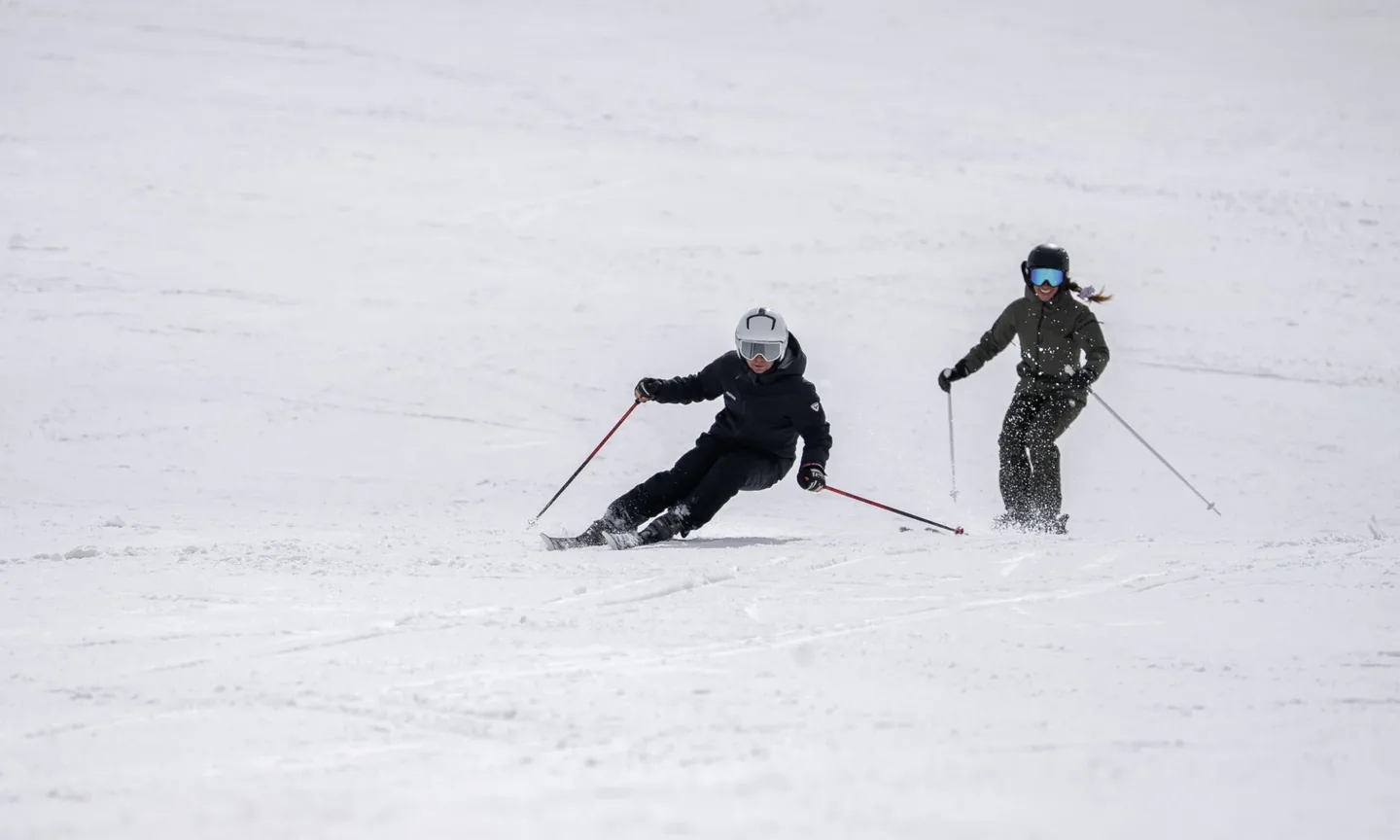
The advanced level in skiing does not arrive simply from having the parallel down comfortably. There are skiers who already do it well and still feel that something does not quite fit as soon as nobody is correcting them. That point, just after the technique has been consolidated, is where this stage begins.
It is not a question of daring to take on difficult terrain. It is understanding the technique well enough to know what you have to do in each situation, to read what the snow and the ski are telling you, and to have a real capacity for self-analysis: adapting your technique without anyone prompting you, turn by turn. It shows as much on a red run with uneven snow as on an easy blue: finesse and precision on simple terrain are advanced level too, not just the ability to survive difficulty.
In this guide we explain what exactly changes at this stage, how we train that autonomy in Baqueira, Beret and Bonaigua, and what separates an advanced skier from one who simply "is not scared any more".
Why do I feel stuck if I already ski well?
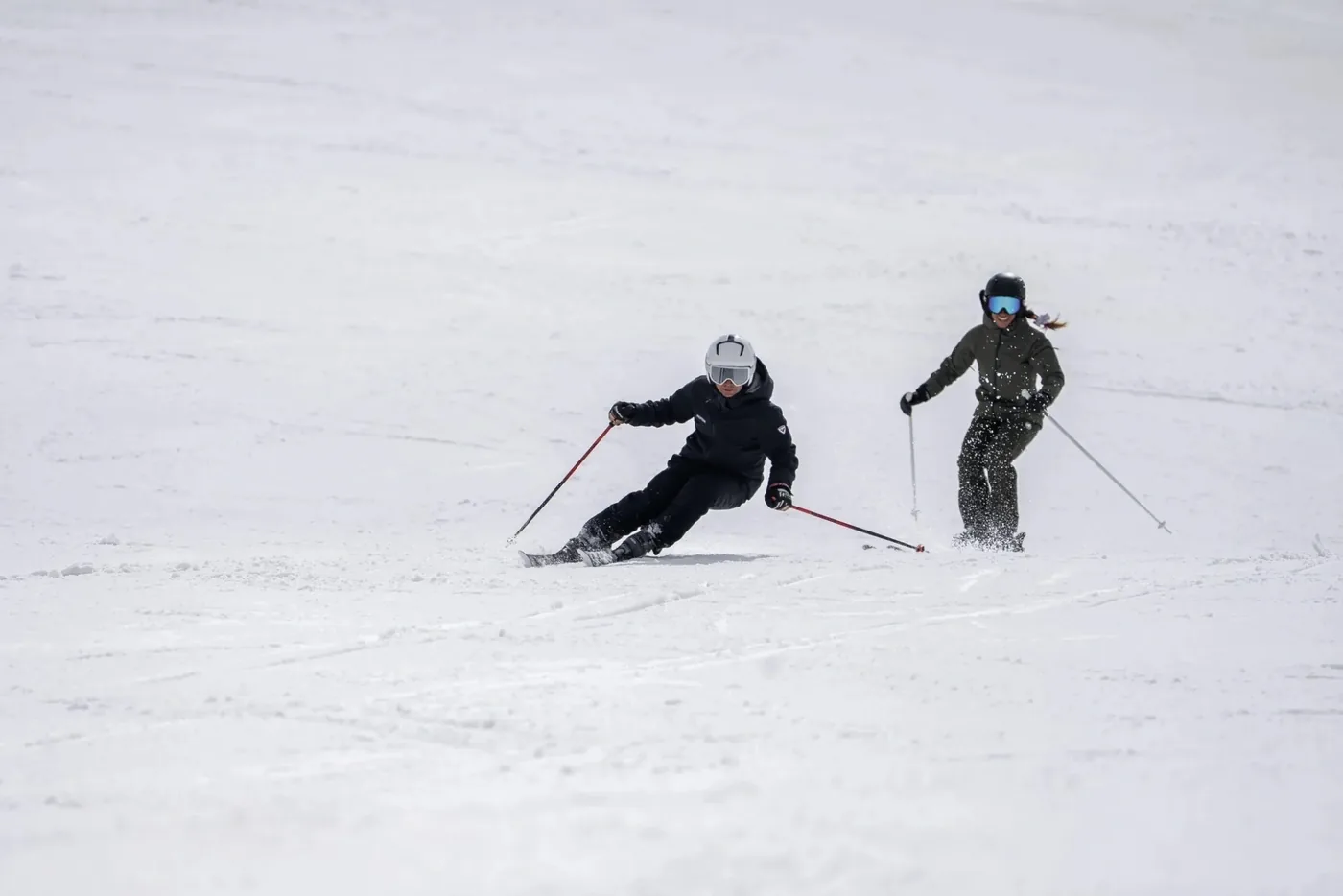
It is the most common complaint we hear at this stage: "I already ski well, I ski red runs without a problem —and blacks in every kind of snow and condition— but I do not feel I am improving". The block is often not physical — it is that the skier still depends on external references to correct themselves. While someone is telling them what to do, it works. Alone, they are lost.
This is the moment when many adults decide they have "reached their ceiling" and stop taking lessons — when in fact it is exactly the opposite: it is the stage where the difference between skiing with an instructor and skiing without one shows most, because until now that difference was masked by the learning curve itself.
The second block is misdirected demand: looking for ever more difficult terrain without first consolidating fine, precise reading and execution on easy terrain. A skier who forces black runs without yet mastering precision on a blue is not progressing in autonomy — they are accumulating risk without building the base of quality knowledge and self-analysis that really defines the advanced level. That is exactly where our private ski lessons for adults come in: a real diagnosis before exposing you to terrain that is not yet yours.
How is real autonomy trained at the advanced level?
It is not trained by repeating the same run until you have memorised it — that is motor memory of a line, not autonomy. At Alpine we work on three things at once to build that "quality knowledge":
Reading the terrain before skiing it
Before setting off, the student describes what they see: where the gradient changes, where the snow may be harder or more transformed, where they would drop in. We work through how to approach each specific situation — a patch of ice, transformed snow, the change in snow type on entering off-piste, how the wind affects surface friction — and how to readapt the postural pattern and the technical action to each change, recognising it in advance instead of reacting late. The instructor first helps to spot it, then proposes, then lets the student interpret, and from there solutions are worked out together. The goal is not for the student to learn one set answer per situation, but to learn to identify what is changing and decide what to modify.
Self-analysis after every run, backed by video and data
We ask the student to say what they felt before the instructor says anything — where they noticed the support going, where they had to skid instead of carve. That prior verbalising is what trains the self-analysis. We back it with video analysis, which confirms what was said against a moving image of themselves, and even compares it with selected demonstrators' video, so the difference is clear. When the student works with Carv, the empirical data is one more support. The data or the image does not replace the sensation: it serves to check it, put it in context and understand better what is happening.
Progressive exposure, sought out or taken as it comes
Sometimes varied terrain simply appears as we ski, and we take it in the moment; other times we go looking for it on purpose because a particular situation deserves it. In both cases one variable is isolated at a time —only snow, only gradient, only visibility— so the student understands what they are adjusting in their technique and why.
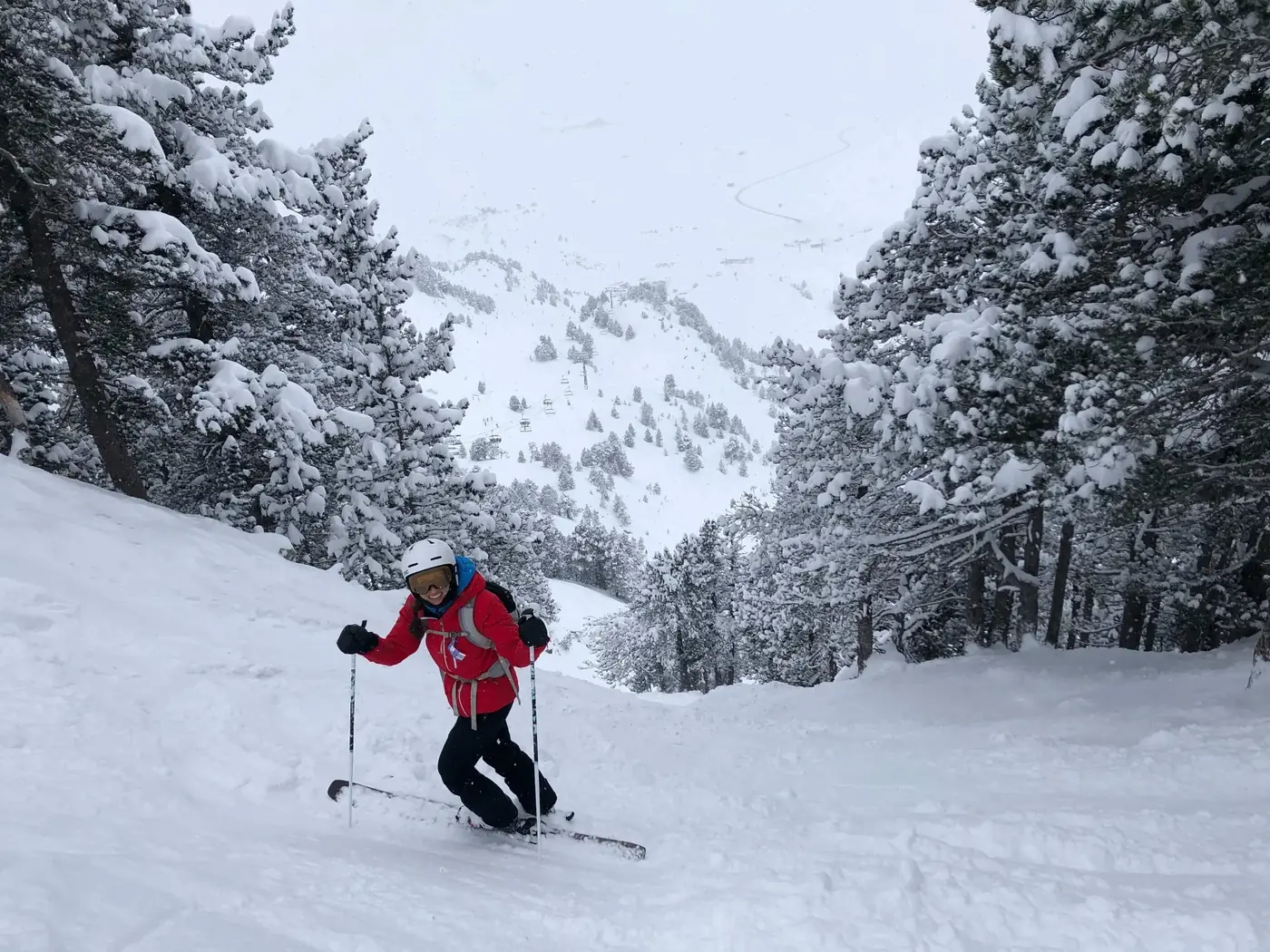
In Baqueira we use the whole mountain for this stage — every corner teaches something different, and that is exactly the point.
What is an advanced skier, really?
Balance in skiing is never a posture you reach and then hold. It is a continuous response to forces that never stop changing: the gradient, the snow, the speed, the turn itself.
A beginner
Looks for a stable position and clings to it.
An advanced skier
Continuously seeks balance inside a state of imbalance that keeps changing.
That is what really changes at this stage. Rotation, angulation, the edge change, the transfer of support and many other technical resources stop appearing as independent actions and become part of one continuous movement in which everything is related.
But that movement does not always follow the same sequence either. A sequence that on paper counts as technically efficient can be modified, even minimally, if the skier understands that the small variation may produce a better effect for that particular situation. Technique then stops being a recipe to repeat and becomes a tool to adapt.
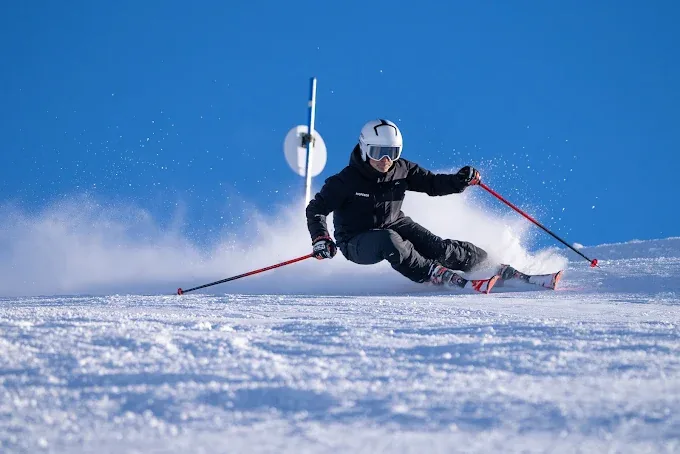
And there is something deeper. The advanced level is recognised not only by what the skier does, but by what they understand. The technical structures we learned through repetition have a purpose: to build precision, create references and get certain movements to the point where they run without conscious thought.
But a moment comes when the skier understands those structures well enough to stop being limited by them. They can keep them when they are the most efficient answer, but also modify them, combine them or even alter them slightly when the situation calls for it.
They no longer confuse the effect with the cause. They do not necessarily read a given position as the origin of the movement just because it is what we see at the end of the action. Good equipment helps, and it shows in the result as much as in the feel, but it is not what explains a clean carved turn on its own. The result emerges from the interaction between edging, pressure, ski orientation, body movement and the forces generated through the turn.
An advanced skier is not only able to execute and to feel. They are also able to pre-organise and anticipate. Before the terrain has even finished demanding a response, they are already preparing the next one, adapting their movement to what is coming and not only reacting to what has just happened.
And there another important difference appears: efficiency no longer depends on reproducing a given technique. The skier with real level uses the resources available, combines them and adapts them to the conditions. They are not trying to reproduce a shape, but to get the effect they need with as little interference as possible. Because having level does not only mean performing the movement better: it means understanding it, knowing what effect it produces and when it is worth modifying.
How real progress towards the advanced level shows
Javier and the short turn at Saumet
Javier wanted to improve his short turn. We spent a 2.5-hour session on that alone, on the Paum run, off the Saumet drag lift: a red wall that finishes on the flat and which, in that day's conditions, let us do many runs back to back, on very good groomed snow and with perfect light to work in. Choosing the terrain well is part of an advanced lesson too: knowing the mountain thoroughly means you can find, at any moment, the gradient, the snow, the space and the conditions that best suit the technical goal.
We began with two or three concrete pointers on the movement and filmed his run. Then it was Javier who explained first what he had felt, before I said anything. We went through the video together: what was happening, what was not working and what he should watch for on the next lap. We rode up, one single pointer focused on what we had just analysed, and another filmed run. We talked again about the sensations, what had changed and why. At that point I also showed him video of a demonstrator performing the same turn with the movement perfectly resolved, so he could relate it to his own image. Two more runs following the same structure.
The support, the orientation of the trunk, the rhythm and the execution of the movement all improved clearly. Not from doing more repetitions, but from understanding better what he was doing and checking immediately what effect it produced. Javier still wants to move forward, as everyone does, but in two and a half hours we got a clear, verifiable change — and above all, he started to have more tools to work out for himself what he was doing and how to modify it.
The sequence is simple, but it is precisely the one we are after at this stage:
- Feel
- Say it
- Video
- Compare
- Understand
- Try
- Feel again
- Adjust
Alpine's recommendation for this stage
If you feel you already ski well but have stopped improving, we do not start by putting you on harder terrain — we teach you to read yourself before anyone corrects you. That capacity for self-analysis is what separates the skier who progresses from the one who only accumulates hours. In Baqueira we work on it with chosen exposure, not random: one variable at a time, backed by video analysis and, if you use it, Carv data.
At this stage, my recommendation is to look for an instructor with solid technical training and enough experience to analyse and adapt technique beyond the basic patterns. If you are going to ask for this kind of lesson at a school, ask who will be teaching it and what experience they have with skiers at this level. If you are looking for the best ski school in Baqueira Beret for this kind of goal, rather than looking only at the school's name, it is worth checking who your instructor will be, what training they have and what experience they have accumulated with advanced skiers.
Is advanced level on-piste the same as being ready for off-piste?
Yes, ready you are — but the advanced level on-piste gives you the base, it does not cover everything: off-piste demands complementary skills of its own (reading ungroomed snow, orientation, risk management) that are worked on separately. From here there are two possible paths: making the jump to freeride in Baqueira, or carrying on refining on-piste with private lessons and Carv technology to measure your own data —how much edge angle you are really generating, and with what symmetry— instead of trusting the sensation alone.
Book your advanced-level lesson in Baqueira
If you already ski well but feel you have stopped improving, perhaps you do not simply need more hours on the slope — you need to learn to read yourself. At Alpine we train that autonomy with a real diagnosis, video analysis and chosen exposure to terrain, across the whole mountain.
Víctor Puche Fita — TD3, SAFE Formación demonstrator, founder of Alpine Ski Academy.