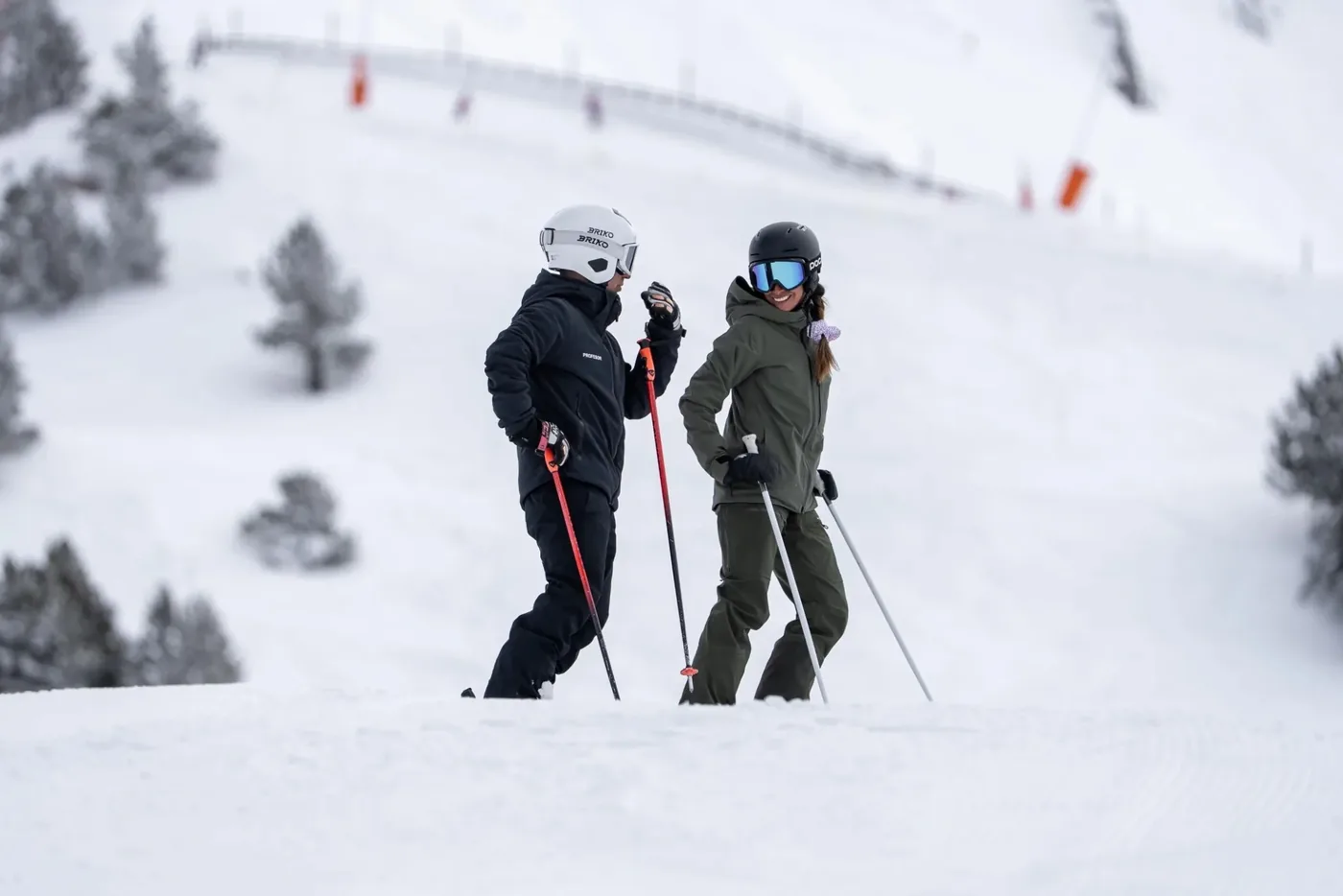
You have several seasons of skiing in Baqueira behind you and you want to make the jump from intermediate to expert, but you are not quite sure where to start. You no longer fall on blue runs, you link turns easily and you left the wedge behind a long time ago. And yet, when you watch someone come down a red with precision, you know there is something that still escapes you.
It is the most common block for the intermediate skier: they are not short of nerve or hours on the slope, they are short of precision. Making the jump from intermediate to expert does not depend on skiing more holiday days, but on understanding exactly which technical movement to apply at each moment, how to approach it, which sensation to look for and how to refine that sensation — and, above all, which decision to make and how to adapt it to each situation, because no run and no snow ever repeat exactly the same conditions.
In Baqueira we see it every season: students with years of skiing behind them who stall at the same point because nobody has shown them, with data and concrete exercises, exactly what they have to correct — something we work on thoroughly in our private lessons for adults.
The intermediate skier is not usually afraid of the slope — they are "afraid" of stalling, though it is not fear in the literal sense: it is more the wish not to stay stuck at the same point forever. They have internalised their way of skiing so deeply that any attempt to change it comes out worse at first, and that sends them straight back to what they already command. It is a quiet trap: the more comfortable they feel at their current level, the fewer reasons they find to force the change that would move them on.
On top of that there is a deeper problem: nobody has explained what to look at. They know expert skiers do "something" differently — the stance, the speed, the cleanliness of the turn — but they cannot identify the specific movement that makes the difference, let alone how to train it. Without that precise diagnosis, any attempt at improvement becomes trial and error with no clear direction.
The outcome is predictable: season after season skiing the same terrain, with the same sensation, without a clear signal of what to change.
How the movement that makes the difference is trained
The jump is not set by the number of days skied, but by the precision of what is trained — and of how it is understood. An intermediate skier can pile up whole seasons repeating the same pattern without ever correcting it, because nobody pointed out the exact movement or gave them a concrete task to work on it.
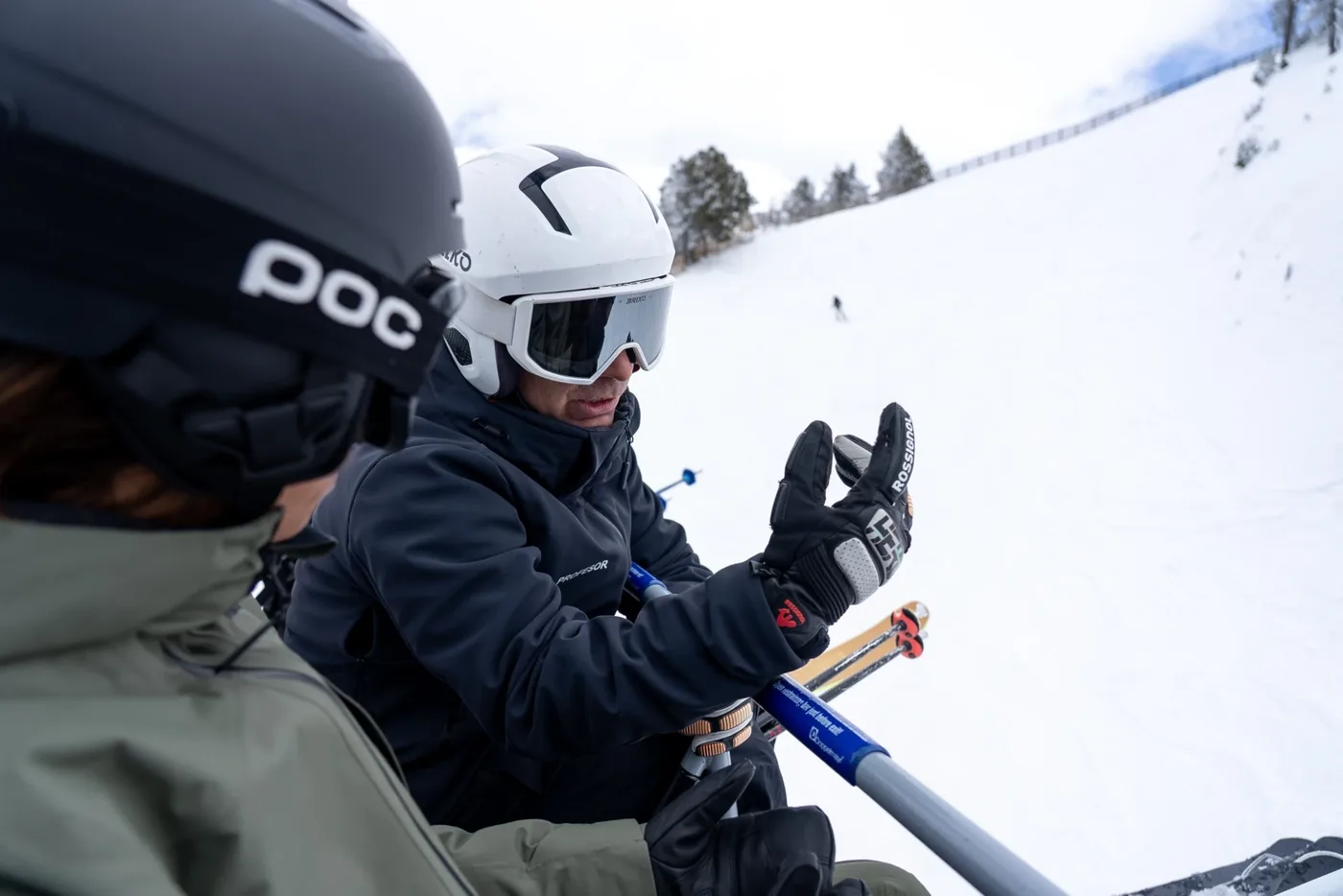
The first thing we do at Alpine Ski Academy, ski school in Baqueira Beret, is diagnose where the student really is technically: which plane of action they command and which they do not yet, which postural pattern they hold under pressure and which they lose as soon as the terrain or the speed changes, and which specific mechanical element they execute precisely, which they execute clumsily, or which they leave out altogether. From there it is not about "skiing more", but about practising consciously, with variation, focused on exactly that point, with specific rather than generic exercises: understanding what the student can already do, and teaching them to observe and decide for themselves.
One exercise, not more hours
A biomechanics study from the University of Salzburg compared an intermediate skier with an expert, measuring how each applied force to the ski through the turn. With no specific exercise, their patterns were practically opposite.
With a single targeted exercise —a one-sided hip hold that forces the balance to reorganise— the intermediate's pattern came to look a great deal like the expert's.
No extra hours on the slope were needed: the right task was.
TD3 Instructor
The most common mistake of the intermediate is training on autopilot — going down the same run as always feeling that they are "practising", when in fact they are only repeating. Improvement does not come from repeating: it comes from applying one concrete improvement, with intent, to something very specific.
The second key element is where you direct your attention while you practise. The research on motor learning is consistent on this: when the skier's attention goes to the effect of their movement —what happens to the snow, where the ski goes— the learning is more solid and holds better than when it goes to consciously controlling a part of their own body. That is why in Baqueira we avoid instructions built around "put your hand here" or "flex like this" as an end in themselves, and work with cues that direct attention to the result of the movement on the snow.
With the right diagnosis and the right task, the skier not only executes the technical movement better, but consciously widens and improves their understanding of their own movement — and in an adult, that conscious understanding is the key piece, far more than in a child, who learns above all by imitation. They start deciding with more judgement: how to adapt the centre of mass to the variations in pressure imposed by the relief and its gradient, the visibility, the type of snow or the speed — when to carve and when to let the ski skid, when to push and when to hold back. That ability to regulate the decision in real time, adapted to each situation, is what really marks out an expert.
What changes in a single well-focused session
Pep, half a season stalled
Pep had spent half a season stalled with his Carv, unable to improve his metrics despite skiing regularly. The problem was neither physical nor one of general level: it was a very specific error of understanding. He was generating a sustained inclination right through the turn, looking to feel the edges more sharply and the body closer to the snow, but without correctly applying the moment at which the angulation had to start being built.
In one session we filmed his skiing to pin down exactly what was stopping him progressing. Once we had identified the precise moment of the turn where the movement failed, we worked on conscious angulation exercises in each phase of the curve —not angulation as a fixed posture, but as a response built at the right moment. The goal: to close his carved turns more, with everything that brings — better support at the end of the curve, better projection into the start of the next one and more capacity to tighten the turn radius.
TD3 Instructor
In that same two-hour session, his Carv IQ went up 5 points. Here we did not do fine work on the execution and precision of a movement he already knew — it was understanding what he was missing and starting to apply it. That understanding alone translated directly into measurable data.
This is what we are after in every refinement lesson: not a generic improvement, but a verifiable change in the exact movement that was holding the student back.
My recommendation as an instructor
In 24 seasons in Baqueira, the advice I always give is the same: if you notice you have spent more than a season skiing the same way, do not look for more days on the slope — look for someone who will tell you exactly what to look at. That single change of focus is what makes the difference between staying stuck and making the jump.
How many lessons do I need to feel the jump to expert?
There is no single figure, and anyone who gives you one without watching you ski is lying to you. What is constant: the change is not measured in holiday days, but in sessions well focused on the right movement. Some students notice a measurable improvement in a single two-hour session —as in Pep's case—; others need several sessions spread across the season to consolidate the change, especially if the movement to correct has been automated for years. The real pace is set by each person, not by a generic number.
What part does Carv play in this process?
Carv measures precisely how you execute each turn —pressure, edging, symmetry between skis— which turns a subjective sensation ("I think I do it right now") into an objective figure. It does not replace the instructor's eye, but it speeds up the diagnosis: instead of guessing where the movement fails, we see it measured, turn by turn, and can aim the practice exactly there.
Make the jump with someone who can see it
If you have spent seasons skiing the same way, you do not need more days on the slope — you need someone to tell you exactly what to look at. Tell us your level and we will work together on the movement that is holding you back.
Get in touch on WhatsAppSee our prices and rates
Víctor Puche Fita — Technical Director TD3, SAFE Formación demonstrator, founder of Alpine Ski Academy.