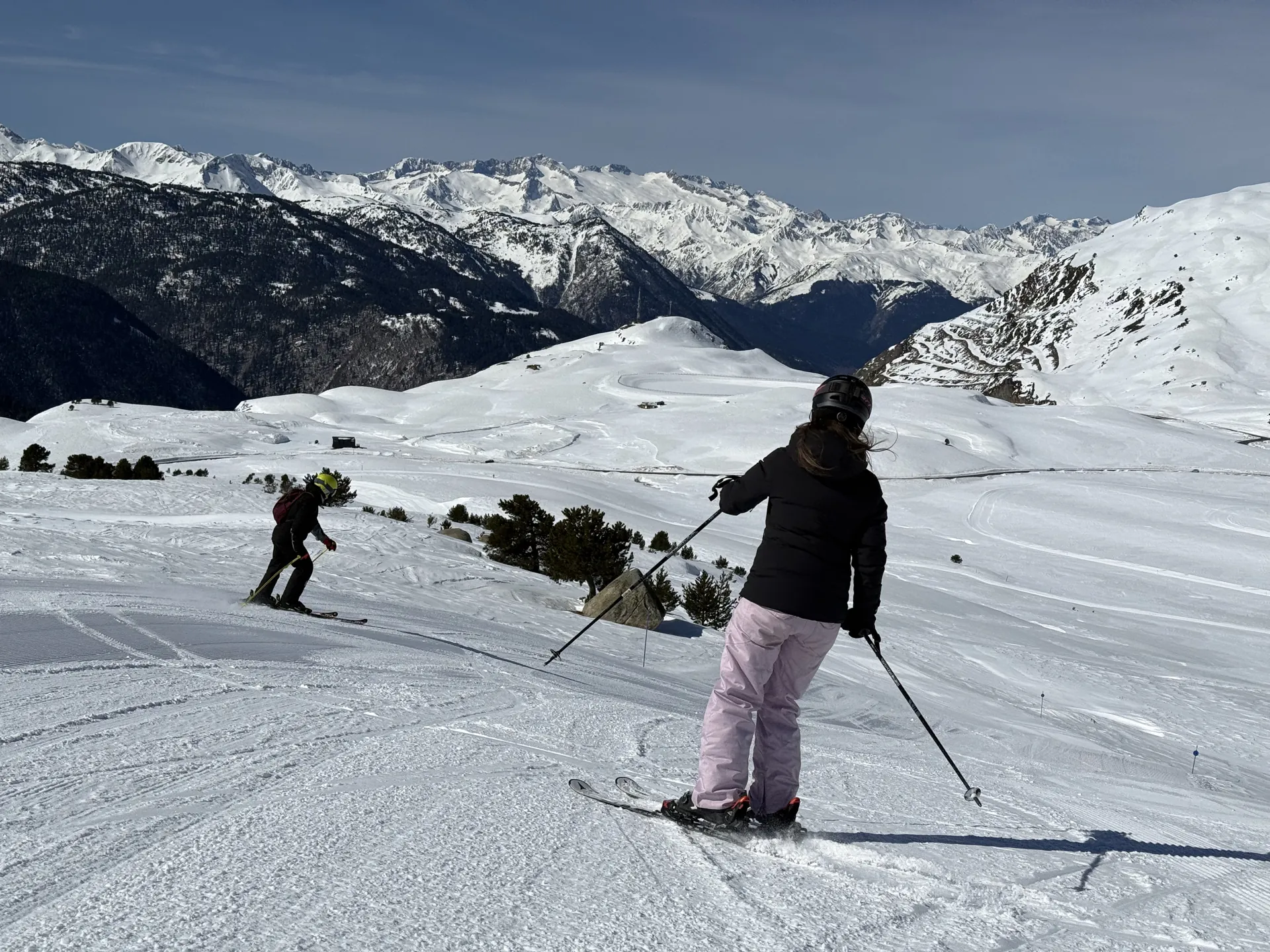
Being afraid on the snow is not only a beginner's thing. In 24 seasons teaching in Baqueira we see it at every level. It happens to someone putting boots on for the first time and to someone who comes down blues comfortably but freezes on a red.
What changes is the moment it appears. Some are scared of the chairlift, others of speed, ice or fog. Others are coming back from an injury and do not trust their knee. And many feel the eyes of a partner or friends who ski better.
Here we go through those fears one by one, and then the tools we use to work on them in lessons. It is not about stripping the fear out of you by force of will, but about giving you the resources to turn it into respect.
Why do you freeze up skiing even when you know how?
The body does not tell a real danger from an imagined one. When the head sees a threat, the body protects itself. It leans back or into the hill, stiffens the legs, loads the inside ski and turns abruptly.
Those are exactly the movements that make the ski accelerate and that wipe out the feeling of control. Fear produces worse technique, and worse technique produces more fear.
So fear ends up producing technical errors: weight back, rotation into the curve, the abrupt turn. But many of those “errors” are natural reactions or a lack of knowledge. That is why we do not teach by correcting faults, but by giving new skills. When the skill arrives, the error disappears on its own.
It is the first thing we do in our private ski lessons for adults: work out exactly what is freezing you. Only then do we choose the terrain and the task that give you back control.
It is not a rare problem. The Fear Project, a British study, asked 225 women skiers. 62 % said fear or anxiety affected their experience on the snow. The most cited fear was getting injured, or injured again.
First day on skis: fear of falling and of looking foolish
If it is your first time, the most common fears are falling, hurting yourself and looking foolish in front of people who ski well. We cover them in detail in our guide to how to learn to ski in Baqueira from scratch.
Learning to ski as an adult: starting at 40, 50 or 60
Starting late is not a problem of ability, but of pace. We plan the progression gradually, with sessions measured to your fitness and breaks so that tiredness does not wreck your posture.
What helps an adult most is understanding why they are doing each exercise. Once they grasp the movement and see that it works, confidence grows faster than technique.
Fear of the chairlift and the lifts: getting on and off without falling
Fear of the chairlift is one of the most common among people starting out. For many, the tensest moment of the day is not the piste: it is getting on and off, or staying upright on a drag lift.
The key is the loading and unloading. You arrive with your skis parallel, without opening them into a wedge, and with the instructor sitting beside you. They tell you when to stand up and go with you for the first few metres.
That presence alongside you changes everything: if something goes wrong, there is someone who can help you right then. And another common worry disappears, which lift to take or how not to get lost, because the instructor takes you along the route that suits your level.
Vertigo on the chairlift: what to do about the fear of heights
Pulling the safety bar down as soon as the chairlift allows already gives a sense of protection. During the ride, talking to the instructor or planning the next descent together stops you fixing on the drop.
Fears on the piste: speed, gradient, ice and people
Fear of speed: controlling it without braking at every turn
Fear of speed is almost never a fear of going fast. It is the fear of not being able to stop, or of losing control at that speed. It is not solved by braking more, but by controlling speed with the shape of the turn.
A tighter radius reduces it and a more open one lets it run. At each speed we adapt the stiffness of the legs, which act as dampers without locking, the position, the anticipation and a progressive build of the movement. And you learn to pick the moment: we let the skis run on sections with good visibility, a steady gradient, few people and a clear exit.
How to slow down as you face the fall line
When the skis point downhill, the body reacts defensively, leans back and the ski accelerates just when you need control most. We work on it with a progression in difficulty and in execution, step by step, with the wedge christie to lean on when needed. We improve both the technique, how you execute the turn, and the tactics, where you decide to make it.
Fear of red and black runs
Fear of red runs is almost never a lack of technique: it is what you see. From the top, the head adds up all the drop that is left and turns it into a threat. On a black you add the snow, the speed and sometimes the visibility.
The edges of the piste, exposed sections or trees close to the line all add pressure, which is why we choose lines with room. The tools you will see below are designed, above all, for this moment.
Narrow sections and tracks: getting down them without freezing
In a narrow section there is no space left for a wide turn. The wedge christie gives control at the start of each turn without having to accelerate.
Skiing on ice or hard snow without losing grip
Fear of ice comes from the feeling that the ski is not responding. On hard snow we open the feet a little wider, which helps balance and the feeling of grip through each turn.
Crests, moguls and changes of terrain: how to see them coming
What you cannot see is more frightening. When the instructor goes down ahead, you see where they pass and how their body reacts to the terrain. That way you anticipate the crest or the transition and get ready before you reach it.
Skiing around people: crossings, merges and fast skiers
On the busy slopes of Baqueira, often it is not the gradient that frightens, but other people. Someone passing fast and close, a crossing or a merge onto another run tighten the body and throw off the next turn. Without realising it, you ski watching what is coming from behind instead of your own line. The answer is tactical, and you will find it in the instructor section.
Stuck on a run above your level: what to do
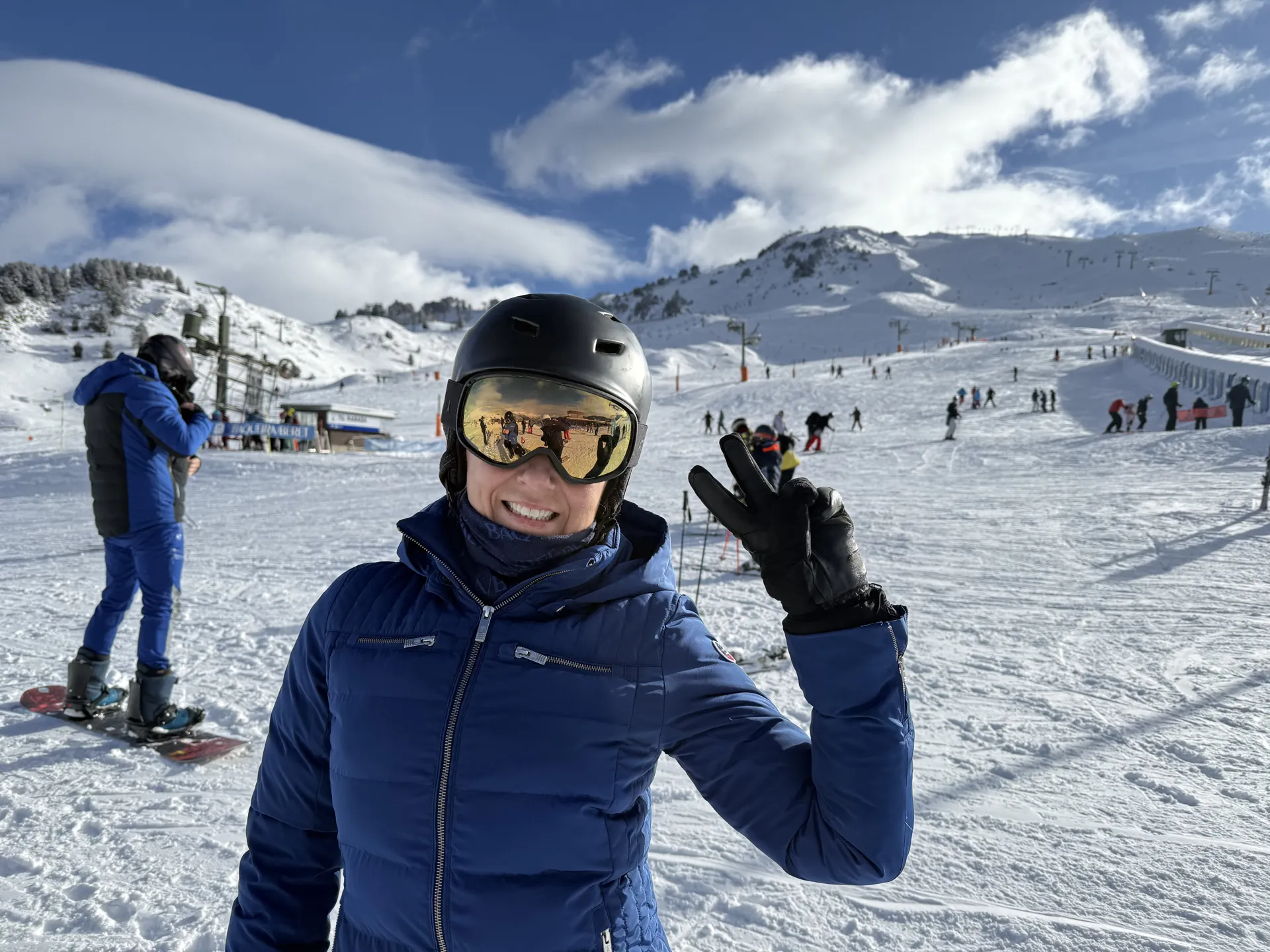
Stop at the side where you can be seen, never in the middle of the run. Breathe, look only at the 2-3 metres where you are going to turn and think of one simple task, such as finding the outside ski early. If the grip is poor, a wedge christie gives you control at the start of the turn.
With an instructor this situation should not arise, because they pick the challenge you can meet that day. If you are on your own and cannot carry on, ask the resort's piste staff for help.
Fear of getting hurt: falls, recovery and coming back to the snow
Fear of falling is the most universal one, and it weighs more once you have already been hurt. Coming back, the knee may have recovered, but confidence takes longer.
How to get up after a fall on skis
Staying on the ground in the middle of a pitch, or in front of other people, is a very common fear. That is why we teach how to get up in different snows and gradients.
Put the skis across the slope and below your body. With your hands in front of your knees, push yourself up onto them. If the skill is not there yet, or your fitness makes it hard, the instructor physically helps you up.
If you lose a ski in the fall, stay at the side and recover it calmly, without crossing the run. Set it across the slope so it cannot escape and step into it from the downhill side. If you cannot recover it safely, ask for help.
Going back to skiing after an injury or after many years
Coming back to skiing after a knee injury calls for gradualness. We recommend doing it with the go-ahead from your doctor or physiotherapist. We start on runs that do not demand much of the body, and the level only goes up when confidence allows it.
The instructor acts as a guide: they choose the runs and set the line through the kindest terrain. You see where they pass and how the terrain reacts, so you anticipate each section and avoid surprises.
The same goes for anyone coming back after many years. Technique returns sooner than you expect, but it is worth finding it again on easy terrain before chasing the level you used to have.
That is how we did it with Elena, who was coming back from a knee injury. We started on a green to pick the feel up again, going over posture and the mechanics of the turn. We soon moved on to three or four easy blues, on a relaxed day out.
Meanwhile, we watched whether fear was making her overload the good leg, or whether she was sharing the support well through each turn. And we kept advising her. In two days she was skiing just as she had before the injury.
Fear of what others think: a partner, friends or children who ski better
There is one fear that has nothing to do with the snow. It is skiing with a partner, friends or children who do it better than you. The comparison weighs more than the gradient, and the freeze arrives even when nobody says a word.
On top of that comes the fear of holding the group up, or of looking timid for choosing an easier run. Choosing carefully is not a lack of level: it is judgement.
In a lesson that weight disappears. The instructor does not compare you with anyone: they look at your skiing, your goal and your pace. Once you gain confidence on your own terms, skiing with your people stops being a test and goes back to being a plan.
That is what happened to Alejandro and Montse. She started with private lessons at her own pace and, two seasons later, they ski together and even take lessons as a pair.
Where to look when you ski: the next turn, not the whole run
Every fear has its moment, but the tools for working on it are almost always the same. The five that follow work on the chairlift, on a red, on ice or in fog. The first is the most powerful: where you put your eyes.
Look at the ground, 2-3 metres ahead of your ski tips, exactly where you are going to turn. That patch of snow is never as steep as the 150 metres of drop you have left.
By narrowing the field of view, the gradient flattens. The perspective that frightens disappears and a small, achievable task appears: turn here, now. That task occupies the head and shuts out the thoughts that block the movement.
It is learned at low speed, even one turn at a time, with the instructor positioned just below the planned curve as a backstop. It works just as well for a frightened beginner as on a difficult run.
To that gaze we add a simple task the pupil can already do. For example, shifting the weight smoothly using an easy reference: dropping the outside hand. We also train it on steep walls even when there is no freeze, to prepare for future moments of stress.
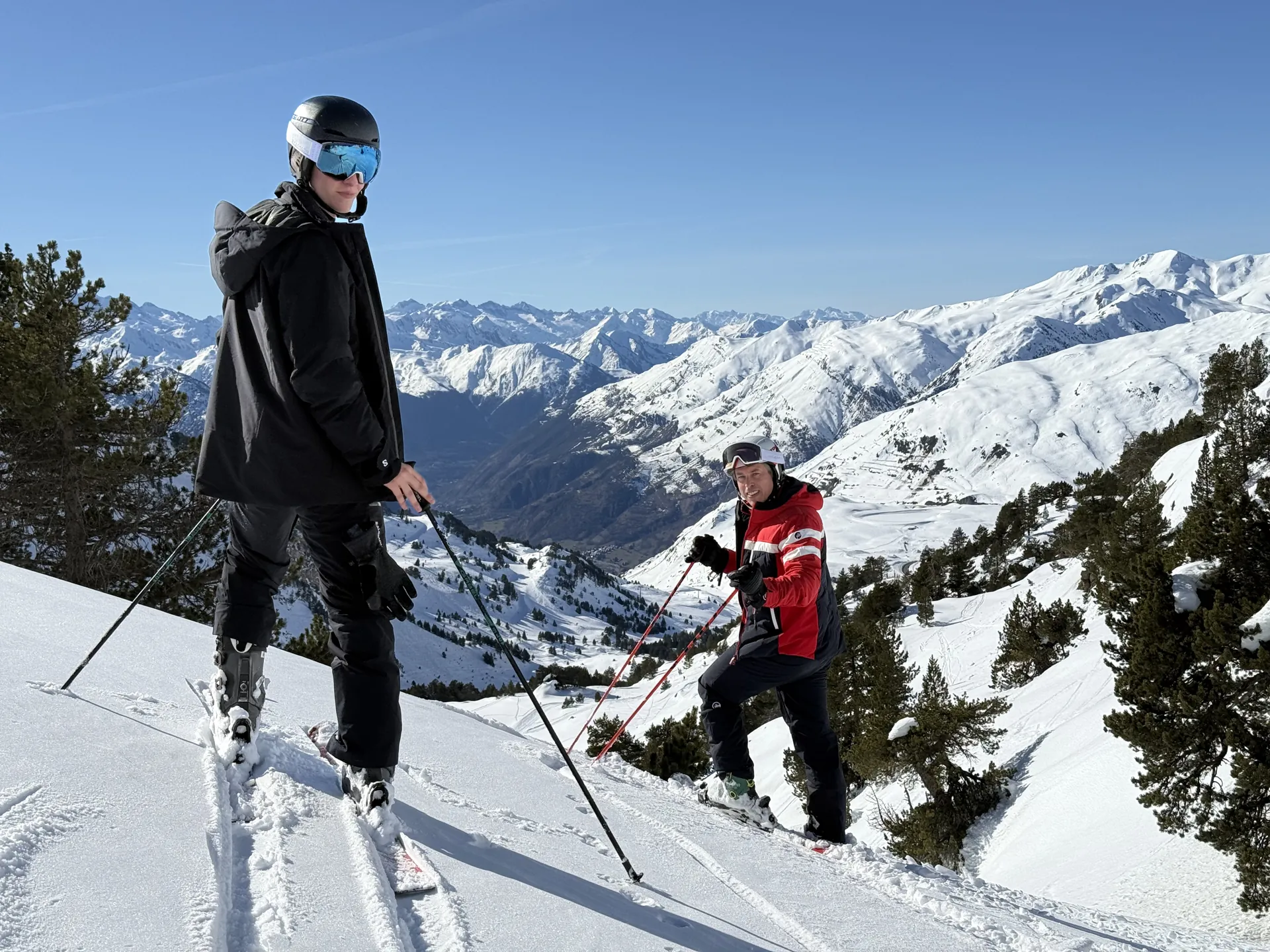
One of the places where we work on it most is the wall on the Gallina run, in Saumet, before crossing towards Baciver. We use it with refined-parallel skiers who tense up in front of a gradient. It is steep but short, finished in about five turns, and it lets you rehearse in the right setting. It works best once the snow grips well or is starting to transform slightly.
The outside ski: the foundation of feeling safe
If the gaze gives the head a task, the outside ski gives the body a base. Confidence rests, literally, on the outside foot of the turn. That is why we work on it and make it automatic on every kind of run: green, blue, red and black.
When we work on the feel, we want the pupil to notice the inside of the outside foot, from the ball of the big toe to the heel. From the shoulder and straight down, the weight of the body settles over the hip and then onto that base in the foot.
We build it from the ground up, from the sole of the foot to the hip, the shoulders and the head, with exercises, video and conversation. It is the opposite of what fear asks for. Fear pushes you into the hill and onto the inside ski; the outside ski gives control back.
Ski posture according to the snow, the gradient and the speed
On that base, the posture adjusts. There is no single posture for the whole resort: every snow, every gradient, every speed and every visibility condition asks for a slight readjustment.
Knowing how to make that adjustment, or having an instructor who points it out and explains it, changes a great deal. The movements come out more efficient and the feeling of control is far more pleasant.
Rhythm and timing of the turn on steep pitches
On a black we adapt both the rhythm of travel and the rhythm of the movement itself. Over-rotation, leaning on the inside ski and abruptness are punished far more than on a blue.
So we refine the movement until that adaptation gives the right result on the gradient. Always when the person is ready for that terrain, never before.
The wedge christie: a safety resource, not a step backwards
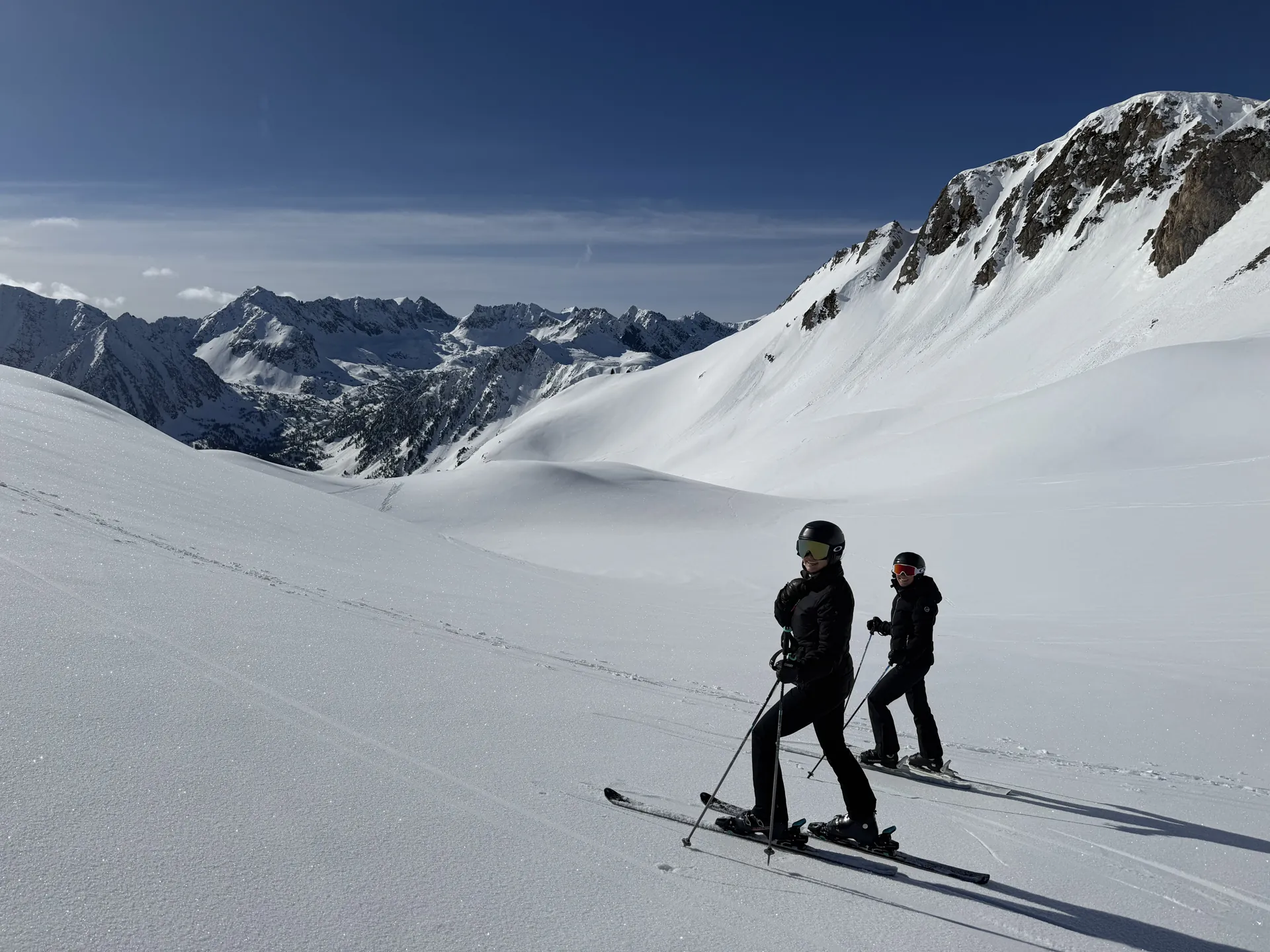
When the terrain still bites, there is one resource many people avoid out of pride. Opening the skis on a red looks like going backwards, and it is not: the wedge christie is a tool for gaining extra security when you need it.
We use it in moments of freezing, on sections where we do not want to accelerate and when the grip is unkind. Also with pupils who freeze in narrow sections, on steep pitches or off-piste.
The opening is made at the start of the turn, before facing the gradient. It settles the new support and reduces the acceleration at the most delicate moment of the turn. That way, balance on the new turn is built from a position of control.
Breathing and anchors: mental tools for skiing calmly
Fear is also worked on from the inside. Lluc Navarro created the Followme method out of Gestalt psychology and body work. It offers simple tools that fit the way we teach.
The first is breathing. Sometimes it is enough to remind the pupil to breathe during the movement for the body to loosen and the turn to flow.
The second is the anchor: associating a specific gesture with a feeling of safety and calm. When fear appears, that gesture helps recover the calm state before the next turn.
How to ski in fog in Baqueira: posture, poles and piste markers
Fog is the case where all these tools work together. It turns a familiar run into a different one: you cannot see the relief, the gradient is hard to judge and bumps appear that nobody expected.
The posture changes: centred, the body over the feet, tall but with active flexion. It is close to a mogul stance, without the feet so close together, to absorb the bumps we cannot see.
The tactics change too: we come down close to the piste markers and look for steady, even gradients that place us in space. We avoid the flats and runs with transitions.
The inside pole is dragged along the snow, like a blind person's cane, to feel the real gradient. They do not make you see better, but they get you through, and that is where an instructor who knows what each run offers in fog really shows.
Skiing in wind and bad weather: which runs to choose
In wind or bad weather, the key is choosing the right runs and their aspects. We look for progressive gradients and avoid the flats.
We prefer areas sheltered by nearby mountains and wooded sections, which give relief and cut the wind. These are the places the instructor will take you so that you keep feeling good and avoid unpleasant moments. And it is something you can apply later when you ski on your own.
What a ski instructor does when you are afraid
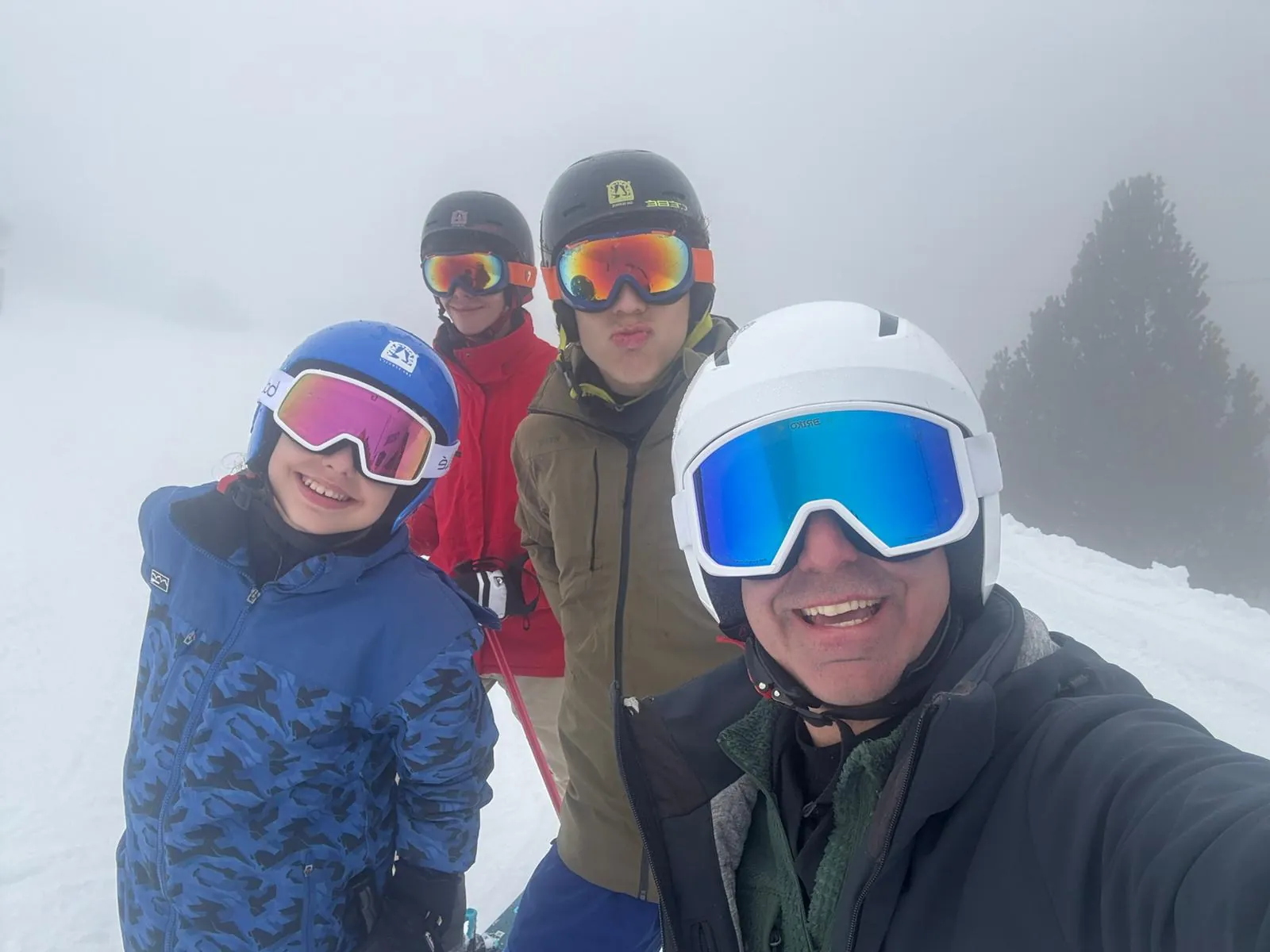
The tools are learned better with someone who adapts them to you on each section. This is what the instructor does while you ski.
Patience: the instructor is not a relative or a friend
Many pupils worry that the instructor will lose patience, judge them or notice their fear. For us, patience is part of the job. We are not a relative or a friend teaching in their spare time: we are there for precisely this.
So you can say you are afraid without feeling judged. The sooner you tell us, the sooner we adapt the lesson. And before correcting anything, we ask how it felt.
That is what Victoria went through, a pupil who had lost her confidence skiing. With Juanka Ramos, a TD3 instructor on our team, she recovered the confidence she had lost.
A safe line: the instructor watches whoever is coming down behind
The instructor applies the safety rules: how and when to set off, where to take the line and where to stop. On the move they are constantly looking uphill.
That way they take the line towards the freest space and leave whoever is behind room to pass without trouble. You do not have to watch anyone, only ski your own line, and that calm prevents tension and freezing.
Which run to choose for your level and the conditions of the day
The same run is not equally hard for two people, nor for the same person on two different days. In fog, on hard snow or with sun and good snow, the difficulty changes completely.
That is why the instructor does not follow a fixed list of runs. They pick the challenge that fits: the one that keeps the progression going and is still achievable, according to your level, your goal and that day's conditions.
In the Followme method this is called the elastic band effect: asking for one notch above your current level. Just enough to progress, without tipping into frustration.
Where the best snow is on a run: the sides and the aspects
Within each run, the instructor takes the line along the sides with the better snow. They also choose the aspects most likely to be in good condition at that hour.
How to take on a difficult section: what to look at, how to move and what posture to use
Before each tricky section, the instructor sets out the solution: what to focus on, how to execute the movement and which posture suits. And they explain why, so that next time you solve it yourself.
What you gain when the freeze goes: enjoyment, safety and independence
The first thing that comes back is the enjoyment. The turn stops being a defensive brake and the descent recovers its rhythm and the pleasure of gliding.
With the enjoyment comes safety: you know you have resources if the snow, the visibility or the traffic changes. And it changes how you see the resort, because you understand where the best snow is or where it pays to take your line.
And what you have learned stays with you. The tools you work on in a lesson you then apply when you ski on your own, with your family or with your friends.
How to gain confidence skiing: from fear to respect
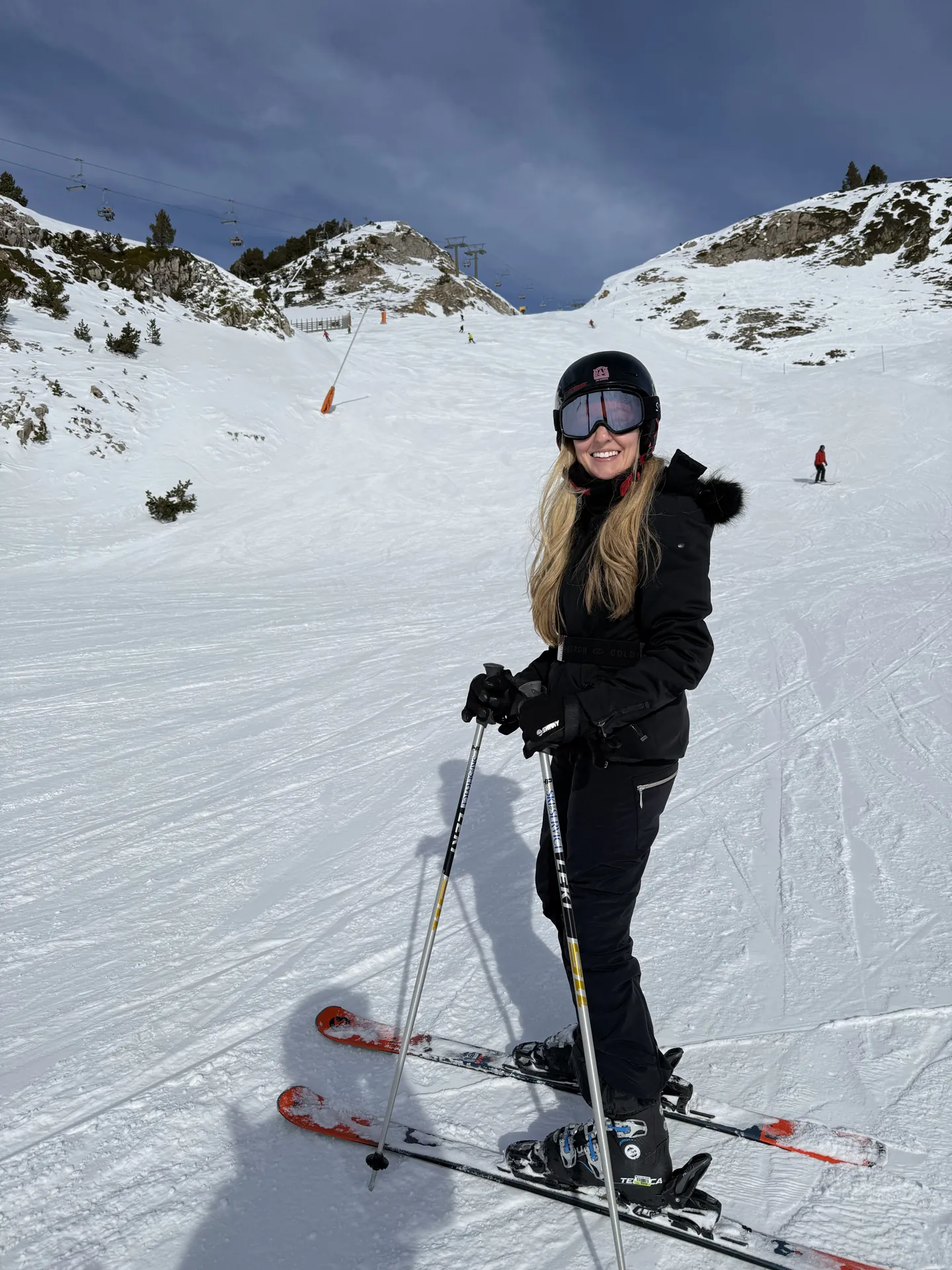
Fear does not disappear through willpower. It changes when you know what to do: where to look, where to take your support, how to set yourself up on each snow and where to take your line.
Always avoiding the run that frightens you makes the fear grow; exposing yourself little by little, with tools, makes it shrink. The run is still there, but it becomes terrain you know how to read. That is respect.
That is the approach we work with at Alpine Ski Academy, a ski school in Baqueira Beret. Less bravery and more resources, with a real diagnosis and the right challenge for each day.
Ski Baqueira with confidence
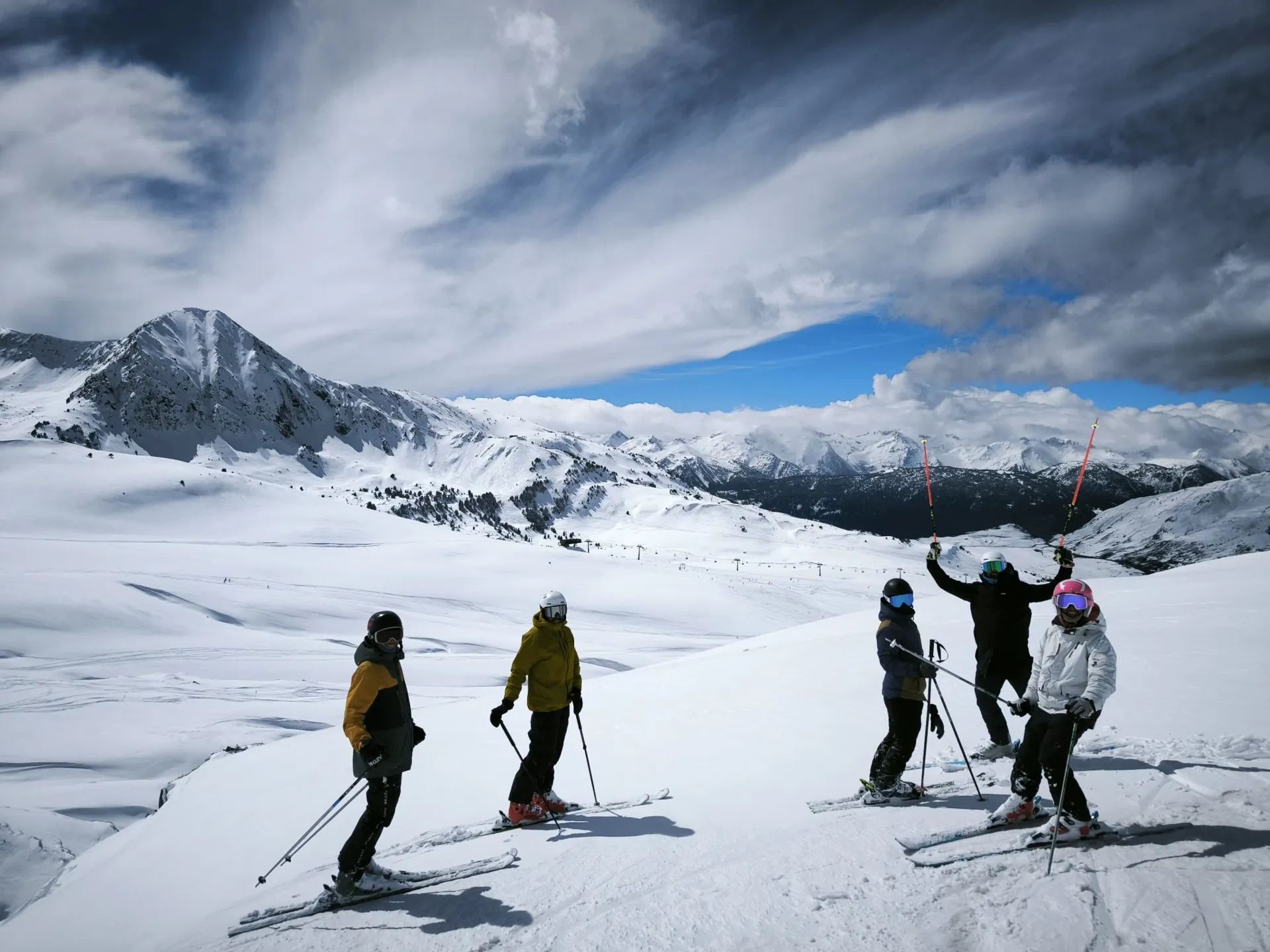
Whatever your fear is, you do not need more courage: you need tools and someone to set the line while you learn them. Tell us what is holding you back and we will prepare the lesson for your level and the conditions of the day.
Víctor Puche Fita — Technical Director TD3, SAFE Formación Demonstrator, founder of Alpine Ski Academy.
Sources, consulted on 16/10/2026: Navarro, L., “Introducción al enfoque corporal del esquí Followme” · The Fear Project (Kimberley Kay and Carol Porter, with Snowsport England), reported in In The Snow.