Technique · The carved turn
Carving lessons in Baqueira: master the carved turn
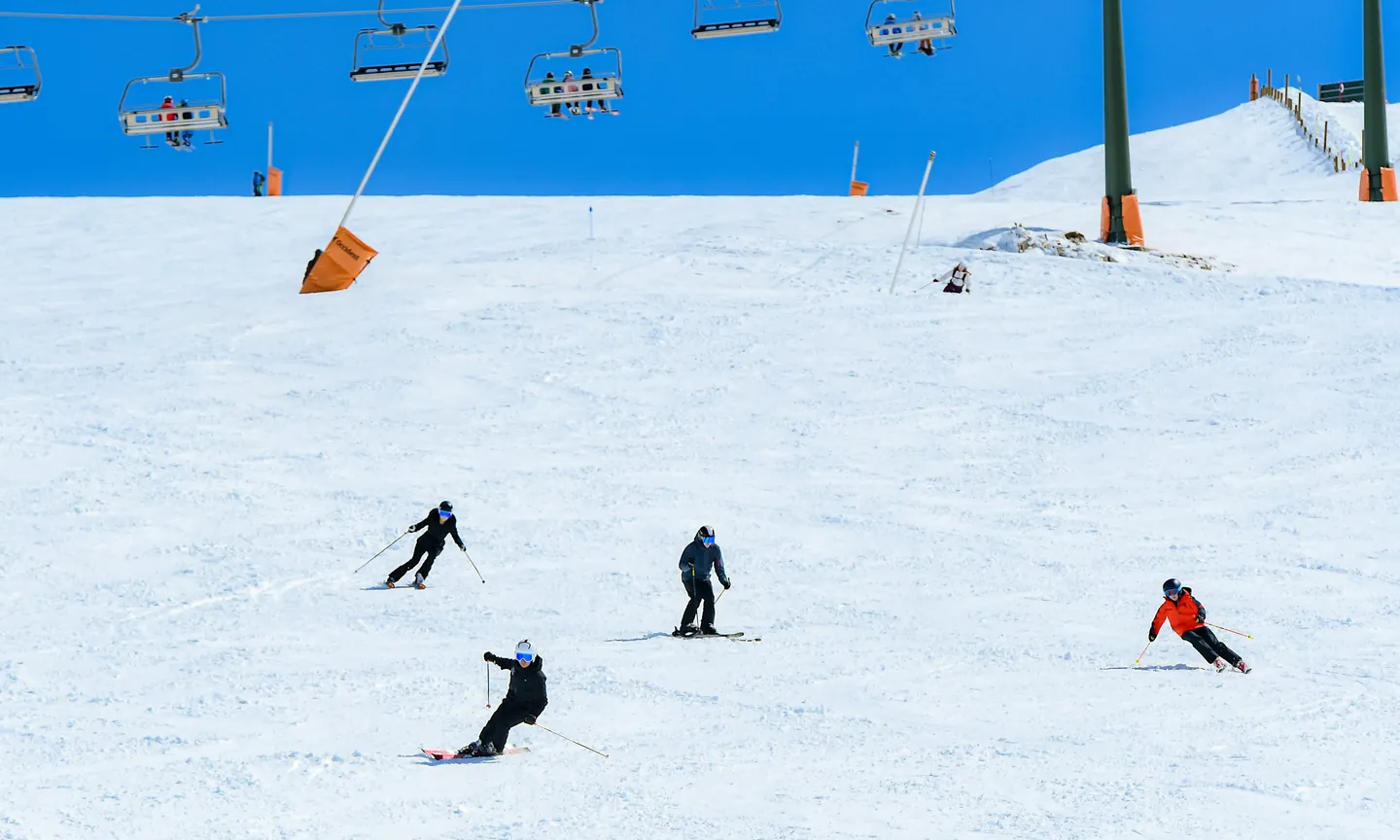
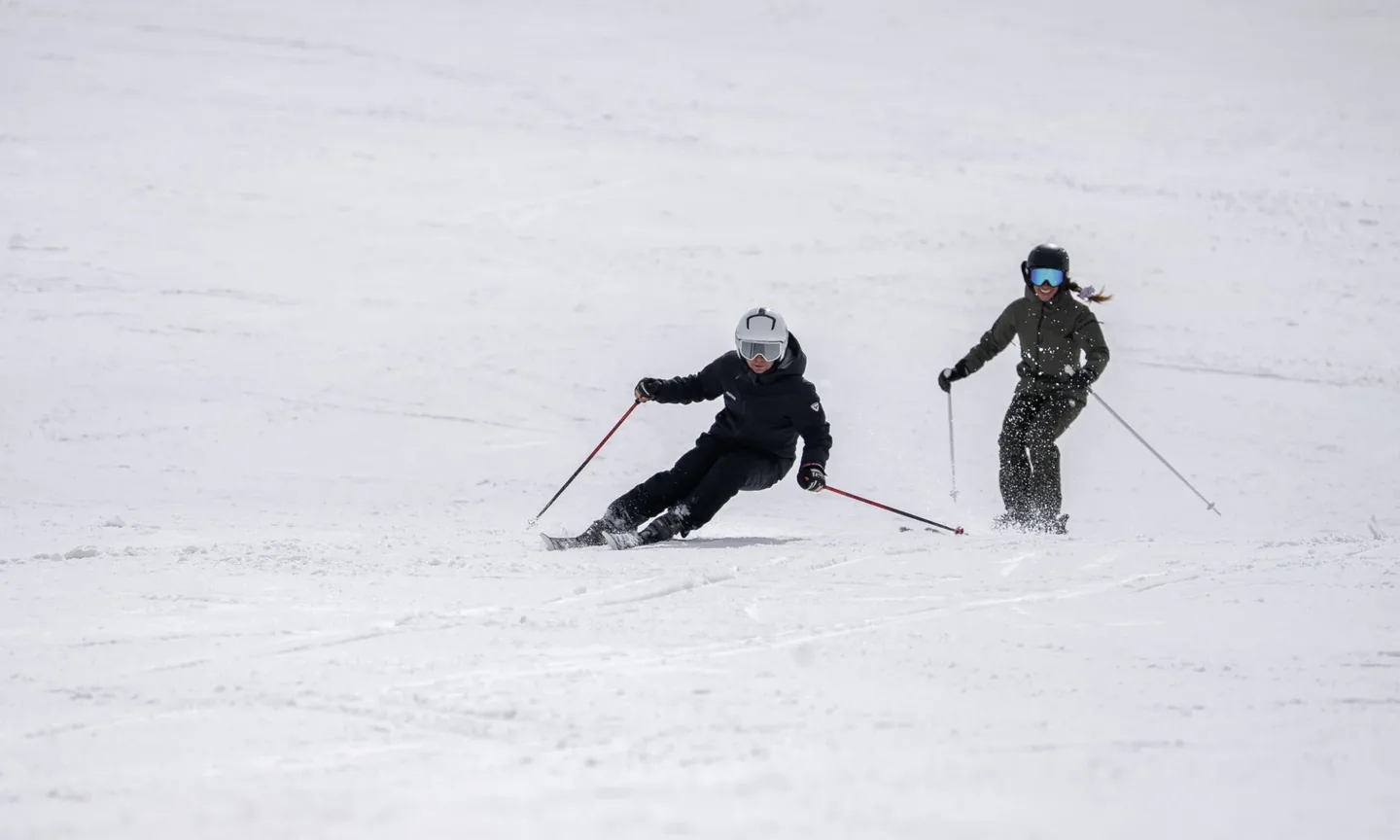
Carving lessons in Baqueira solve a problem I see repeated every season: skiers with years of red runs behind them who still skid every turn exactly as they did on the first day. It is not a problem of level or of fear — it is that nobody has explained to them how to make the edge cut without skidding.
In private lessons for adults with this approach, the difference usually shows within a couple of hours: the ski starts to work differently, without you having to force every turn to control your speed.
What is carving, really, and how does it relate to skidding?
We use a precise definition: carving is skiing while producing a predominantly carved directional effect, keeping control of that effect, in the most efficient way possible. Each of the three parts matters on its own.
Carving=carved effect+control+efficiency
A predominantly carved directional effect
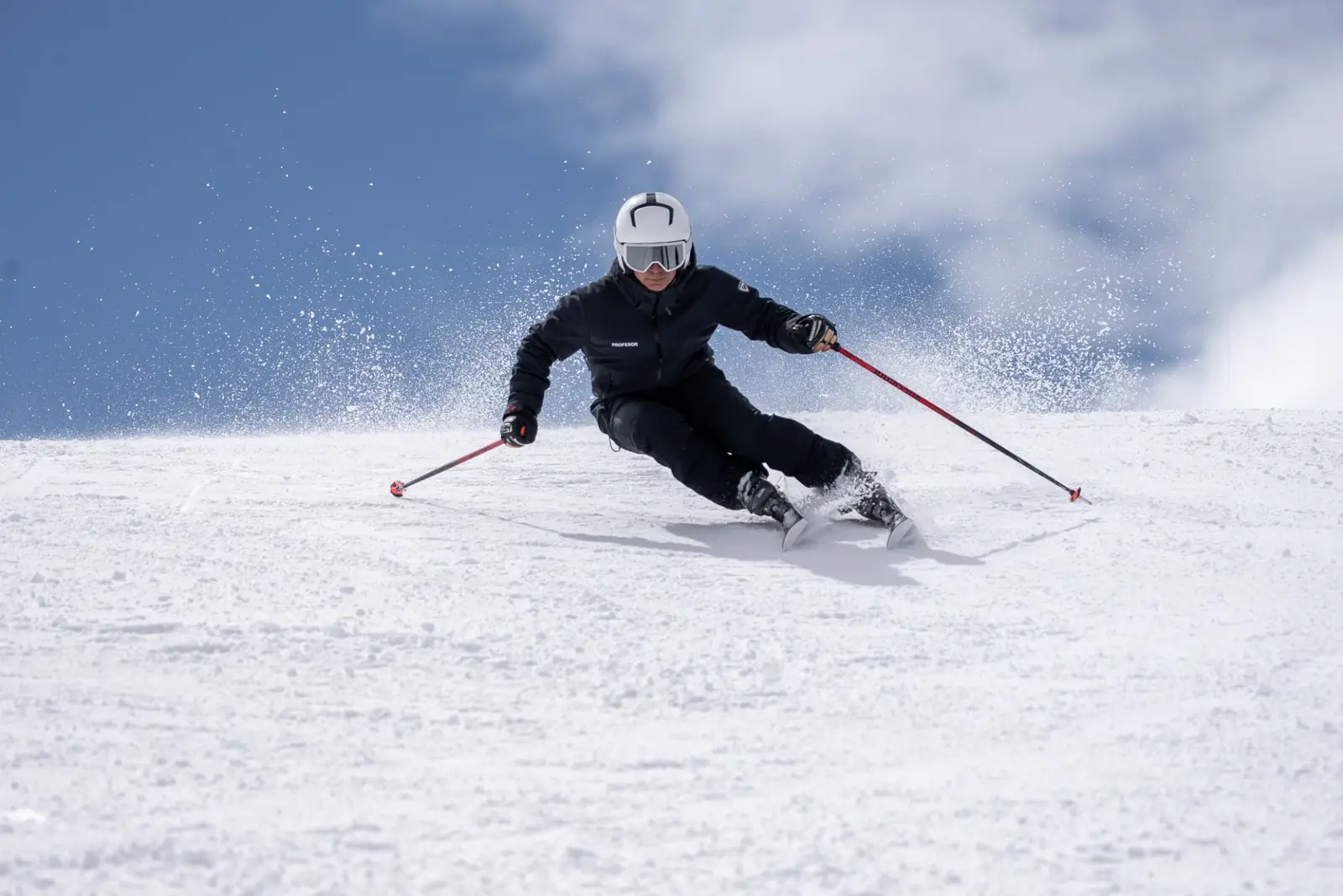
It describes what happens between the ski and the snow: the ski works on its edge and reduces lateral sliding compared with a predominantly skidded turn. In a well-executed turn you can see two relatively clean tracks, although the real imprint also depends on the type of snow, the edge, the radius and the speed.
Keeping control of that effect
It matters just as much. A ski that cuts does not mean the skier is in command of the movement — the geometry of modern skis can make them roll onto the edge and describe part of the turn by themselves. From outside it looks like carving; if the skier cannot manage that effect, they will struggle to repeat it when the gradient, the snow or the radius changes.
In the most efficient way possible
We are not after maximum angle or maximum speed, but the intended result with the support and pressure that situation needs, without unnecessary compensations.
This is where it helps to separate three concepts that are sometimes used as synonyms:
- Directional effect
- It describes how the skis interact with the snow.
- Skidding
- It appears when there is a significant component of lateral sliding. It is not an error to eliminate: it is a tool to control speed, change trajectory or adapt to the terrain.
- Driving the ski
- It does not define by itself whether a turn is carved or skidded: it refers to the control the skier exerts over the effect they are producing.
That is why the driven skid exists — there is lateral sliding, but deliberate and controlled — and a carved effect can also occur without full control yet. Confusing the effect with the control leads to teaching a posture or an outward appearance instead of teaching how to manage the movement.
The goal of learning to carve is not to stop skidding — it is to be able to grade it and decide when to use it.
The problem appears when skidding becomes the only response available: years solving every turn with the same motor pattern, and when the skier tries for a more carved effect, they usually just look for "more edge" — they increase the inclination without having organised the support, the outside ski does not receive the pressure it needs, it loses grip mid-turn and exactly the feeling of instability they wanted to avoid appears.
Nor is angulation a posture to copy "because that is how good skiers carve" — how much and when depend on the gradient, the speed, the radius and the snow. So in a carving lesson we do not want the student to "lean more". We want them to understand what effect they want to produce, what they need to do to produce it and how to keep control over it.
How a carved turn is built
A useful way to analyse the movement is to follow this chain:
- Position
- Balance
- Projection
- Edge change
- Support
- Pressure
- Angulation
- Trajectory
- Release
- Transition
It is not a list of ten independent movements — they all interact continuously — but splitting them up helps diagnose which element is limiting the rest.
Position and balance
Position is not a fixed photograph but a body organisation that responds to the forces, the gradient and the snow — it changes between the entry of the turn, its zone of maximum pressure and the transition. Balance is the base: it is not standing still, it is keeping a functional relationship with the skis while the body moves. The most common mistake appears when the skier loses balance towards the inside just as they try to increase the angle — the feeling is "I need to lean more", but the solution is usually the opposite: organise the support better.
Projection and edge change
Projection is the movement of mass that releases the previous turn and builds the conditions for the next one — it is not "throwing yourself forward". It lets the edge change appear as a consequence of the movement, not as an isolated gesture of the feet. The edge change can be more progressive or quicker depending on the goal, and very different in a long-radius turn from a short one.
Support and pressure
Support is not "putting all your weight on the outside ski" — it is an organisation of foot, ankle, knee, hip and trunk that transmits and manages forces; the inside leg still has a role in balance. The useful question is not "load the outside ski more", but what is stopping that support from being effective. Pressure is not constant: it rises and falls with the trajectory, the speed and the phase of the turn — it is managed, not held at any price.
Trajectory, release and transition
The goal is not to adopt a posture, it is to build a trajectory — the radius, the speed and the space available shape the work of the skis. To build a new turn you first have to release the previous one, reducing the accumulated pressure and reorganising the body. And the transition is probably the moment that best reveals whether the skier is in command of the movement: when it is well organised, the new turn is born from the previous one without having to "jump" from one to the other.
How the carved turn is taught in a lesson with Alpine
We do not start by saying "today we are going to carve". We start by watching how you ski: two skiers who look as if they skid the same from the outside may need completely different corrections — one a balance problem, another entering the edge late, another falling to the inside as they angulate.
The turn can also be divided in several valid ways —entry, middle zone (apex or LMP) and finish; or positive and negative phase, depending on whether you are working with or against inertia— and that division helps isolate which element is specifically affected. Many carving errors come from the base: if the skidded turn is not executed well, that makes learning the carved turn harder later.
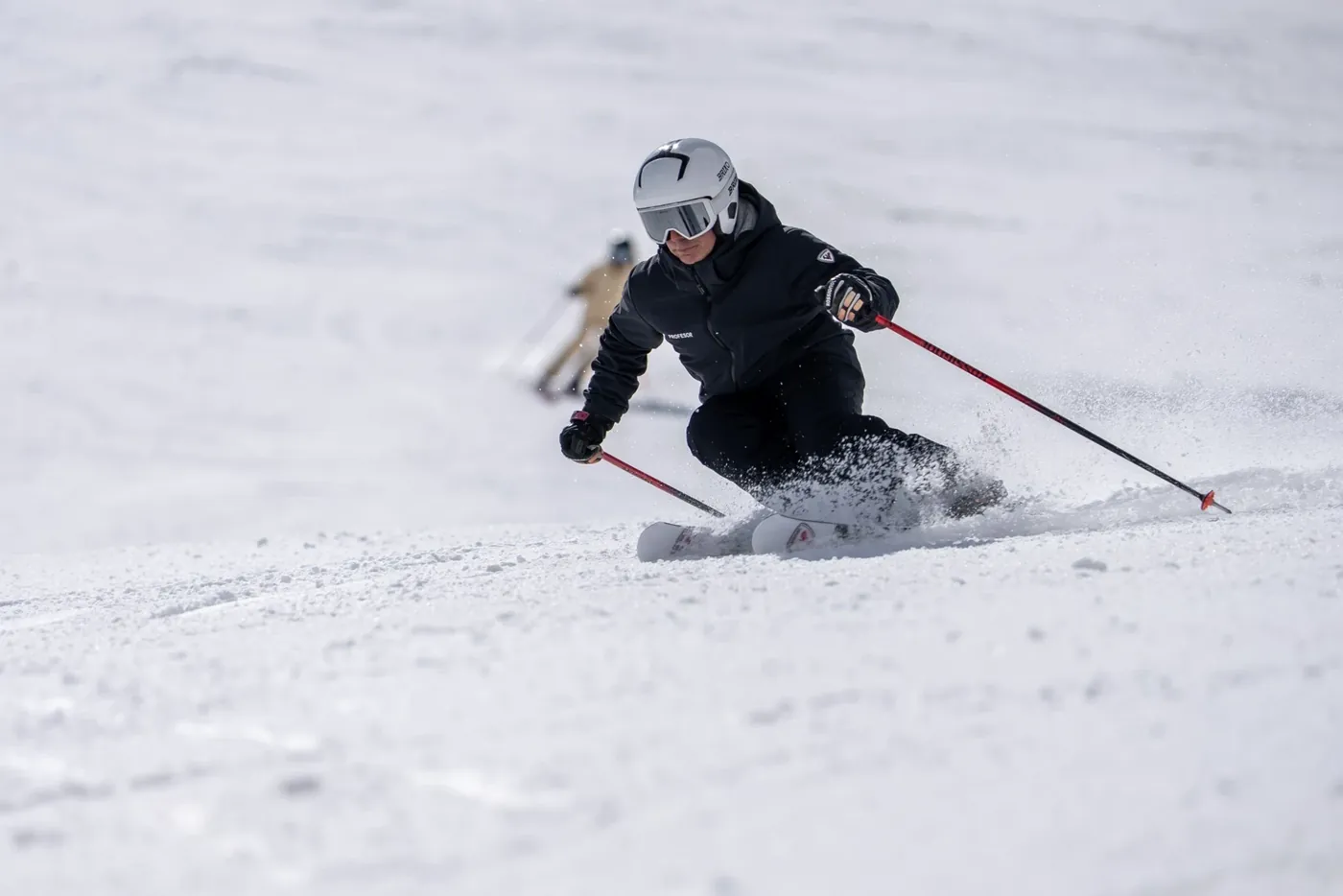
Video analysis
There is a real difference between what you think you did and what you actually did — you can feel that you loaded the outside ski and see on video that you lost it mid-turn. In motor learning this is called augmented feedback: external information that complements your own sensation during execution.
Scientific evidence supports its use to aid motor learning, although there is no universal formula for when or how much to give (Moinuddin et al., 2021; Petancevski et al., 2022). Video analysis done by an expert, straight after the action and with the sensation still fresh, is already a very powerful tool in itself — the key is that an expert analyses it, not the data itself (Ruzicka & Milova, 2019). We do not turn it into an exam: we use it to answer what you felt, what we see, and what we are going to change.
Carv data, if you bring it or want to add it
Carv measures something neither the eye nor video can fully see: the asymmetry between legs, the cleanness of the cut or the degree of edge angle, and it lets you compare turns, legs or sessions.
But the data does not replace the instructor — if Carv shows less angle in one direction, that may be down to balance, support, the turn entry or a difference in mobility. The data measures; the instructor interprets.
Terrain, chosen on purpose
We always look for the gradient, the type of snow, the aspect and the crowds that best favour the specific element of that session, adapted to the student's level and learning phase — the choice is never random.
A real example · a spring day
- First hour · Costarjàs (Beret)The freshly groomed run and the morning sun turn the previous night's frost into that "cream" that gives such good sensations on the edge early on.
- Second hour · Dera ReinaIf the sun has already softened the sunniest runs too much, we move here: its north-west aspect keeps the snow performing better, with the medium radius its wide terrain allows.
- Winter, a cold day or the afternoonThe choice changes completely — what matters is not a fixed formula, but knowing how, where and why each run behaves.
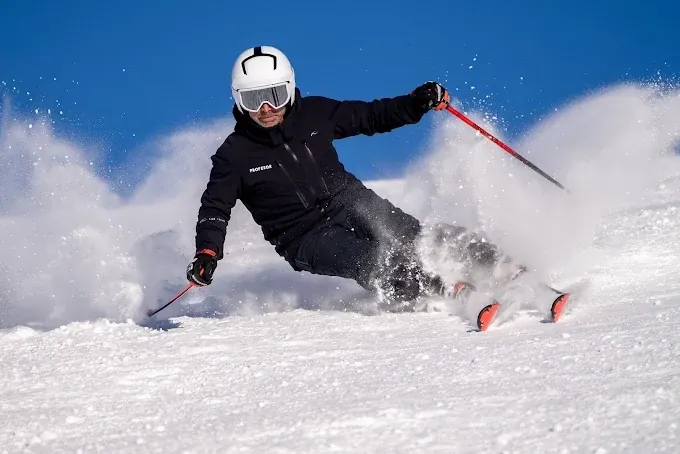
Carlos's case: when the carving effect is already there, but the angulation fails at the base
- Level
- TD1
- Starting point
- Cutting, but without efficiency
- Focus of the work
- Angulation from the base
Carlos is a TD1-level skier who was already producing a carved directional effect — the edge was already cutting the snow. But he was doing it inefficiently: in every turn he pushed his hip to the inside, overloaded the inside foot and projected his mass towards the centre of the radius, compensating with shoulder and head while his core stayed far from the real support. Carving that only half worked — cutting, but without efficiency.
The work began with video analysis, so he could understand the real image of his own turn. Then, teaching drills without poles:
- Fixing the trunk Inside hand on the tip of the outside ski and outside hand on the hip.
- Javelin on one foot To each side, on flat smooth terrain, to internalise the postural pattern without the pressure of the slope.
- Behind the demonstrator On runs of different difficulty, always starting from a tall, extended position — marking the support first and only then the progressive angulation, not chasing maximum range but bringing the hip correctly over the outside foot.
It was not about maximum angulation or speed, but about understanding and precision on a simple base.
We also worked on flexing the inside knee to release load, and dismantled two false images common with this error:
False image
The feeling of being "closer to the ground" that usually comes with angulating badly from the hip.
False image
The tendency towards exaggerated counter-rotation that turns the trunk towards the direction of the skis as the turn progresses.
Result
Little by little, Carlos has become a more compact and efficient skier: he projects his mass correctly over the outside foot, drops the unnecessary gesturing and creates angle with the inside foot instead of compensating with the trunk.
Learning at this level has no end point — being very good at the carved turn is hard and takes time. But understanding better what happens under your feet already gives you freedom: the more guidance and quality in practice, the sooner that freedom shows on the snow.
What we recommend before booking a carving lesson
In Baqueira, what I see most is people signing up for "a carving lesson" thinking it is something you learn once and that is it. It does not work like that — it is a skill refined session by session, on a well-built postural base.
Start now
If you already ski parallel confidently and notice that every turn ends in a skid without you deciding it, this is a good time to start.
First, the base
If you are still consolidating speed control, it is better to work on that base first.
Check your angulation
If you already carve but, like Carlos, feel that something does not fit even though the ski already cuts, it is almost always in the angulation or the postural base — not in repeating the movement more times.
Lorenzo's case
The case that proves it best is Lorenzo's. He started skiing at 50, with the lack of balance and motor skill you would expect at that age. We have spent 11 seasons together, one week every year, and from the first day we worked on the base correctly: from the wedge to the carved turn, always adapted to his real capacity.
Today he carves better than skiers his own age who started at 15, with far fewer hours and kilometres behind him — because Lorenzo did not have to change anything, he learned from scratch in the right conditions. Others fixed a way of moving in their early years and rooted it in their balance, and that habit is much harder to dismantle than to build well from the start.
Today, at 61, and since he started carving at 56, Lorenzo enjoys in the right areas that feeling of grip and control that only the carved turn gives.
What level do I need to carve in Baqueira?
You do not need to be an expert skier, but you do need a base:
- A solid parallel
- Speed control on blue and red runs
- Enough comfort to hold a stable position while you change edges
This is not a beginner lesson. And the entry level is not the end of the road, as Carlos shows: even TD1 skiers who already carve keep refining the carved turn for years.
The real question is not "do I have the level to start?", but "do I have the base needed for the technical work to make sense?".
About the author
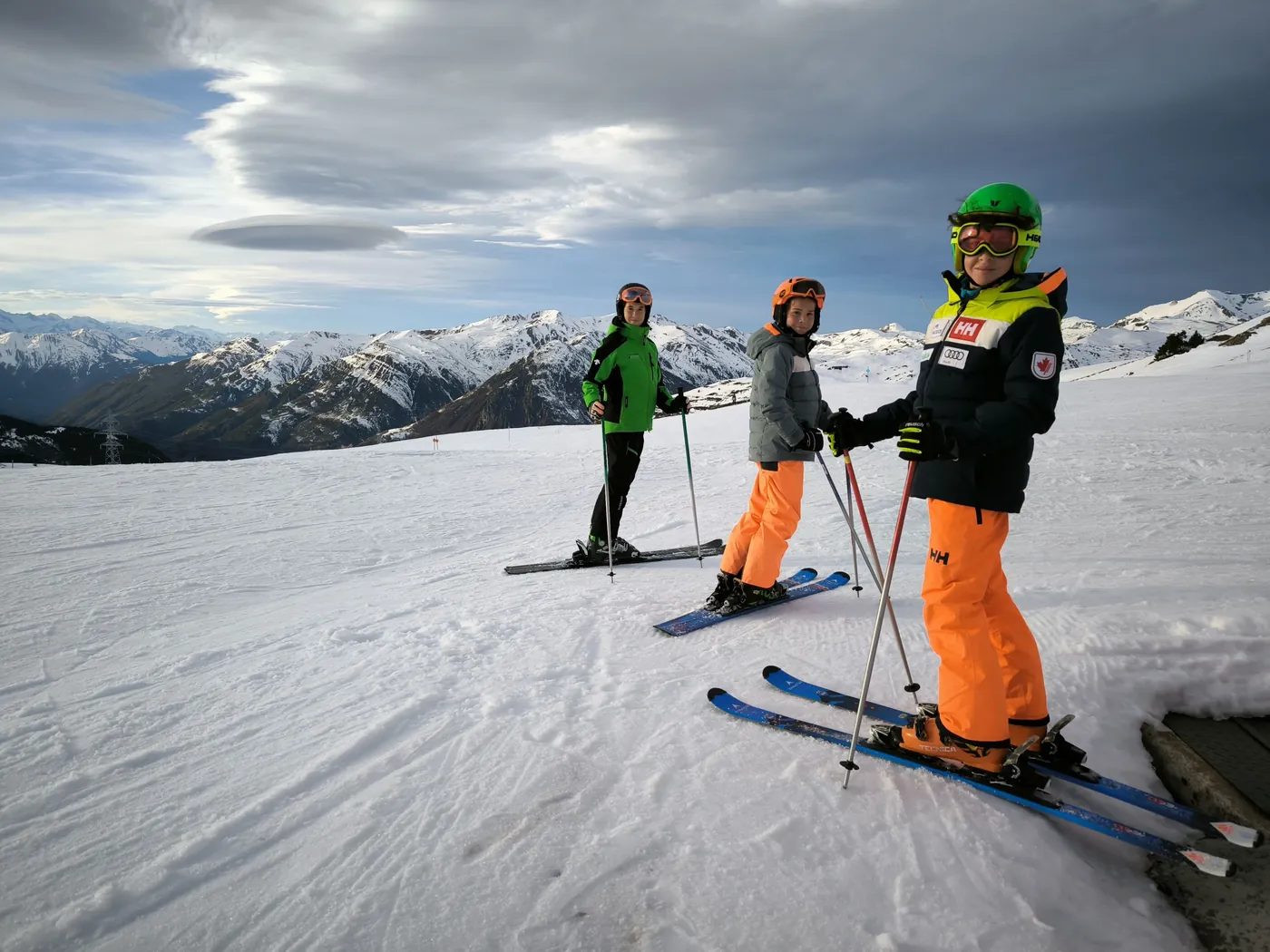
Víctor Puche Fita
Technical Director TD3 · 24 years teaching in Baqueira Beret
Technical director of Alpine Ski Academy, TD3-certified demonstrator instructor. He writes about technique, progression and making the most of every day on snow.
Meet the teamFrequently asked questions about carving lessons in Baqueira
Do I need specific skis to carve?
These days almost every piste ski is designed with a sidecut geared towards carving. For piste and all-mountain use, waist widths usually sit around 66-86 mm, with turn radii between 10 and 21 metres — you can see the full breakdown by level in our ski rental guide. In other disciplines (racing, freestyle, freeride or moguls) these figures vary.
Is carving just for skiing faster?
No. The goal is precision and the feeling of control. With an efficient carved turn you usually do go faster too, but more safely — speed appears as a consequence, not as the starting point.
Can I carve on a blue run?
Yes, and a wide blue run with a moderate gradient can be better learning terrain than a demanding one: if the terrain forces you to focus only on not losing control, your attention disappears from the technical task.
How long does it take to learn to carve?
There is no universal figure — it depends on the starting point. Feeling a carved turn once is not the same as having learned it: real learning arrives when you can repeat it, adapt it to different radii and hold it when the gradient or the snow changes. Even at very high levels there is always something left to refine.
Can I use Carv in a carving lesson if I do not have my own device?
Yes. If you do not bring your own device, you can add the Carv option to the lesson.
How much does a carving lesson in Baqueira cost?
The price depends on the length and format of the session. You can check the current rates on prices and rates.
Book your carving lesson in Baqueira
If you already ski parallel confidently and want to stop skidding and start working on the carved turn, it is time to take the technical leap.
At Alpine Ski Academy, ski school in Baqueira Beret, we work with you from the first diagnosis to the feeling of clean grip on the edge.
Víctor Puche Fita — TD3, SAFE Formación demonstrator, founder of Alpine Ski Academy.
Sources and technical references
- Terminology and technique: Víctor Puche Fita — Nevasport, "Cuando las palabras cambian la técnica" (When words change technique).
- Motor learning and feedback: Moinuddin, A., Goel, A., Sethi, Y. (2021). "The Role of Augmented Feedback on Motor Learning: A Systematic Review." Cureus, 13(11), e19695. — Petancevski, E. L., Inns, J., Fransen, J., Impellizzeri, F. M. (2022). "The effect of augmented feedback on the performance and learning of gross motor and sport-specific skills: A systematic review." Psychology of Sport and Exercise, 63, 102277.
- Video analysis in alpine skiing: Ruzicka, I., Milova, J. (2019). "Increasing the efficiency of motor learning with the help of video analysis." Cypriot Journal of Educational Sciences, 14(4), 723-730.