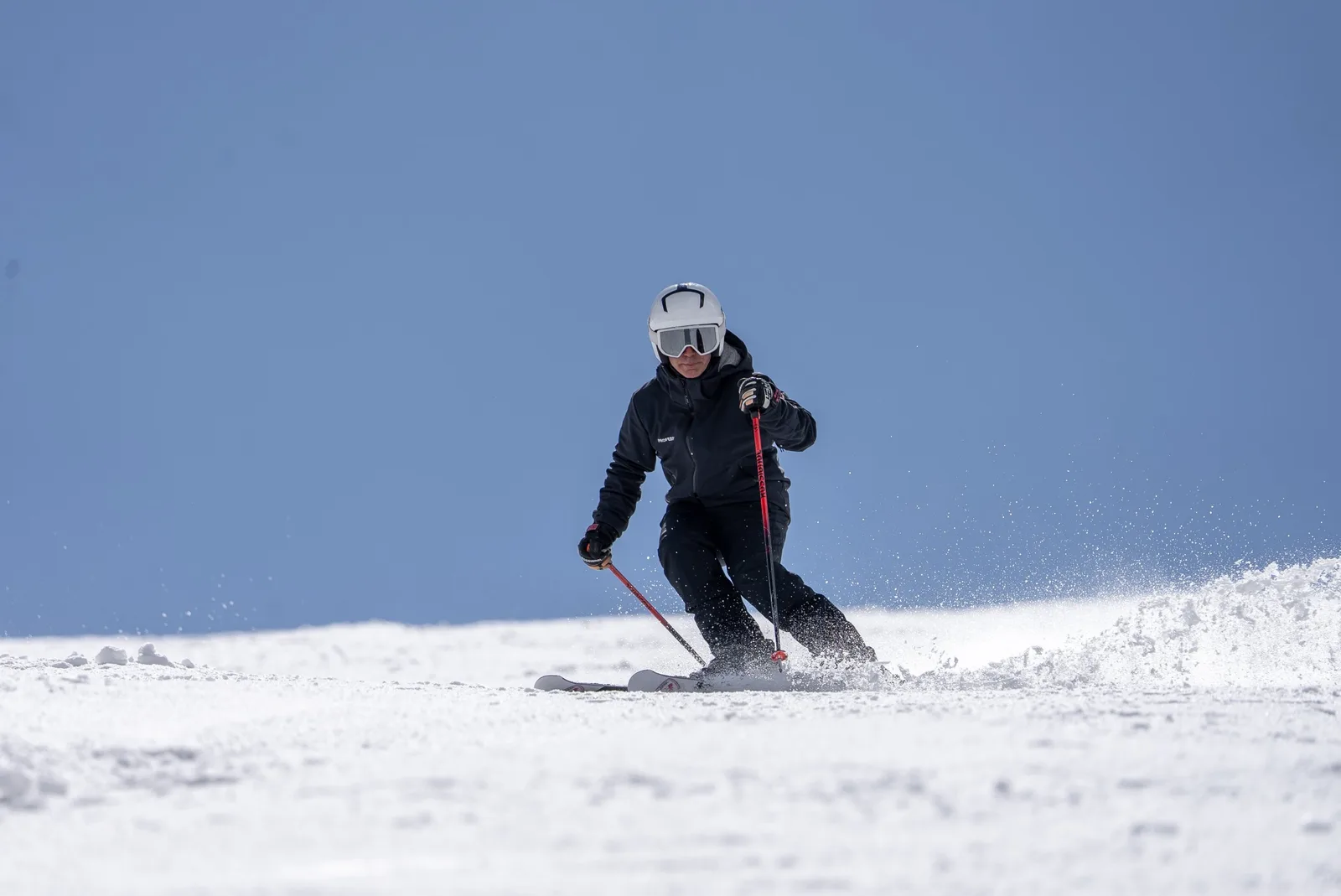
The short turn is one of the skills most often asked for in an advanced lesson. It is also one of the most misunderstood. Many skiers take it to mean turning quickly and end up coming down faster than they wanted to.
A good short turn is not measured by cadence but by control. What counts is how much speed you manage through the shape of each turn, how you finish it and how you link the next one without losing your position.
This guide explains the technique behind it: the stance, the movements of the body, the outside ski, the edge change, the pole plant, rhythm and coordination. We also go through the most common mistakes and the drills we use in our private short-turn and ski technique lessons for adults in Baqueira.
What is a short turn in skiing?
The short turn is a series of small-radius turns linked close to the fall line, with rhythm and with no traverse between them. It takes up little space on the piste and speed is managed turn by turn.
It is not a single technique. Depending on the pitch, the snow and the speed, the same short turn can be solved in several ways, and all of them are valid:
| Form of the short turn | What the ski does | When it fits |
|---|---|---|
| Skidded | Part of the turn slides sideways and friction controls the speed | Steep pitch, narrow sections, hard or uneven snow |
| Carved | The edge cuts the snow without skidding | Gentle or medium pitch, good snow, speed matched to the radius of the ski |
| With an edge set at the end | The edge is set hard as the turn finishes and the body carries on into the next turn | Steep pitch, where controlling speed is the priority |
| Mixed | The skis are steered at the start and then left to carve | The most common way of turning tighter than the radius of the ski allows |
Wedeln and slalom: the two extremes of the short turn
The short turn has two classic reference points that help explain its forms.
The first is wedeln, known on Spanish pistes as «vedel». The Austrian school made it the goal of the expert skier in the 1950s. Its most recognisable technical feature was the feet held very close together. On that base, short turns were linked with the ski almost flat and the tails skidding, the upper body facing down the valley and a rhythmic pole plant. It is the reference for the skidded short turn and it is still part of the recreational skiing repertoire.
In today's short turn the feet are not locked together: they come together or apart depending on the phase of the turn and the terrain, looking for the most functional position for balance at each moment.
The second is special slalom, the shortest-radius discipline in racing. With today's equipment it is skied mostly carved. On the tightest courses, racers steer the skis at the start of the turn and then let them carve.
Between those two extremes sits the short turn we work on the piste. You skid more or carve more depending on the pitch, the snow and what you need on each section.
What is the difference between short turns and carving?
Carving describes how the edge works: it cuts the snow without skidding. The short turn describes the radius and the rhythm of the turn. That is why a short turn can be carved, skidded or a mixture of both, depending on what the terrain asks for.
What level do you need for short turns?
In basic parallel you already draw turns of different radius, but still without the rhythm of the short turn. Introducing it there would be starting too early.
The short turn proper starts once the skier has mastered advanced parallel: skis parallel throughout the turn and control of braking through skidding. At first it is worked on easy terrain and at a slow rhythm, to build the shape of the turn before the speed.
At an advanced level it gets refined: you move on to steeper pitches, to different snow and to a more demanding rhythm. That is where video and Carv come in, to adjust the detail.
Short-turn technique in skiing: how it is done
An efficient short turn does not depend on a single movement. It is built on a base stance, on the movements of the body and on technical elements that act on the ski. All of it converges in rhythm and coordination. We separate them here to explain them, but on the piste they are trained as a whole.
Skiing stance for the short turn
The base stance is an active attitude, not a fixed position. The body sits centred over the feet, with flexion shared between ankle, knee and hip, ready to act and react in every turn.
The upper body stays facing the fall line. The hands are in front and in view, at the same height, without the inside one dropping towards the slope.
The feet have no fixed separation. They come together or apart depending on the phase of the turn and the terrain: closer gives mobility, wider gives stability.
In the short turn we start from a slightly taller stance than in a medium-radius turn. That leaves room to flex and extend quickly at every edge change.
The most common mistake is a low, backseat stance: the skier sits down, loses the support at the front and the ski runs away in every turn.
Flexion-extension, angulation and separation in the short turn
These are movements worked in any turn. What changes in the short turn is how they are used.
Flexion-extension: quick, connected and in mid-range. The frequency is high and each movement links into the next. The legs work in mid-range from a slightly taller stance, without ever fully flexing or fully extending. That way flexion and extension are always connected.
The pelvis goes with that movement, tilting forwards and backwards, from anteversion to retroversion, pushing the mass forwards in every turn. It is the same movement as in a medium-radius turn, at a much faster frequency. That is why there is no time to think about it in each turn: you have to practise it until it comes out on its own.
In the short turn, angulation before inclination. The rhythm is so fast that there is no time to incline and then change. On top of that, because you are facing down the slope, the initial phase of the turn does not stretch out and there is no time to be inclined. So we focus on angulation: a direct angled support that lets you go from outside ski to outside ski.
Separation: managing the rotation and the block of the upper body. In a long turn there is an active rotation of the upper body towards the direction of the skis. In the short turn, because we are facing much more down the slope, that rotation exists but is minimal: it works almost as a block that keeps the upper body facing the fall line while the legs turn underneath. That block does three things:
- It prevents excessive rotation and weighting the inside ski. On a pitch, if the upper body gets misaligned it is easy to lose the outside ski.
- It speeds up the edge change.
- It makes it easier to project into the next turn and arrive there with good support.
Outside ski and fore-aft balance in the short turn
From outside ski to outside ski. In the short turn the transfer of support has to be quick and complete. Almost all the weight moves to the new outside ski in every turn. The inside one goes along and stabilises, but does not hold. If the support stays shared or falls on the inside ski, the outside ski does not grip, the turn opens up or it does not drive us properly into the new turn.
From the upper body: the projection. This is work done by the mass of the upper body. In the initial phase of the turn, the projection moves the weight forward and places the feet under the body. At the end, managing the flexion with a good outside ski takes the load towards the heels, the back of the support. That travel, from front to back in every turn, sets up the projection of the next one.
From the feet: pushing as if kicking a ball. Here the feeling starts in the feet. The foot comes out from under the body with pressure at the front and moves forward, as in kicking a ball. As it goes forward, the support moves back towards the heels. Then the foot passes under the body again to the other side and repeats the movement. It is a loop: the feeling is that the feet go from one side to the other, always passing under the body and pushing forwards.
The most frequent mistake is starting the turn with the weight back, above all on a pitch and out of fear of the speed. The skis move ahead, shoot out at every extension and the skier loses position turn after turn.
Edge change in the short turn: by extension or by flexion
We always begin with extension-projection. It is the most natural way to change edges in the short turn. The legs extend and the mass is projected forwards and into the inside of the new turn. As it passes over the feet, the skis change edge. It connects with the slightly taller stance we start from and with the projection work of the upper body.
The flexion change comes with mastery. In carved short turns, with momentum and a very refined rhythm, you can get to changing edges by flexion: the legs are drawn up and the edges change with the body low. For that you have to master the reaction of the equipment, so that the angle and the pressure of the ski favour that movement. Without that mastery, flexion adds nothing and the turn loses control. It is also more physically demanding, because you ski more flexed through every transition.
Skidded or carved short turns: pivot and ski pressure
The pivot, the key to a round turn. Mastering the pivot is what lets the short turn be a rounded turn. You always start from a more skidded turn, where it is easier to get a feeling close to the right one. As the skier gains level and coordination, manages the forces better and understands the technique as a whole, the turn can become more and more carved.
The Z-shape mistake. It is one of the ones we see most. The skier thinks the ski moves sideways and pushes the tails out. The turn stops being round, it becomes a Z, the ski brakes in jolts and the rhythm breaks.
A pressure there is no time to think about. The pressure grows through the turn, but the turn is so fast that there is no time to feel it progressively. At that frequency and that rhythm, you have to manage it well without getting to think about it. The difficulty is linking turn after turn a good load, an exact moment of pressure and a precise angle on the skis: just enough for them to cut, without them moving too far sideways or cutting more than necessary. And it is harder the steeper the pitch.
Pole plant in the short turn
The pole is not only there to mark the rhythm, although it helps to mark it. As you take the tip towards the snow, a single movement produces several effects at once: it flexes ankle, knee and hip, it helps you angulate, it orients the body towards the slope and moves it forwards. On top of that, touching the snow gives you information for balance.
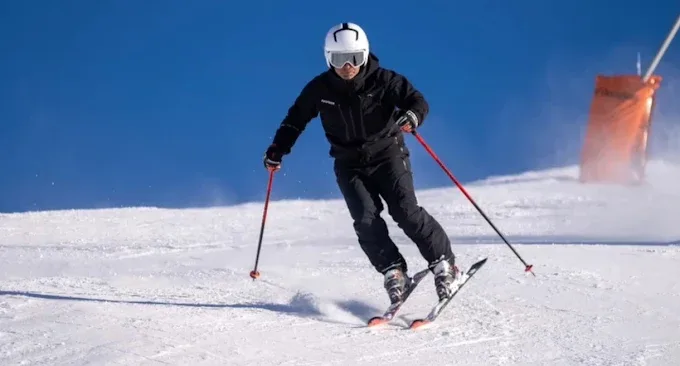
More to the side than in a medium radius. In a medium radius, the arm goes forward with the turn and the plant can end up closer to the ski tip. In the short turn the travel runs in a straight line down the fall line and the skis always point downhill. The arm does not make that movement towards the ski: it stays out to the side. The pole is planted ahead of the boot, on the supporting side, right at the end of the turn and before the edge change.
Soft on the way in, firm on contact. The movement is soft while the pole approaches the snow and firm at the moment of contact. That firmness helps manage the force at the end of the turn and keep the rhythm or the control point.
Without lifting the elbow. Passing the pole does not force you to raise the elbow. With a pole of the right length, the elbow works at close to a right angle. It is not an exact measurement: it is a reference so the movement stays natural and does not disturb the upper body.
The most frequent mistakes. A vertical pole, one that arrives late or one planted too close to the body does not help you turn and it disturbs the rhythm. That is why the hand is prepared in advance, in front and in view.
From medium radius to short here too. Like the rest of the elements, the plant is trained first in medium radius. At the fast frequency of the short turn it is hard to work on its precision, so it is shortened little by little.
Rhythm and coordination in the short turn
Rhythm is not a beat imposed from outside. It is the ability to anticipate and organise each turn: preparing the next one while you finish the previous one, with similar turns to the left and to the right. When there is rhythm, the movement becomes more efficient and the skier spends less energy. One side usually comes out better than the other, and working on that symmetry is part of rhythm too.
Coordination is where all the previous elements come together: the stance, the flexion-extension, the block of the upper body, the outside ski, the edge change and the pole. In the short turn each one has to arrive at its moment. If one comes early or late, the turn falls apart and the others have to compensate.
Rhythm is not speed. A frequent mistake is raising the cadence before mastering the shape of the turn: you turn faster, but worse, and the speed builds up. First the shape and the control; then the frequency. And the rhythm adapts to the terrain: on a changing pitch or in uneven snow, keeping it means adjusting every turn without losing the flow.
World Cup short turns: what we learned with Livio Magoni
A few seasons ago we trained at a camp in the race stadium at Beret with Livio Magoni, coach of Tina Maze and Petra Vlhová, and the biomechanist who worked with him. He showed us a specific way of training the short turn that they used in his team at a high level. It is not the only way to work on it, but it brings an interesting focus.
He explained that, in the short turn, many World Cup athletes do not feel only the work of the feet. While executing it they also put their attention on something larger and heavier: the feeling that the inside shoulder blade pushes forwards. It was a focus he suggested we work with.
That feeling helps project the mass forwards, towards the next turn. With it, it is easier not to encourage excessive rotation or sideways push, two mistakes we often see in recreational skiers.
In lessons we use that focus once the leg movement is already automatic. Before that, we build the base first and change the focus afterwards.
In racing there is one more nuance. On the flats, with less speed and momentum, racers make a kind of swing to generate drive. Even though it adds some rotation, it gains them tenths. It is an athlete's resource: on a flat, the recreational skier still puts control first.
Common short-turn mistakes in skiing and how to correct them
Most short-turn problems do not come from a single movement but from one element that arrives late or fails and drags the others with it. This table sums up the ones we see most in lessons, what the skier notices, what it causes and where we start correcting them.
| Mistake | What you notice | Consequence | Where we start correcting it |
|---|---|---|---|
| Weight back at the start of the turn | The skis run away in front and you lose your position turn after turn | The skis accelerate and you lose control of your speed | Projection of the upper body at the start and push from the feet, as in kicking a ball |
| Z-shaped turn (pushing the tails out) | The ski brakes in jolts and the rhythm breaks | You get disoriented, you start each turn from further away and you can end up with too much weight on the inside ski at the end of the turn | A mastered pivot to round out the turn, starting from a more skidded turn |
| Rotation of the upper body | Each turn drags the whole body round and you arrive late at the next one | The same problems as the Z, plus you lose control of the angle and of the pressure under the foot | Blocking the upper body towards the fall line: separation |
| Weight shared or on the inside ski | The outside ski does not grip, the turn opens up or it does not drive you into the next turn | Without support there is no reaction to tip into the next turn efficiently and responsively | Quick transfer from outside ski to outside ski |
| Inclining instead of angulating | You lose grip and the edge change arrives late | The same effect as weighting the inside ski: the weight goes inside and the next turn starts with no reaction | Direct angled support from the start of the turn |
| Flexion-extension at full range or interrupted | The movement is cut off and the turn loses continuity | It makes you slow: you lose rhythm and the capacity for the quick movements the short turn asks for | Mid-range, from a slightly taller stance and always connected |
| Pole vertical, late or close to the body | The pole does not help you turn and the rhythm falls apart | Backseat stances, poor support and a loss of coordination and control | Hand prepared in advance and a lateral plant, ahead of the boot |
| Raising the cadence before mastering the shape | You turn faster, but worse, and the speed builds up | You lose sensory precision: what you feel is neither real nor correct, perception gets distorted and learning becomes harder | Shape and control first; frequency after, from medium radius to short |
| Focus and eyes in the wrong place | The body turns without you noticing and it is hard to anticipate the next turn | It sits behind the rotation and other mistakes: where you put your attention and your eyes organises the rest of the movement | Eyes down the fall line, well ahead, and attention on one specific effect: the push of the shoulder blade or that of the feet |
On a steep pitch these mistakes are amplified: what barely shows on a gentle pitch makes you lose control within a few turns on a steep one. That is why we correct them first on easy terrain.
Every correction follows the same path: from medium radius to short, from slow frequencies to faster ones and from gentle pitches to steeper ones. For each one there are also specific drills. With them we clean up the feeling and put the focus exactly on what we are working on, to get the most out of the specific action that produces the improvement.
Drills to improve your short turns in skiing
All short-turn work begins in the medium radius. The purest and most carved sensations always appear there first. From that medium radius, the turn is shortened little by little, as a garland or a fan, until you reach the short turn. The frequency follows the same path, from slow to fast.
The terrain follows the same logic: from gentle pitches to steeper and steeper ones. We never work on short turns on a complete flat, because without a pitch there is no momentum and no movement. We always look for at least a slight pitch.
How to choose drills for the short turn
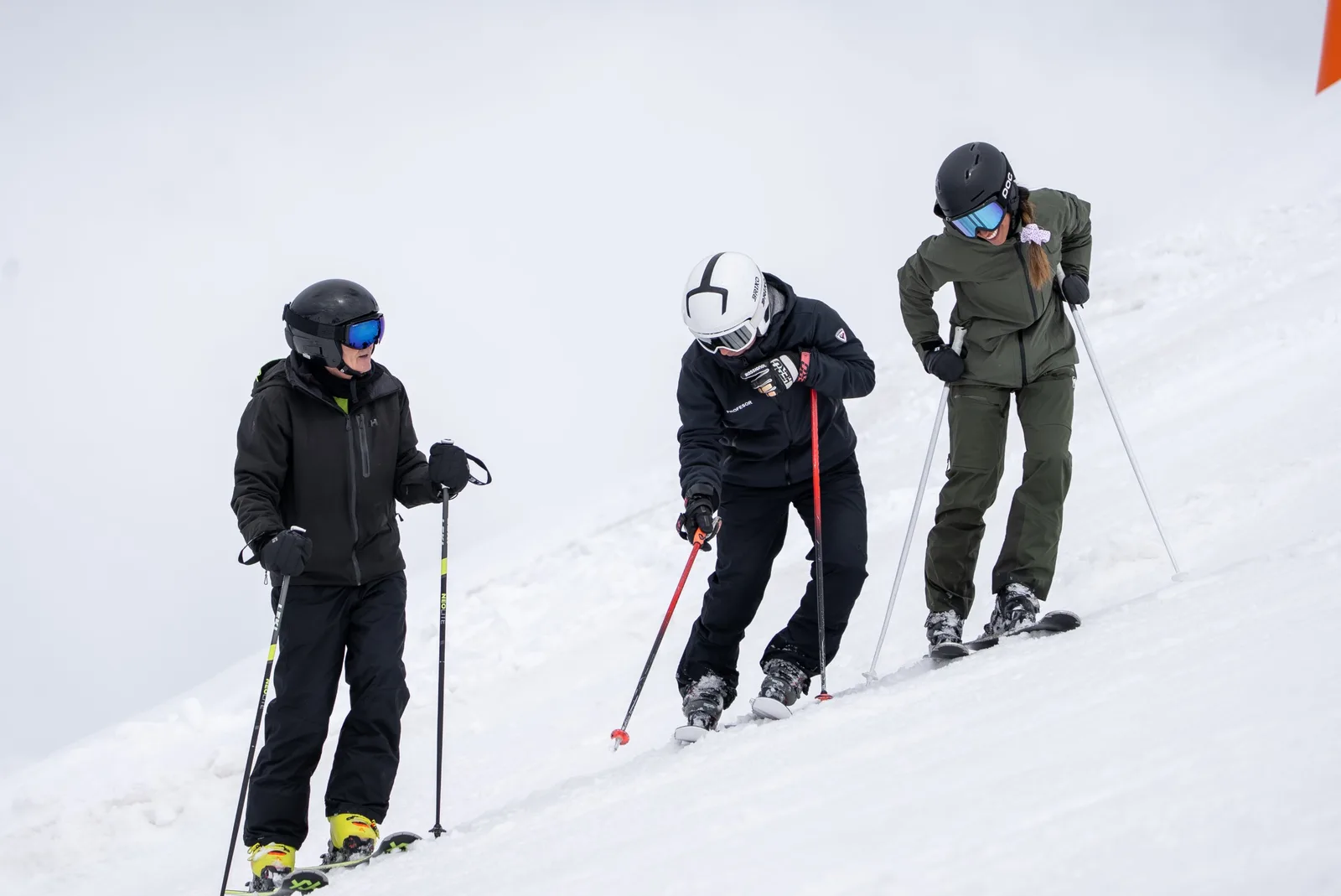
There are a great many drills for the short turn, and which one you use matters less than it seems. What matters is why we choose it, what it is like and where we put the focus while it is being worked.
Each drill is worked very specifically, with all the attention on the action or the movement that helps improve what we are correcting. Everything else, at that moment, does not matter.
That is why we look for simple drills. An exercise that improves one thing at the cost of producing a bad stance or a bad execution in another is no use to us. The simpler it is, the cleaner the feeling and the clearer the focus.
Short-turn drills for each technical element
| Element we work on | Example drills |
|---|---|
| Separation (rotation-block) | Window with poles · window without poles · hands or poles on the hips · shoulders level |
| Outside ski and angulation | Dragging the outside pole · tip-tap (lifting the inside tail) · alternating skis on the outside |
| Pivot and round shape | Side-slipping with a pivot · from hockey stop to a patient start |
| Edge change and rhythm | Short turns down a corridor on the fall line · short turns with a small hop |
| Pole plant | Pole-plant garland |
| Focus and eyes | Corridor or hourglass with reference points on the fall line |
Improving short turns with video and Carv: which metrics matter
Video on the piste. We film several turns in a row and review them there and then, not at the end of the day. Before seeing the footage, the pupil says what they felt. Then we compare their turn with a demonstrator's so they can see the difference. It is the same method we use in advanced lessons, applied to a single movement.
Carv: the short turn in data. Carv is a system of sensors in the boots that measures every turn, left and right. It records the whole run (tempo in turns per minute, corridor, real radius, pitch, snow type, balance, distance and vertical metres) and the detail of each turn. In the short turn, these are the metrics that tell us most:
| Metric | What it tells us about the short turn |
|---|---|
| Tempo and real radius | Whether the frequency and the size of the turn are the ones we are after, or only look like it |
| Turn shape | Whether the turn is round or turns into a Z |
| Rotation speed | How fast the skis turn in each turn |
| Early edging and edge angle | Whether the edge engages early and at the right angle, or the turn skids too much |
| Weight release | How the weight passes from one foot to the other at the change |
| Edging similarity | Whether one side comes out better than the other |
Ski parallelism and G-force complete the reading. The detail of each metric is in our guide Carv in Baqueira: this is how your ski technique looks in data.
The value is in what the skier does not perceive. A good tempo does not guarantee the turn is well built. A correct radius can hide differences between left and right. And a good edge angle does not mean the ski is working well all through the turn.
Data does not replace feel: it serves to check it and put it in context. And Carv is based on one particular technical model, which works very well for one kind of skiing but is not the only valid way to ski well. Interpreting it remains the instructor's job.

Víctor Puche, Alpine's technical director, has the highest Ski:IQ in Spain on the Carv leaderboard for the 2025-26 season: 170, achieved on short turns. If you want to work with this data, you can add Carv to your ski lessons with Carv technology in Baqueira.
Where to train short turns in Baqueira Beret: pistes by level
Baqueira Beret has pitches for every stage of the short turn. We use them from gentle to steep, following the same progression from medium radius to short and from slow frequency to fast.
| Sector | Gentle pitches | Medium pitches | Steep pitches |
|---|---|---|---|
| Baqueira | Pla de Baqueira · Mirador · the old Solei face | Pla de Baqueira (middle sections) · Vuelta a Casa · la 1 · Tortuga | Isards · Luis Arias |
| Beret | Dera Reina, lower and middle sections | Costarjàs · Audeth | Dera Reina, upper section · Dossau, upper section · Ticolet, middle section |
| Baciver | — | Saumet · Paum | Upper part of Baciver |
| Bonaigua | Tuc de la Llança | Peülla (medium-steep) | Peülla (medium-steep) |
The final choice depends on the day: the snow, how busy it is and the time decide which pitch suits at any given moment.
Can you improve your short turns in a single lesson?
Carlos: more rhythm and a better outside ski in two hours
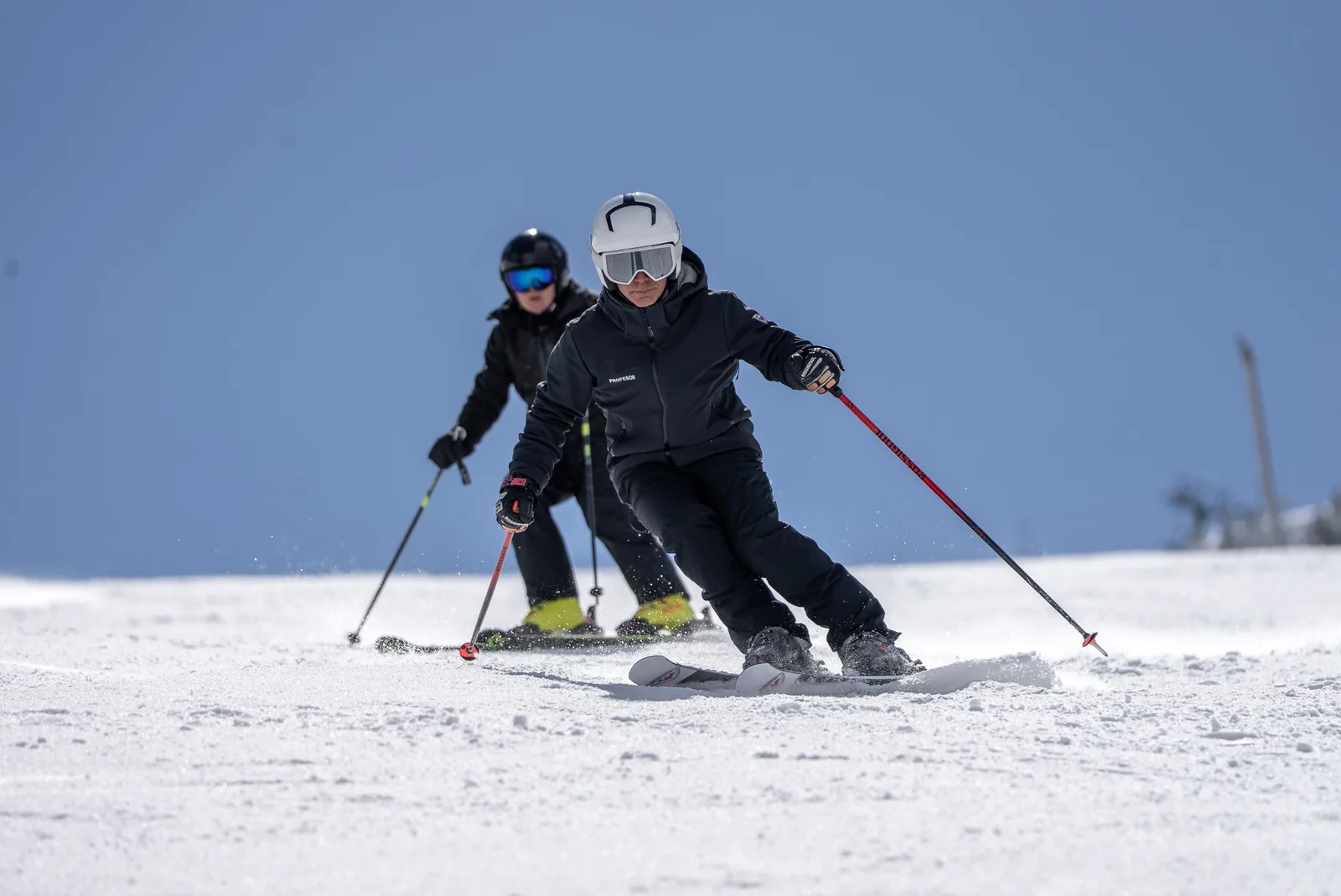
Carlos is one of the pupils who skis with his own Carv. He already had a well-executed short turn; what he was after was a little more rhythm and speed of execution. We spent a two-hour session on short turns alone, on the medium pitches of Pla de Baqueira.
That day the snow was hard and it was busy. It was not a day to go fast, neither for the snow nor for the crowds, but it was a day to work on technique and skill. It is a good moment for this kind of session.
We worked on the outside ski and on the movement of the feet under the body. We took out the rotation of the arms and the misalignment of the shoulders, and looked for support further to the side and further forward.
We filmed every run and reviewed the Carv metrics after each section. In two hours his short-turn IQ went up several points to 151. You could see it on the video too: more rhythm, support further to the side and the shoulders facing down the slope.
Alpine's recommendation for the short turn
If you want to improve your short turns, do not start with the steepest pitch or the fastest frequency. Start with a medium radius, on a gentle pitch and at a slow rhythm. That is where the cleanest sensations appear, and from there the turn is shortened little by little.
Work on one focus at a time. A simple drill, with all your attention on one specific movement, improves more than ten corrections at once.
And look for an instructor who can read your short turn: which element arrives late and which one drags the others with it. If you are going to book a lesson with this goal, ask who will be teaching it and what experience they have with short turns. At Alpine Ski Academy, a ski school in Baqueira Beret we work on it with video on the piste and, if you like, with Carv data.
Short-turn lessons in Baqueira: book your session
If you already ski parallel comfortably and want a short turn with more control, tell us how you ski now and what you want to improve. If you have a video, even better. With that we will suggest the instructor and the format that suit you.
Víctor Puche Fita, Technical Director TD3, SAFE Formación demonstrator and founder of Alpine Ski Academy.
Sources: INEFC, synoptic table of alpine skiing · LeMaster, R., The Ultimate Skiing · Carv, short-turn metrics · Skiing History, «Whatever Happened to Wedeln?» (2023) · FIS, alpine ski equipment regulations.